The short answerReady as a regular starting centre-back for a LaLiga side outside the top six that keeps the ball, ideally beside a partner who wins the air. Not a locked-in top-six starter, and not a Championship centre-back. Levante, Espanyol and Racing Santander fit on role and minutes, with Celta Vigo the harder option. Inside the City Football Group network, the natural route is Girona's own return to LaLiga. None of that is a transfer tip.
Montilivi on 8 November was the kind of afternoon relegation is supposed to fix. Girona had more shots and more corners, and still lost 0–1 to Almería, who left Catalonia top of the table, to a Miguel de la Fuente goal on 67 minutes. Alejandro Francés started at centre-back, as he has in 11 of Girona's 13 league games, and played the full match. A season ago, in LaLiga, he started 11 of his 24 league appearances.
That is the twist worth testing. Relegation is usually written as a club story, a story of wages and sales and who leaves first. But it also does something stranger to individual players. It hands a rotation player a starting job in an easier league, and then dares everyone to decide whether the numbers he produces there are a promotion or a mirage.
So this Scout asks the narrow question. Not whether a 24-year-old who has played LaLiga and the Champions League can play football. He can. The question is what kind of next step the evidence supports, in which role, and for which kind of club — and what Girona's ownership does and does not change about that.
The short answer
Ready as a regular starting centre-back for a LaLiga side outside the top six that keeps the ball and wants its centre-backs to pass it forward, ideally beside a partner who wins the air. Not as a locked-in starter at a top-six club, and not as a Championship centre-back. The clubs that make sense on role and minutes are Levante, Espanyol and Racing Santander, with Celta Vigo as the harder, more crowded option. None of that is a transfer tip, and none of it implies interest. Girona are part of the City Football Group network, but the natural route inside that network is Girona's own return to LaLiga, not a hop to another club. He is under contract to 30 June 2029, a five-year deal signed when Girona bought him from Real Zaragoza in July 2024.
Two seasons, two different jobs
Start with the minutes, because the angle depends on them. In LaLiga last season he made 24 league appearances, but only 11 were starts, for about 1,100 minutes. Part of that was an ankle ligament injury against Valencia in October 2025 that kept him out for around six weeks. This season, in the Segunda, the official league count has him on 13 appearances, 11 starts and 1,004 minutes. The event file we use for the rates runs slightly higher, at 1,087, because it counts stoppage time differently. Either way, he has gone from part-timer to first choice.
He is 24, right-footed and 181 cm, and he has played on both sides of a centre-back pair and at right-back. This season the event file has him mostly on the left of the pair. That matters later, because the clubs where minutes exist are not all short on the same side.
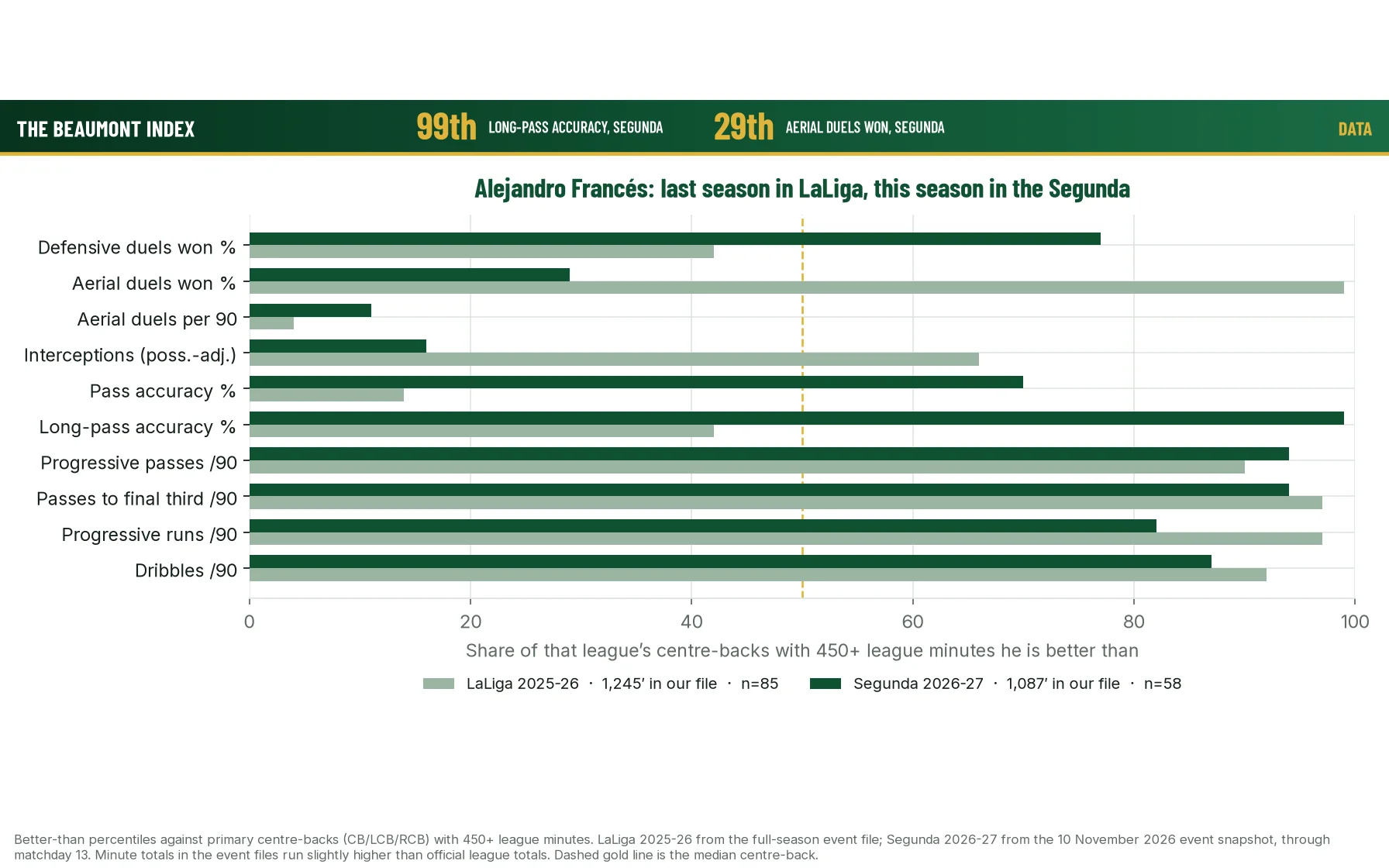
Against Segunda centre-backs with 450 or more league minutes — 58 of them in the 10 November snapshot — his passing is close to the top of the pool. His long-pass accuracy, 71 per cent, is better than 99 per cent of them. Progressive passes and passes into the final third, both 8.2 per 90, sit in the 94th percentile. He carries the ball forward more than most, too: progressive runs are in the 82nd, dribble attempts in the 87th. His defensive duel success, 61 per cent, is in the 77th.
Then the other column. Aerial duels per 90 sit in the 11th percentile, and he wins only 59 per cent of the ones he contests, which is the 29th. Possession-adjusted interceptions are in the 16th. Those are not small gaps. They describe a centre-back whose numbers are built on the ground and on the ball, not in the air.
What changed after relegation
Last season tells you this is not a new player, just a cleaner one. Against 85 LaLiga centre-backs in 2025-26, he was already a forward-moving defender: progressive runs and passes into the final third both in the 97th percentile, forward passes in the 92nd. But he gave it away. Overall pass accuracy sat in the 14th percentile, and long-pass accuracy in the 42nd.
In the Segunda the risk has come out of the passing. Long-pass accuracy has gone from about 47 per cent to 71. Overall pass accuracy has climbed to the 70th percentile. The carrying has dropped back, from 2.6 progressive runs per 90 to about one. That is a trade, not a decline. He is choosing the pass over the run, and the pass is arriving.
The aerial story is consistent across both seasons, and it is the one to take seriously. He contested very few headers in LaLiga too: aerial volume in the 4th percentile. He won most of those few, which put his win rate in the 99th, but on a sample that small the rate tells you less than the volume does. Two seasons, two leagues, and the same answer: he is not the centre-back who goes up for the long ball.
The size of the step, and what travels
The league comes first. On our league-strength scale — goal difference per 90 against an average club from Europe's top five leagues — the Segunda sits at about −0.92. LaLiga is about −0.06. The step back up is therefore about 0.86 goals a game, which is large. The Championship, at about −0.86, is almost exactly the Segunda's level, so a move there would be a sideways step in strength. The Premier League, at about +0.61, is about one and a half goals a game above where he is now.
Girona are not a soft context inside that Segunda. Our ratings have them as the second-strongest side in the division on underlying performance, about a quarter of a goal below an average Big Five club. The table is less kind: eighth on 21 points after 13 games, a point outside the play-off places. That matters for the numbers. A centre-back on a team that has the ball faces fewer duels and fewer crosses. The possession-adjusted interception rate is meant to correct for that, and it still sits low.
The useful test is the raw one. Take his Segunda per-90 rates, unchanged, and rank them among centre-backs with 450 or more minutes in bigger leagues.
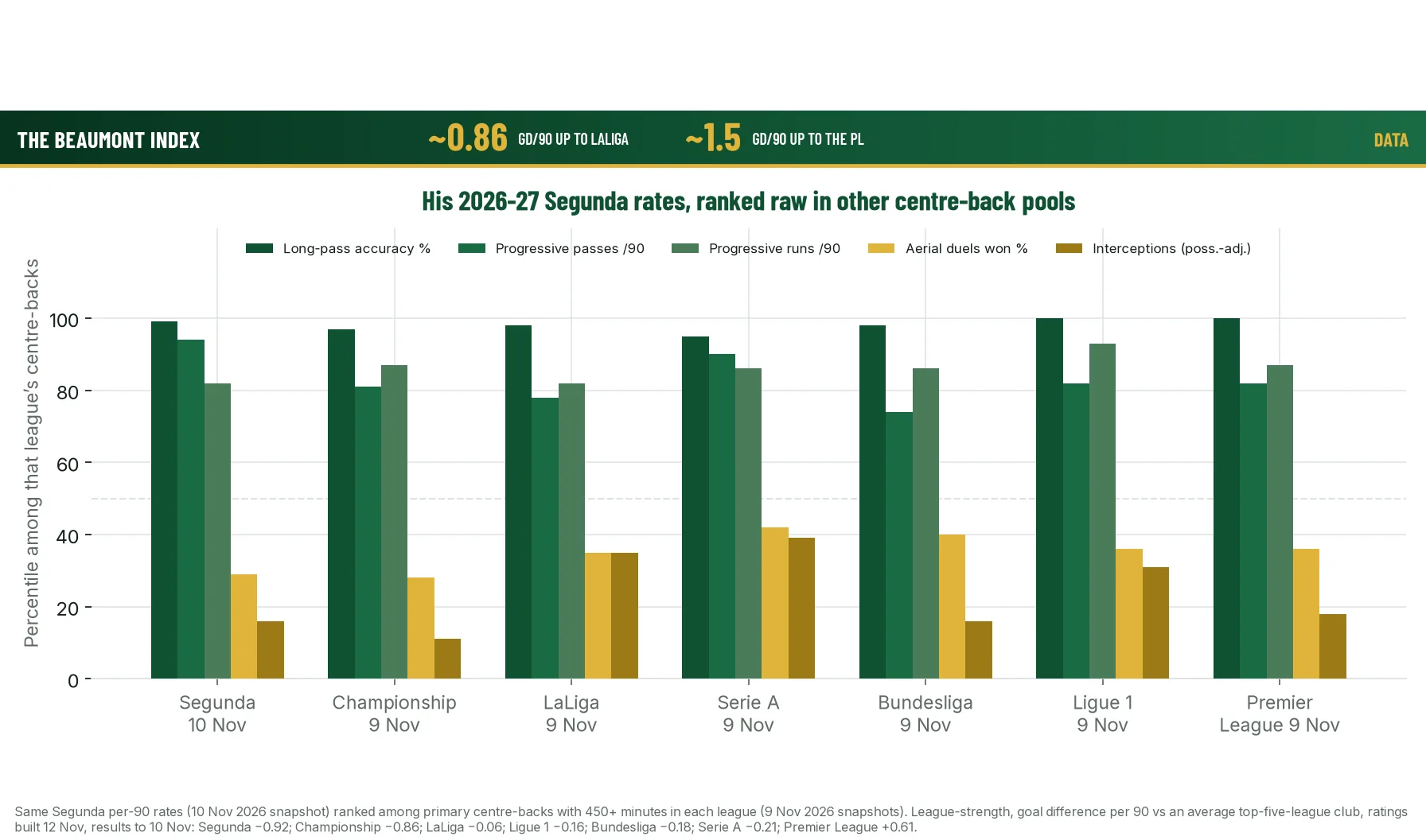
In LaLiga's current pool, his long-pass accuracy still ranks in the 98th percentile. Passes into the final third sit in the 80th, progressive runs in the 82nd, progressive passes in the 78th. The passing travels. In Serie A the passing looks even better relative to the pool, in the 90s. The aerial and interception rates do not travel. In LaLiga, aerial duels won sit in the 35th percentile and aerial volume in the 16th. In the Championship, aerial volume is in the 1st percentile of the pool. That is the clearest signal on the page: the league that matches his current level in strength is the worst match for his profile.
Read that carefully. Raw percentiles are a starting point, not a forecast. A step of 0.86 goals a game will compress the passing numbers, and the honest expectation is a good LaLiga passer, not an elite one. What the raw ranks do say is that the thing he is best at already looks like a LaLiga skill, and the thing he is weakest at already looks like a LaLiga weakness.
Ownership pathway: the route is Girona itself
Girona sit inside a multi-club network, so this section comes before any list of clubs. City Football Group is Girona's largest shareholder, with 47 per cent, alongside Marcelo Claure on 35 per cent and Pere Guardiola's Girona Football Group on 16 per cent. That is not majority ownership, and Girona are legally their own club. CFG also placed its Girona shareholding in an independent blind trust for 2024-25, to satisfy UEFA's multi-club rules while both Girona and Manchester City were in the Champions League.
The documented traffic in that network mostly runs into Girona, not out of it. Catalan outlet Girona Media counts 24 players who have arrived from CFG clubs since 2015-16, 21 of them from Manchester City. Vitor Reis, a City centre-back, was on loan at Montilivi last season. The best-known outward step is Savinho, a Troyes player on loan at Girona who joined Manchester City in summer 2024. Girona's own big sales that summer — Artem Dovbyk to Roma, Aleix García to Bayer Leverkusen — went to clubs outside the network.
So the natural next level inside the network is not another club. It is Girona's own route back to LaLiga, with a player they already own until 2029. Nothing public describes a club plan for him beyond that, and this piece does not assume one. Manchester City sit at the top of the network, but nothing in his profile or the public record points that way, so it is not treated here as a destination. Troyes, CFG's only other club in a top-five league, are 17th in Ligue 1 this season and rated below Girona in our team ratings. That would be a step up in league strength but a step down in team strength, into a relegation fight, and nothing public suggests it. It belongs in the "possible later" column at most, not the next step.
There is no conditional loan route worth describing, because he is already starting. If Girona go up in June, the next level comes to him. If they do not, any move into LaLiga would be an open-market deal with a club outside the network. The four clubs below are hypotheses about role and minutes, not places he is heading, and not clubs that have been in touch.
Four LaLiga clubs where the minutes exist
The rule for this section is strict. No invented fit scores. No implied interest. Just role, reason, and the incumbents he would compete with, from the 9 November LaLiga snapshot.
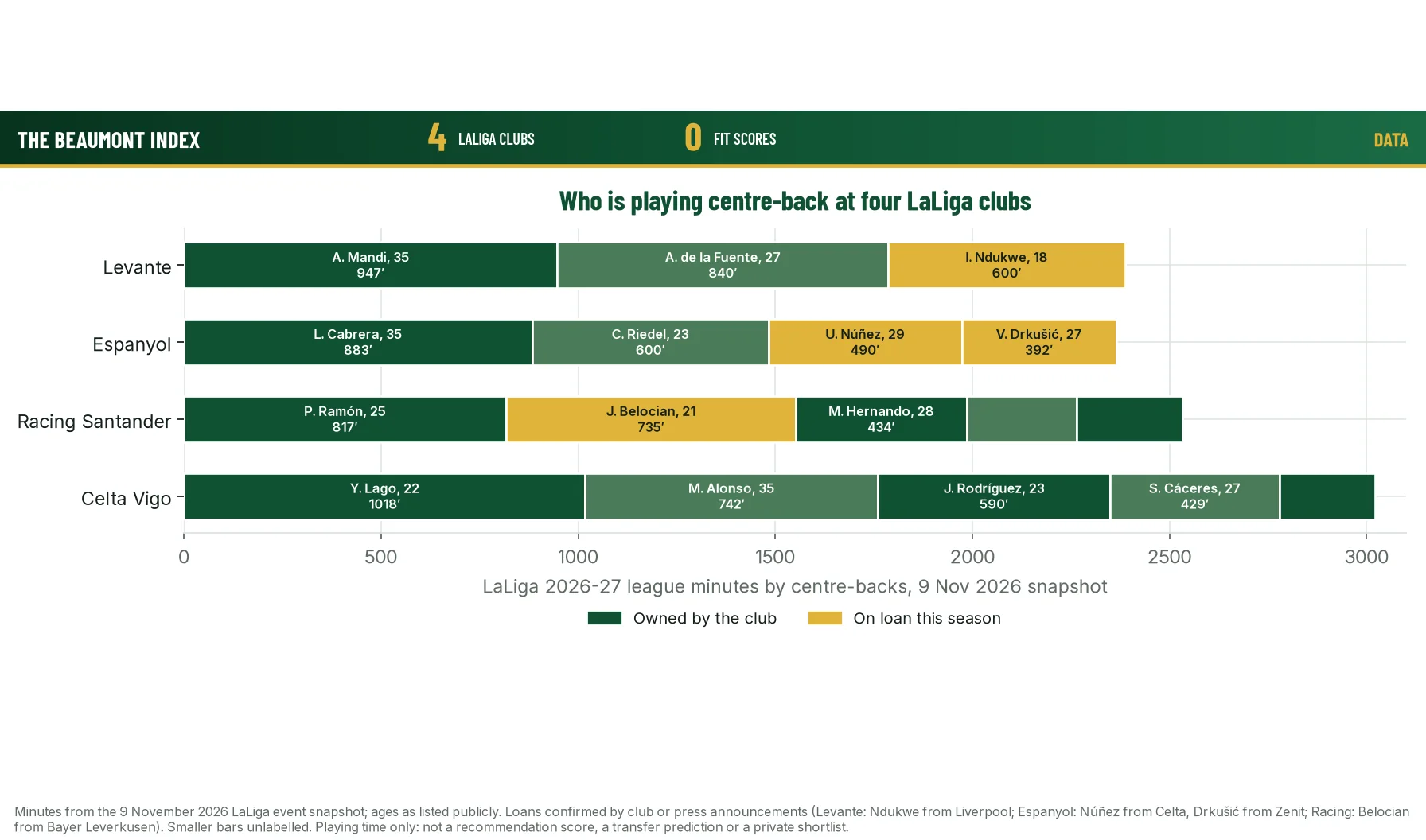
Levante — regular centre-back, succession role. Aïssa Mandi, who is 35, leads their centre-backs with 947 league minutes. Adrián de la Fuente has 840. The third, Ifeanyi Ndukwe, has 600 and is on loan from Liverpool until the end of the season. Levante sit 14th in our ratings, about a fifth of a goal below an average Big Five club — a real step up from the Segunda without being a top-half dressing room. The case is simple: a 35-year-old and a loan player hold most of one side of the pair, and Francés would be competing for those minutes, not walking into them.
Espanyol — regular centre-back, left side. Leandro Cabrera, 35, has 883 minutes on the left. Behind him, two of the next three centre-backs by minutes, Unai Núñez and Vanja Drkušić, are on loan, Drkušić from Zenit until June 2027. Espanyol sit 12th in our ratings, about an eighth of a goal below an average Big Five club. This is the cleanest match for where he has been playing this season, on the left of the pair, and the minutes behind Cabrera are mostly borrowed.
Racing Santander — regular centre-back in a ball-playing side. Pablo Ramón leads with 817 minutes; Jeanuël Belocian, on loan from Bayer Leverkusen until June 2027, has 735. Our team data has Racing among LaLiga's least direct and least aerial sides, which is the context where a centre-back who passes forward and does not live in the air makes most sense. They are also the weakest of the four in our ratings, 17th, about 0.44 below an average Big Five club. That is a smaller environmental jump, at a club our ratings place near the bottom of the division. It is a reason to see Racing as the most natural fit on style, not the most comfortable one.
Celta Vigo — the harder room. Celta's minutes are spread across five centre-backs, led by Yoel Lago on 1,018 and Marcos Alonso, 35, on 742. Our team data has Celta among LaLiga's least aerial sides, which suits the profile. The depth does not. He would be competing with two 23-and-under centre-backs who are already playing, and that makes Celta the club where a regular start is least assured. It is on the list because the style fits, not because the door is open.
Two kinds of club are left off deliberately. Getafe, whose game in our data is built on long balls and aerial contests, would ask him to do the thing he does least. And English Championship clubs, despite the league sitting at the Segunda's level, are the worst raw match for his aerial numbers of any pool we tested.
Limitations
A Scout that only sells the upside is a brochure. The limits on Francés are real, and they belong in the same voice as the praise.
He does not defend the air. Aerial volume in the 11th percentile of Segunda centre-backs, the 16th in LaLiga's pool, and the 4th in LaLiga last season. A club that needs its centre-backs to win the long ball and defend crosses at the back post should look elsewhere, or sign him to play beside someone who does.
The interceptions are low, even adjusted for possession. The 16th percentile in the Segunda is not explained away by Girona having the ball. His defending shows up in the duel numbers, not in the interception numbers. That can work. It is a different profile from the one a side built on winning the ball high would usually look for.
The sample is 13 games. The 2026-27 numbers come from 1,004 official league minutes. The passing shift — long-pass accuracy up from about 47 per cent to 71 — is big enough to notice and small enough to regress. Another half-season will say more than this one.
Last season he was a part-timer, and the ankle was part of why. Eleven starts in 24 LaLiga appearances, with six weeks out after the ligament injury in October 2025. This season he has started 11 of 13, not all 13. First choice in the Segunda is not yet a guarantee of first choice for a whole season.
The league step is large. About 0.86 goals a game back up to LaLiga. Raw percentiles will compress, and the strong passing ranks in this piece are a starting point, not a forecast.
This piece has not used reviewed footage. The judgements are driven by event data, the league-strength model and published match reports. There is no private video notesheet behind them, and no claim here about how he positions himself, steps out, or defends crosses. Anyone buying the passing should still watch him against a striker who wants the ball in the air.
The contract is long, and the network is real. He is under contract to 30 June 2029, so any club outside the network would have to buy him from Girona on the open market. This piece will not invent a price.
The verdict
Alejandro Francés is not a secret, and he is not a finished LaLiga starter waiting to be collected. He is something more specific than either: a 24-year-old who was a forward-moving, loose-passing part-timer in LaLiga, went down with Girona, and has spent 13 Segunda games turning into a centre-back whose passing is among the cleanest in the division. The long-pass accuracy, the progressive passing and the passes into the final third are the most reliable part of the page. The aerial numbers are the least flattering, and they are consistent across both seasons.
Ranked raw in LaLiga's current pool, the passing still looks like a top-flight skill. The air still looks like a top-flight problem. That is why the honest recommendation is a regular start at a LaLiga side outside the top six that keeps the ball — Levante, Espanyol, Racing Santander, Celta if he wants the harder fight — and not a Championship club that would ask him to head the ball all afternoon. Inside the City Football Group network, the next level is not somewhere else. It is Girona, back in LaLiga, with a centre-back they already own until 2029.
Relegation hands a rotation player a starting job and dares everyone to call it a promotion or a mirage. For Francés, the honest answer is half of each. The passing is a promotion. The heading is still the question.
FAQ
Who is Alejandro Francés?
A 24-year-old right-footed centre-back, 181 cm, born in Zaragoza, who plays for Girona in the Segunda División. He joined from Real Zaragoza in July 2024 on a contract to 30 June 2029. This season he has 13 league appearances, 11 starts and 1,004 minutes, after 24 LaLiga appearances and 11 starts in 2025-26.
Is he ready to go back to LaLiga?
As a regular starter for a LaLiga side outside the top six that keeps the ball, yes, on the evidence of his passing: his Segunda long-pass accuracy ranks in the 98th percentile of current LaLiga centre-backs. His aerial and interception rates sit low in every pool we tested, and the Segunda-to-LaLiga step is about 0.86 goals a game on our league-strength scale.
Which clubs fit, and does the City Football Group network matter?
On role and minutes: Levante, Espanyol and Racing Santander, with Celta Vigo the harder option. None of that is a transfer tip. City Football Group owns 47 per cent of Girona; the natural route inside that network is Girona’s own return to LaLiga, and nothing public describes a club plan to move him elsewhere.