Ratings and world ranks in this piece come from before our 25 October 2026 ranking update. Current figures are on each club's page.
The short answerAston Villa beat Manchester City 2-1 by defending deep and compact, pressing hard early and breaking quickly. Nicolas Jackson scored both goals, the first from a City error in build-up. City dominated the ball and created more, but less than usual, and lost at Villa Park for the fourth straight league visit.
For the first quarter of an hour at Villa Park on Saturday lunchtime, Manchester City looked like a team that had forgotten how to start a football match. They took so long over one goal-kick, more than the eight seconds now allowed, that the referee gave Villa a corner for it. In the sixth minute they tried to play out from the back under Villa's press. Marc Guéhi took a heavy touch, John McGinn pounced and played Nicolas Jackson in, and Jackson turned inside Elliot Anderson before finishing high past Gianluigi Donnarumma.
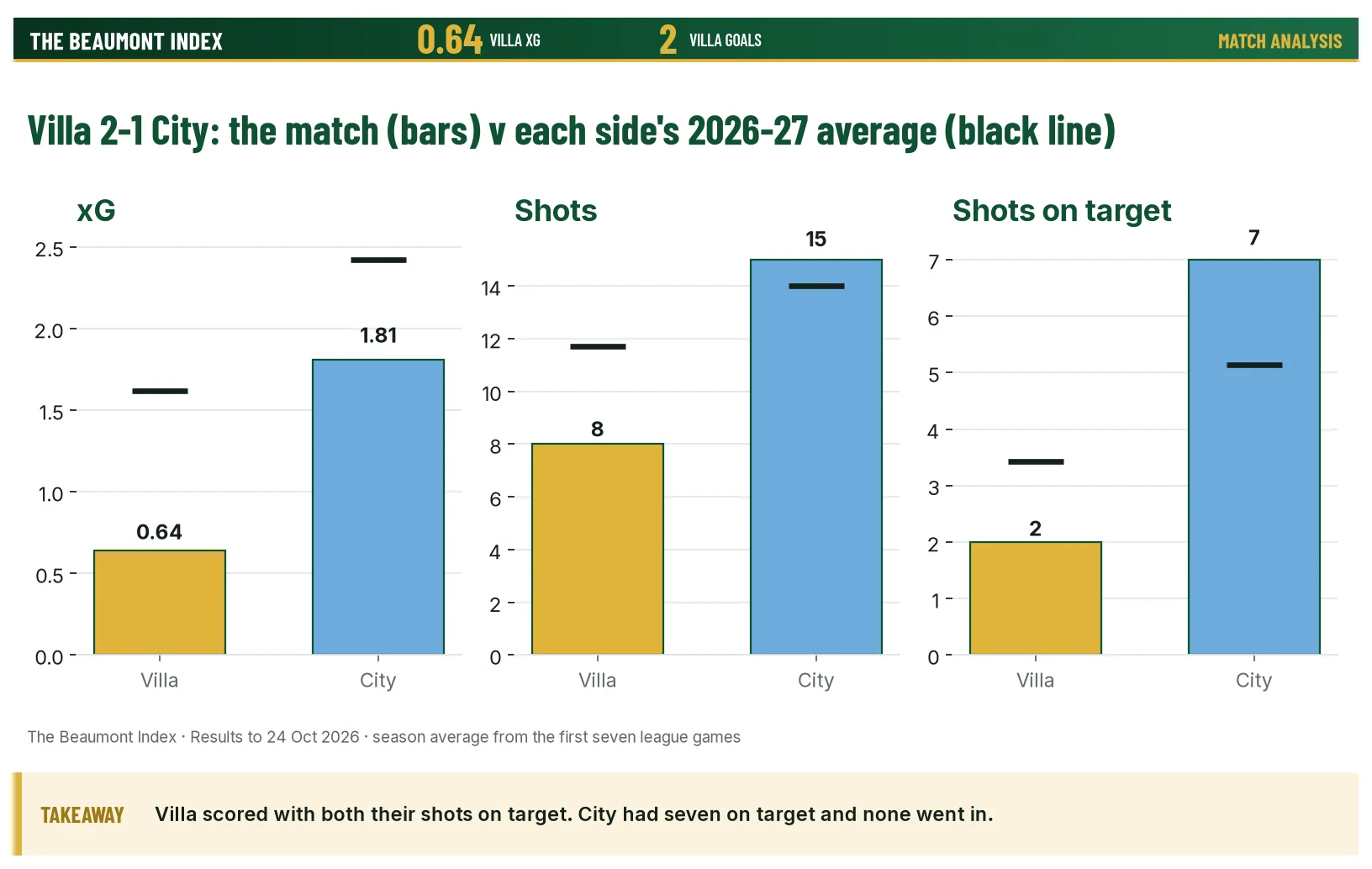
That should have been the cue for a long, slow City squeeze. In a sense it was. City had 63% of the ball, made 528 passes to Villa's 314, and put seven shots on target. Zion Suzuki made six saves in the Villa goal. And Villa won 2-1, which means Enzo Maresca's side, winners of all seven league games, lost to the team with the lowest expected-points rate in the Premier League.
So how did a side that had been playing like a relegation candidate beat the league's form team? The answer is partly shape, partly nerve and partly something that Villa have been doing for a season and a half.
The shapes: mirror images, different intentions
On paper the two teams were identical. Unai Emery picked a 4-2-3-1. So did Maresca, who has used that shape in all seven league games this season, after City used at least seven different formations across the previous twelve months of league football. When two 4-2-3-1s meet, the game tends to be decided by what the double pivots do and by which full-backs win their duels.
Villa's double pivot, Boubacar Kamara and João Gomes, had the better of City's midfield by most accounts. Villa did not try to compete for the ball. They tried to deny City space between the lines and break when they won it. The Guardian's match report described Villa defending "with commitment and discipline to limit the space available", and the numbers back that up. Villa had 37% of the ball and committed 21 fouls, four more than City, which means they were willing to stop moves before they started. Four Villa players were booked, including the right-back Matty Cash.
City's build-up came mostly down the flanks, through Jérémy Doku on the left and Iliman Ndiaye on the right. That was where they looked most dangerous all afternoon, and that was where Villa doubled up, putting two players on each winger whenever they could. It slowed City down but did not stop them. Ndiaye cut in from the right and curled a shot against the foot of the post, and he had a penalty claim waved away. Suzuki kept turning shots away from Ndiaye, Cherki and Doku. Doku's runs on the left caused trouble but never quite produced the goal. City's chances were good but not overwhelming. Their expected-goals total was 1.81, below their season average of 2.42 and, tellingly, below the 1.84 that the average Villa opponent had managed this season.
Read that last sentence again. Villa had been conceding plenty of chances before Saturday. Against City, they conceded fewer than usual.
Villa's double pivot, Boubacar Kamara and João Gomes, had the better of City's midfield by most accounts.
The press: brave early, smart late
Villa's start was the most aggressive part of their afternoon. They went at City's build-up for the first 15 minutes, and the opening goal came straight from it: City trying to pass through the press, a miscontrol under pressure, a quick pass and a finish. The official City report described Villa as flying "out of the traps".
After that Villa dropped deeper and stayed compact. City kept the ball in Villa's half for long spells. The risk for Villa was obvious, and in the first half they rode it with saves from Suzuki and some last-ditch defending. The reward was obvious too. With City committed forward, every Villa turnover was a chance to run at a back line with space behind it, and both match reports noted the threat Villa carried on the break.
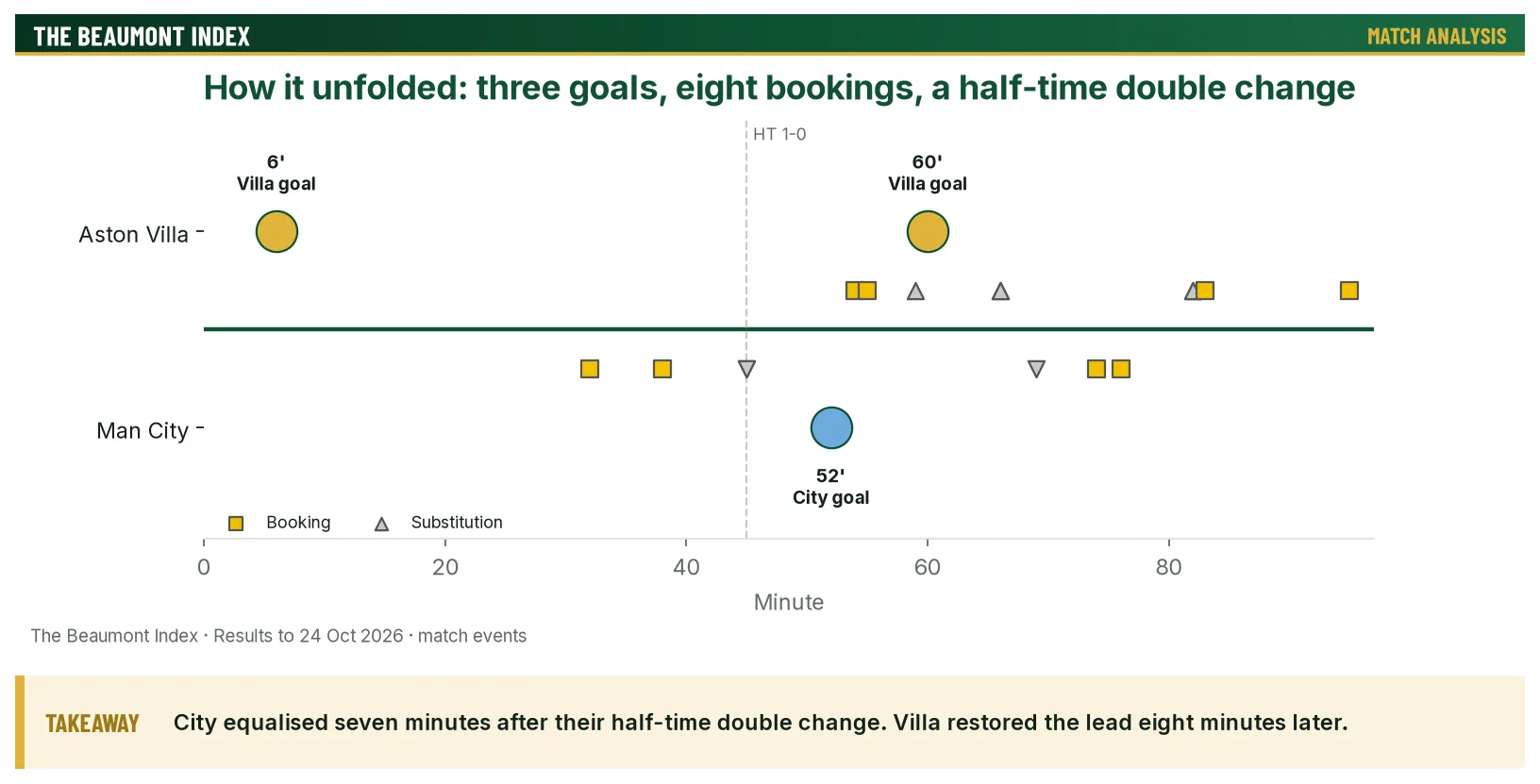
Both of City's first-half bookings came from that dynamic. Guéhi was booked in the 32nd minute for dragging down Jackson as Villa broke; Rayan Cherki was booked six minutes later. At half-time Maresca took both off, sending on Rico Lewis and Phil Foden, which means City spent the second half with a reshaped defence against the striker who had been causing the trouble.
Key duel: Jackson against City's centre-backs
The Guardian's report called Jackson against City's defence a mismatch, and it was hard to argue. He scored both goals and drew the foul that led to a booking. Emery said afterwards that it was how Jackson worked and defended, as well as the goals, that impressed him. He was replaced with eight minutes left.
His second goal was the clearest example of how Villa planned to hurt City. Emery sent on Ibrahim Mbaye for Alysson Edward in the 59th minute. A minute later City lost the ball, Jackson moved it on to Mbaye, and Villa broke. Mbaye powered down the right and pulled a low ball back to Jackson, whose first-time shot crept under Donnarumma's dive. It was Villa's second shot on target of the match. Both had gone in.
That is the hard part to explain if you only watch City's possession. Villa scored twice from chances worth 0.64 goals, which is less than half their season average. Donnarumma will not enjoy watching the second again. City's equaliser was arguably the best goal of the game: a short free-kick, a cross from Ndiaye, and Erling Haaland heading in seven minutes after half-time, his ninth league goal of the season by City's count. Late on, Ian Maatsen cleared a goal-bound Haaland header to protect the lead. Both Villa goals came from City turnovers in transition, which is what Emery had built the plan around.
The habit Villa can't kick
Here is the multi-season part, and it's the most Bill James thing about this game. Last season Villa were about 14 points ahead of what their performances deserved, the kind of gap that usually closes quickly. This season, before Saturday, they were still 2.4 points ahead, despite the league's lowest expected-points rate. Saturday added another two goals from not much.
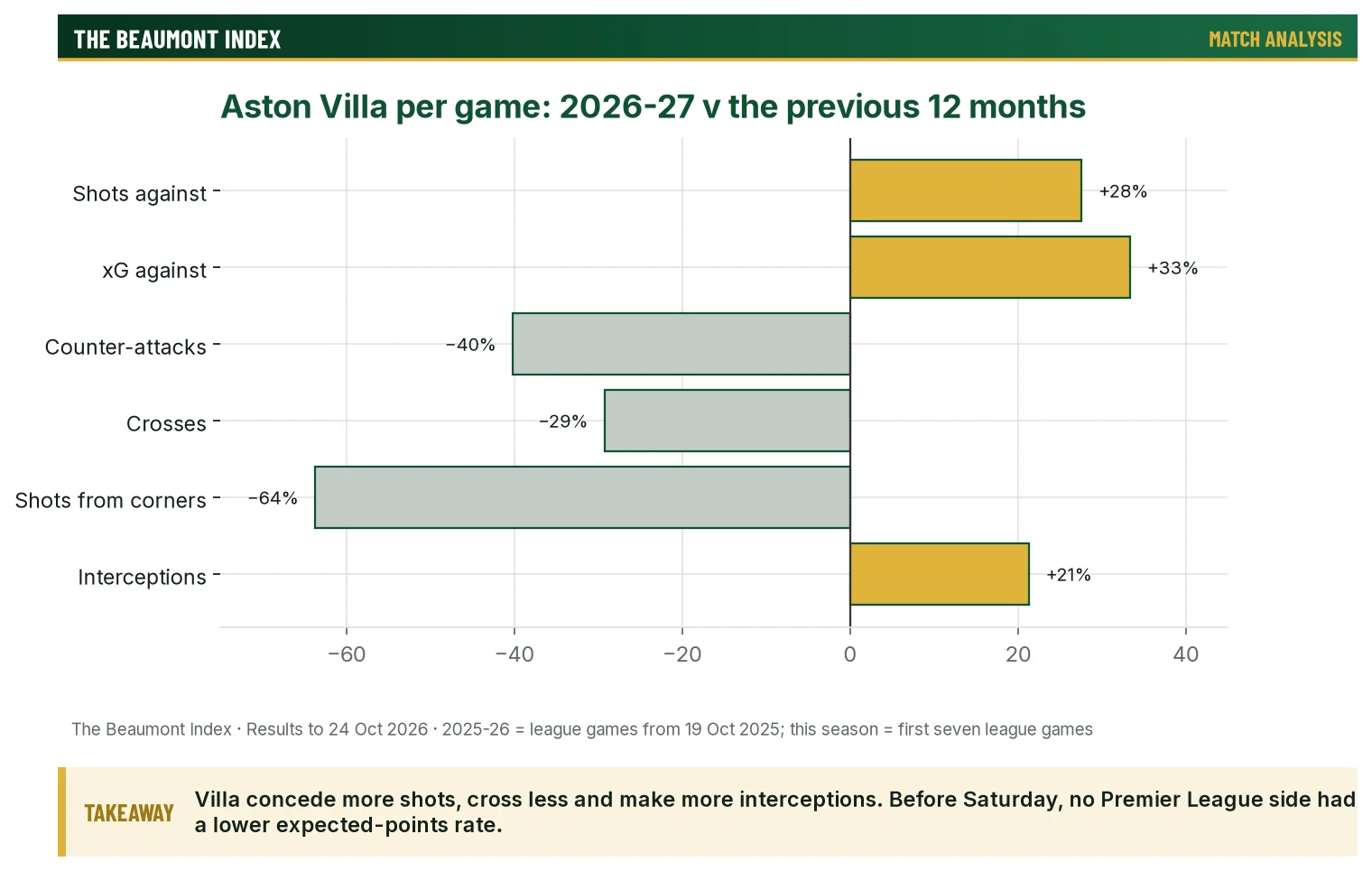
Is that luck or skill? Probably both. Sustained overperformance usually means a mix of good finishing, a keeper having a good spell and a habit of scoring first and then defending well. Villa did all three on Saturday. But the underlying trend is a worry. Compared with the previous twelve months, Villa are facing 14.9 shots a game, up from 11.6. They are crossing less and getting fewer shots from corners. They are making more interceptions, which suggests a team spending more time without the ball.
Villa Park, City's least favourite away day
History mattered here too. This was Villa's fourth straight home league win over City, a run that started in December 2023, and every one of them has been by a single goal: 1-0, 2-1, 1-0, 2-1. Villa have also won the last three league meetings anywhere, including a 2-1 win at the Etihad in May.
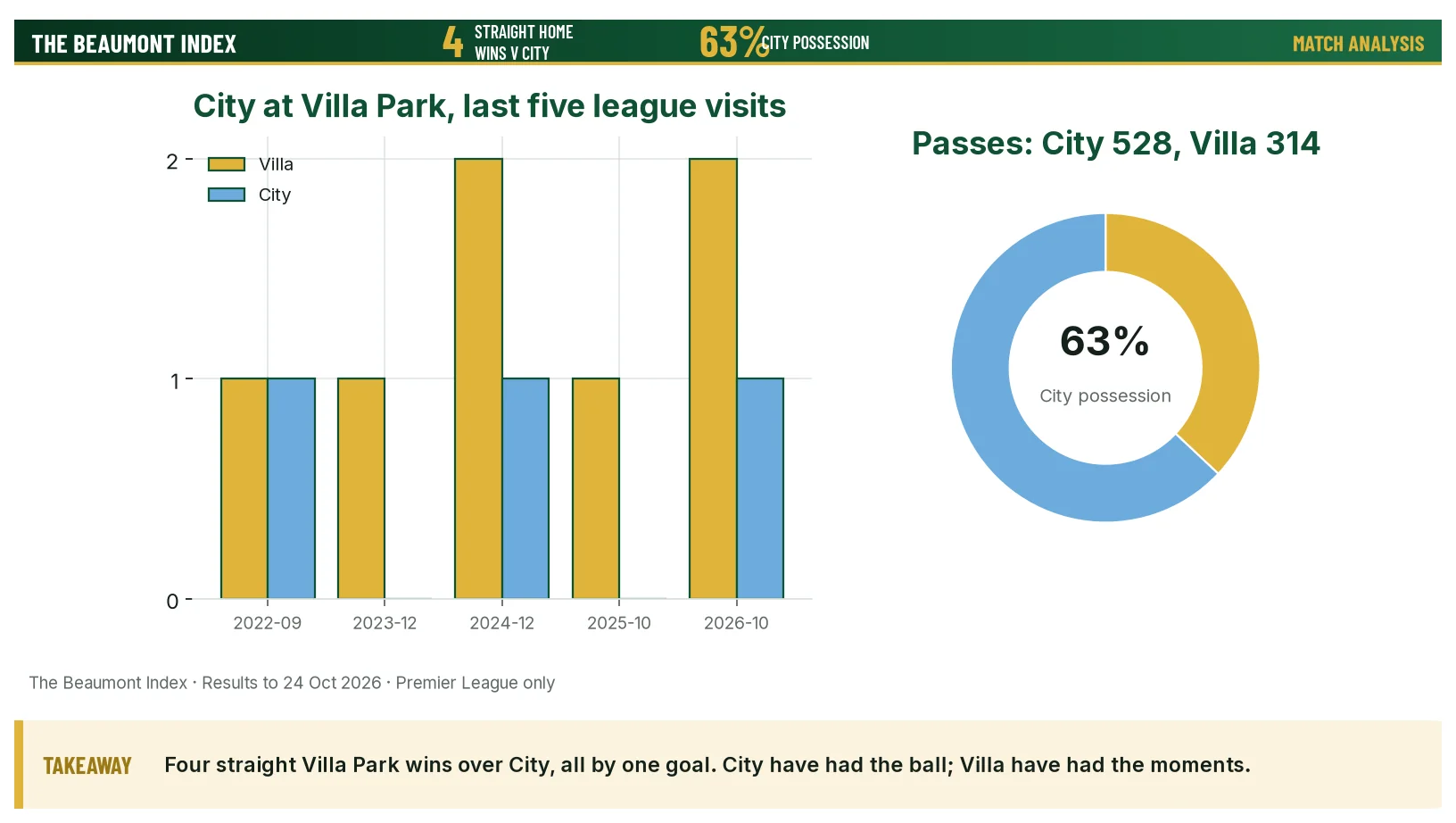
There is a pattern inside that run. City tend to dominate the ball at Villa Park and Villa tend to score on the break, keep their shape and live with the pressure. Every big club has a ground where it seems to play worse. For City, Villa Park has become one.
What it means for City
City came into the game as the Premier League's luckiest team on our numbers, 7.6 points ahead of what their performances deserved. A perfect start built on performances worth 1.92 points a game was always going to meet a day like this. Saturday was not a bad performance by City's standards, just a slightly below-par one by their numbers, against a goalkeeper and a striker having very good days.
City were rated 1731 before kick-off, the second-highest rating in the league. One defeat won't change that much. The thing to watch is whether the defensive errors that cost them at Villa Park keep coming. Two goals from mistakes in one afternoon is a warning, not a crisis.
What it means for Villa
For Villa, this was Emery's team at its most Emery: compact, disciplined, organised to win the moments that matter. The question is whether they can win more of the ball, more often, without living on Jackson's finishing. The ratings, which do not yet include this game, have them at 1626, 9th in the league, and trending down.
One afternoon does not change a trend. But it does show what Villa can still do when the plan works. City had the ball. Villa had the goals. On Saturday, that was enough.
FAQ
How did Aston Villa beat Manchester City?
By defending compactly in a 4-2-3-1, pressing City's build-up early and breaking quickly. Both Villa goals came from Nicolas Jackson, and Villa scored with both of their shots on target.
Who scored in Aston Villa 2-1 Manchester City?
Nicolas Jackson scored in the 6th and 60th minutes for Villa. Erling Haaland headed in Iliman Ndiaye's cross for City in the 52nd minute, after a short free-kick.
Have Aston Villa beaten Manchester City at Villa Park before?
Yes. This was Villa's fourth straight home league win over City, every one by a single goal, starting in December 2023.