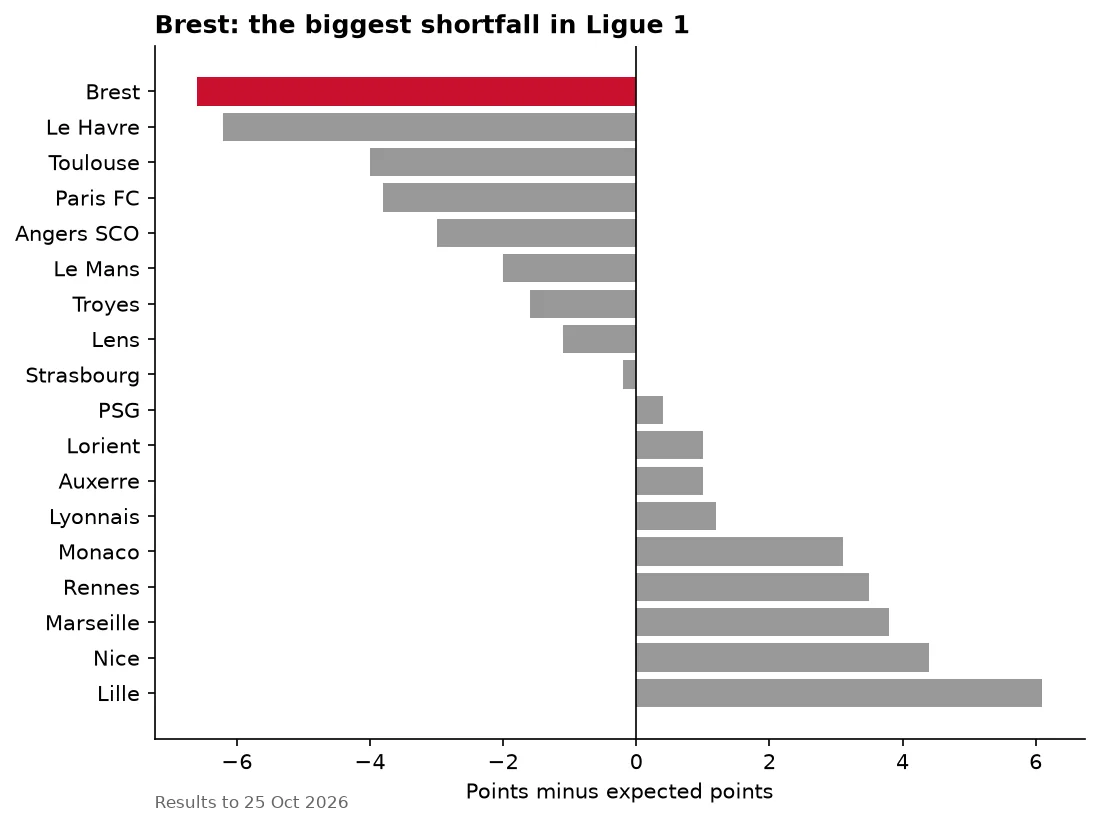
The short answerBrest are 13th in Ligue 1 with nine points from eight games, and on the table they look like a mid-table side having an awkward autumn. The Beaumont Index sees something very different. Measured by the quality of chances created and conceded, adjusted for the strength of the opponents, Brest have been the second-best team in France this season, behind only Paris Saint-Germain. They have the biggest gap between points and expected points in the league, about six and a half points, and their rating is rising faster than all but a handful of clubs in Europe's big five leagues. This is the Index's clearest case of a side whose results have not yet caught up with its football.
Brest are not where most people would look for one of the stories of the season. They lost 2-1 at home to Nice on 23 October, drew 1-1 at Lille the week before, and have won only two league games: 2-1 at Le Havre and 5-1 at home to Angers. Under Julien Lachuer they have scored 14 and conceded 12. Their next game is at Lorient on Monday night, kick-off 19:45 UK time.
On the surface that is a team going nowhere in particular. Underneath, it is one of the most interesting profiles in Europe.
The biggest shortfall in France
Our model rates every team on expected points: what its chances for and against, measured shot by shot, would usually be worth. After eight games, Brest's chances were worth about 15.6 points. They have nine.
That gap of six and a half points is the largest in Ligue 1, slightly bigger than Le Havre's, and it is larger than any other club in the division's. Only Paris FC, on about 17.8, had chances worth more than Brest's. PSG's were worth about 13.6 from seven games, Lens's 14.1 and Toulouse's 14.0.
Put another way: if Brest's results had matched their chances, they would be in the top four, not the bottom half.
The three defeats tell the story. Brest lost 1-0 at home to PSG, 2-1 at Auxerre and 2-1 at home to Nice. All three were by a single goal. Two draws, at Le Mans and at home to Toulouse, were 2-2 scorelines in which Brest could have won. A side that creates as much as Brest has done usually wins more of those games than it loses.
Second only to PSG on performance
The deeper measure is opponent-adjusted expected goal difference: chances created minus chances conceded, per game, corrected for who you have played.
Put another way: if Brest's results had matched their chances, they would be in the top four, not the bottom half.
On that measure Brest are second in Ligue 1, at close to +0.9 a game. Only PSG, at a little over +1, are ahead. Paris FC are just behind Brest, then Lyon, Lens and Toulouse. Brest's schedule has not been especially soft either: their raw figure and their opponent-adjusted figure are almost identical, so this is not a side that has piled up numbers against weak opposition.
This is the core of the scout. Over eight games, Brest have consistently created more and better chances than their opponents, by a margin that only the champions have matched. That is the profile of a good team, not a lucky or unlucky one.
Why their world ranking is only 85th
If Brest are second in France on this season's performance, why does our world ranking have them 85th, behind clubs such as Lille, Marseille, Rennes and Toulouse?
The answer is that the overall rating blends this season with what came before, and with the strength of the squad. Early-season numbers are noisy, so the model does not let eight games override two years of evidence. Last season Brest took 39 points from chances worth about 42, a modest shortfall. In 2024-25 they had a big surplus, about ten points. Nothing in that history says elite.
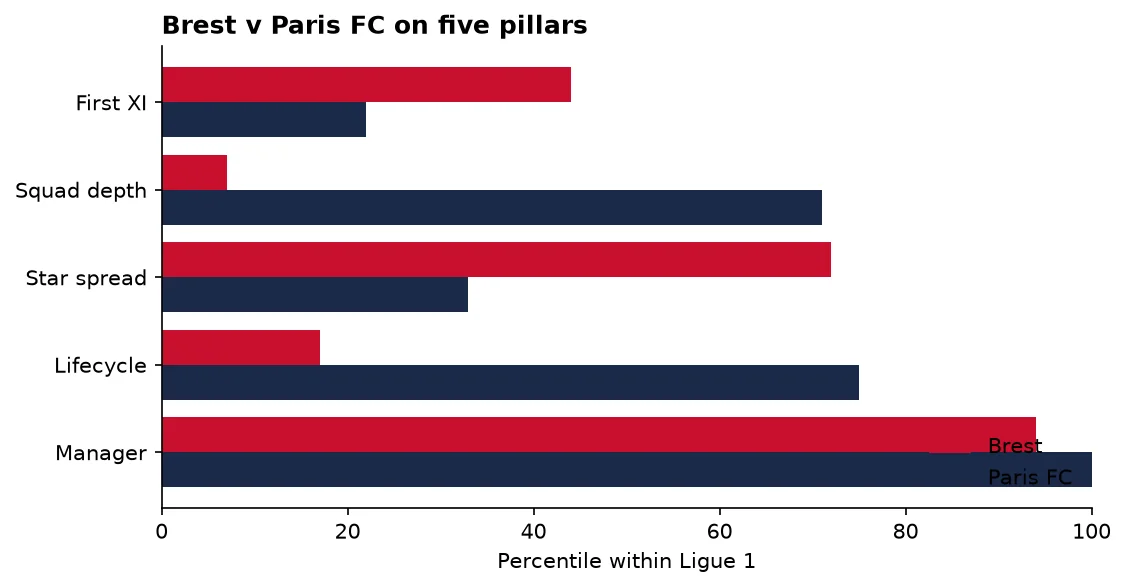
The squad pillars also hold them back. Brest's first XI ranks in the 44th percentile in Ligue 1 on our measure, roughly mid-table. Their squad depth is near the bottom of the league, in the 7th percentile, though their star spread, how widely quality runs through the regular team, is a healthier 72nd. Their lifecycle pillar, reflecting squad age and where players are in their careers, is in the 17th. On paper, this is not a squad built to finish in the top four.
That is exactly why the trend number matters. Our ratings track how fast each club's underlying level is changing, and Brest's is rising by more than half a goal per 90 minutes. Among clubs inside the world top 150, only Barcelona, Ajax, Freiburg, Sanfrecce Hiroshima and Paris FC are climbing faster, along with Brighton at almost exactly the same rate. The model is updating towards Brest, and quickly.
How Brest play
Brest's style is distinctive. Relative to the rest of Ligue 1, they are about two standard deviations above average for aerial play and close to two above average for directness, the share of long balls in their passing. They are a side that goes forward quickly and attacks the box in the air.
That fits the shape of their results. Direct, aerial football tends to produce plenty of chances, but those chances can be lower-percentage and more variable: headers that fly over, second balls that bounce the wrong way. It is a style that can generate strong expected-goals numbers and frustrating scorelines at the same time. Over a full season, though, a side that keeps creating chances at Brest's rate usually sees the goals arrive.
The one pillar where Brest stand out is the manager. Their coaching pillar ranks in the 94th percentile in Ligue 1. Whatever the squad lacks in individual quality, the side is set up to create more than it concedes. That matches what the performance data shows.
The Paris FC comparison
It is worth putting Brest next to the club just behind them on performance. Paris FC have chances worth about 17.8 points, the most in the league, and have taken 14. They are also unlucky, by close to four points, and their rating is rising at almost the same pace as Brest's.
The difference is in the squads. Paris FC's depth is in the 71st percentile and Brest's in the 7th; Paris FC also rate higher on lifecycle, 75th against 17th. Both have managers rated near the top of the league. Paris FC are sixth in the table and 66th in the world. Brest, with similar underlying numbers, are 13th and 85th.
Both point to the same lesson: the top half of Ligue 1 on performance looks quite different from the top half of the table. The two clubs meet in Brest on 27 November, a fixture that on our numbers is one of the best in France this autumn.
What could go wrong
A scout report should be honest about the case against.
First, eight games is a small sample. Brest's 5-1 win over Angers accounts for a meaningful share of their chance creation, and a single big game can inflate a short-season average. Second, a direct, aerial style can produce high expected goals that are slightly less reliable than chances created through the middle. Third, the squad really is thin on top-end quality, as the pillars show, and injuries or a January sale could change the picture fast.
There is also the simple fact that the table does not wait. At 13th, Brest are only two points above the relegation play-off place. A run of narrow defeats, even well-played ones, would turn a promising season into a nervous one.
What the next month looks like
Brest's fixture list over the next four rounds is mixed: Lorient away on Monday, Lyon at home, Strasbourg away and Paris FC at home. Lorient and Strasbourg are below Brest on our performance measure. Lyon and Paris FC are just behind them.
If Brest keep creating at their current rate, the Index would expect them to average around a point and a half a game or better over that run, and to climb towards the top half quickly. If they do not, the most likely explanation is regression in their chance creation rather than continued bad luck.
The verdict
Brest are the Index's clearest example in Europe's big five leagues of a team whose results lag well behind its football. Second in France on opponent-adjusted performance. The largest shortfall against expected points in the division. A rating rising faster than almost anyone's. A squad that does not look the part on paper, and a coach whose side plays far above it.
The table says Brest are a mid-table team with a soft underbelly. The Index says they are one of the best-performing sides in France, waiting for the finishing to turn. Watch the next month. If the goals come, Brest will not be 13th for long.
What we'll be watching
- Conversion. Brest have created chances worth nearly two points a game. A return to normal finishing should be enough to lift them into the top half.
- Narrow games. All three defeats were by one goal. Turning even one of those into a draw each month changes their season.
- The trend line. Brest's rating is rising by more than half a goal per 90. If it holds, their world ranking will climb sharply by the winter break.
- 27 November. Brest v Paris FC: the two most underrated sides in France on our numbers, on the same pitch.
Figures: club ratings, ranks, expected points, pillars and style data come from the Beaumont Index model, with results to 25 October 2026. Results, table position and fixtures are from match reports and league listings as of 1 November 2026.
FAQ
Why are Brest 13th if the Index rates them so highly?
Their chances have been worth about 15.6 points after eight games, but they have nine: the biggest shortfall in Ligue 1. Three defeats were all by one goal.
How good have Brest been this season?
On opponent-adjusted expected goal difference they are second in Ligue 1, behind only PSG.
Why are Brest only 85th in the world?
The overall rating blends this season with previous seasons and squad strength, and Brest's squad depth is among the thinnest in the league. Their rating is rising fast.
When do Brest play next?
At Lorient on Monday 2 November 2026, 19:45 UK time.