The short answerBrighton's 1-0 win at Manchester City on Saturday was the kind of game that usually flatters the winner. City had about 62% of the ball and 21 shots, and Bart Verbruggen made seven saves. But the result does not change what the Beaumont Index already thought of Brighton: they are a genuine contender for the top four and a plausible outsider for the title, not a side on a lucky run. Before kick-off they were ninth in the world on our ratings and fourth in the Premier League. Their points were close to what their chances deserved. And their rating was rising faster than any other club in the top eight. The leaders, City and Arsenal, are the ones whose results have run ahead of their football.
Saturday's game will be remembered for the goalkeeper. Yasin Ayari scored after 11 minutes, sweeping in from close range after Matheus Nunes switched off. From then on City pushed and Brighton held. Iliman Ndiaye hit the post. Verbruggen kept out Nunes, Abdukodir Khusanov and Jérémy Doku. His sprawling save from Nunes in the second half is the one Brighton fans will replay. It was Brighton's first away league win against City at the 18th attempt, three days after City knocked them out of the Carabao Cup on penalties.
City have now lost two league games in a row, after the 2-1 defeat at Aston Villa a week earlier. That is the first time it has happened under Enzo Maresca, who won his first seven league games after succeeding Pep Guardiola. Brighton are third on 19 points, two behind City, and Arsenal can go top if they avoid defeat at Liverpool on Sunday.
A one-game result is not the point
Any honest reading of Saturday has to start with the obvious. A team that has 38% of the ball, faces 21 shots and needs seven saves from its goalkeeper has not dominated a game. If you replayed the second half many times, City would score in plenty of them. On the day, Brighton were the better finishers and had the better goalkeeper, and City were not sharp enough. As a single result, it leans towards fortunate.
But the question that matters is not whether Brighton deserved one result. It is whether the team now sitting two points off the top is good enough to stay there. On that question, one game at the Etihad tells you very little. Eight games of data before it tell you a lot.
Brighton are not running hot
The clearest sign of a hot run is a team whose points are well ahead of what its chances usually earn. Our model measures that with expected points, built from the quality of every shot for and against.
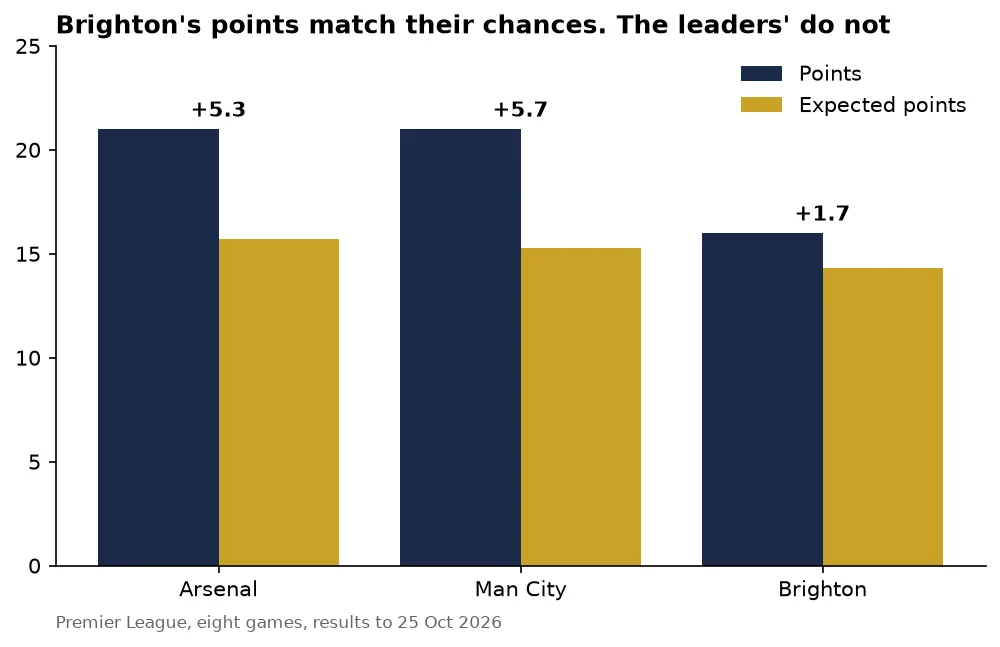
After eight league games, Brighton had 16 points from chances worth about 14. That is a surplus of under two points, small enough that we class their luck as fair. Their results matched their football.
The two clubs above them look different. City had 21 points from chances worth about 15, a surplus of nearly six, the biggest in the league. Arsenal had 21 from chances worth about 16, a surplus of more than five. Both are classed as lucky in our model, meaning their results were running ahead of their performance.
The clearest sign of a hot run is a team whose points are well ahead of what its chances usually earn.
So before Saturday, the table had Brighton five points off the top. On expected points the gap was about one point to City and one and a half to Arsenal. Saturday's result has simply brought the table closer to what the underlying numbers already said.
How good the Index thinks they are
On our opponent-adjusted world ranking, Brighton were ninth in the world before Saturday and fourth in the Premier League, effectively level with Liverpool. Arsenal were first in the world and City fourth.
That is the ceiling question, and it is the honest limit of the case. Brighton are not yet rated as good as City or Arsenal. The gap to City was about 84 rating points, a little under half a goal per 90 minutes on a neutral pitch. The gap to Arsenal was bigger, close to eight-tenths of a goal. On a typical day, both would be expected to beat Brighton.
What makes Brighton different from a normal top-four outsider is the direction of travel. Our trend measure tracks how fast a club's underlying level is changing. Brighton's was rising by more than half a goal per 90 minutes. City's was steady. Arsenal's was falling slightly. No other club in the top eight was climbing as fast as Brighton. That does not make them the best team in England. It means the gap is closing, and it was closing before they won at the Etihad.
The goal difference tells the same story
Brighton now have 24 goals scored and seven conceded, a goal difference of +17. That is the best in the Premier League, ahead of City on +10 and Arsenal on +8. They have the most prolific attack in the league and, after a fifth clean sheet in six league games on Saturday, one of the meanest defences.
Goal difference is a blunter measure than expected goals, but over nine games it is hard to build a +17 by luck alone. Big goal differences come from consistently creating more than you concede. Brighton's expected-goals record before Saturday points the same way. They were creating far more than they allowed, adjusted for the strength of their opponents, which is why their opponent-adjusted performance ranked fourth in the league.
How they are built
The pillars explain why Brighton can sustain this, and also where the risk lies.
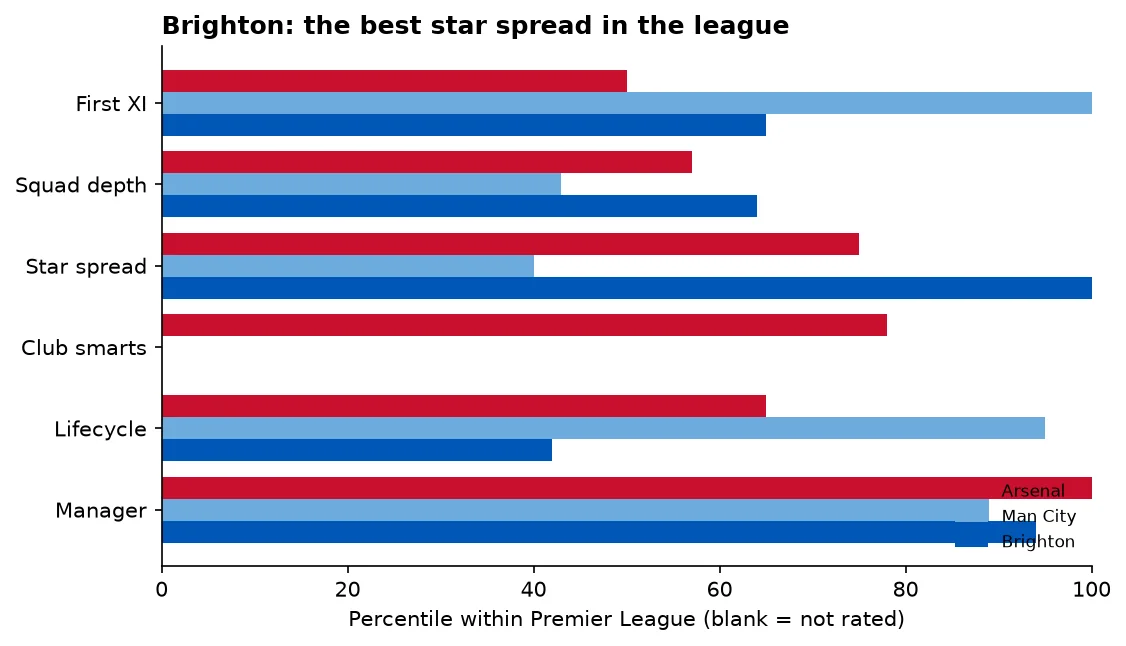
Brighton's first XI ranks in the 65th percentile in the Premier League on our measure, a good side rather than an elite one. City's is in the 100th percentile. Arsenal's is in the 50th, which is worth remembering when people talk about Arsenal's starting team as unbeatable.
Where Brighton stand out is everywhere else. Their star spread, how widely quality runs through the squad, is in the 100th percentile: the best in the league. Their manager pillar is in the 94th, above City's 89th, and their squad depth is in the 64th, well above City's 43rd. Fabian Hürzeler has a deep group of good players and gets more out of them than their raw quality suggests.
That shape matters for a title race. A side whose quality is spread across many players is better protected against injuries, suspensions and fixture congestion than a side built around a few stars. Brighton's run has not depended on one forward on a scoring streak. It has come from the whole squad.
What City's slump does and does not mean
City's two defeats in a row are real, and Maresca has problems. City have conceded ten goals in nine league games, double Arsenal's total, and on Saturday they struggled to keep the ball under Brighton's press.
But the Index does not see a team in collapse. City were rated fourth in the world before Saturday, with a steady trend. Their style profile is still among the most distinctive in Europe, with very high dribbling, possession and deep completions. What has changed is that results which were running well ahead of their chances have started to come back towards them. That is what usually happens to a side carrying a big luck surplus.
For Brighton, that is the useful context. Part of the reason the table has tightened is that City were overperforming. Brighton were not.
Contender or hot run?
Put the pieces together and the answer is clear.
A hot run looks like a team whose points are far ahead of its chances, whose rating has not moved, and whose results depend on a few players. Brighton are none of those things. Their points match their football, their rating is climbing fast, and their quality is spread through the squad.
A genuine contender looks like a team rated among the best in the world, creating more than it concedes, with a structure that can survive a long season. Brighton fit that description. They are ninth in the world, they have the league's best goal difference, and they have the best star spread and one of the best managers in the division on our measures.
The limits are real too. City and Arsenal are still rated as better teams, by margins that would show up over a full season if nothing else changed. Brighton's first XI is not elite. Saturday itself leaned on Verbruggen. The fair verdict is that Brighton are a top-four side on merit and the likeliest outsider to stay in the title race, not yet favourites for it.
What we'll be watching
- The trend line. Brighton's rating was rising by more than half a goal per 90 before Saturday. If it keeps climbing at anything like that pace, the gap to City and Arsenal will be close to gone by the new year.
- Shot quality conceded. Facing 21 shots at the Etihad is fine once. A contender cannot make it a habit. Watch whether Brighton keep their usual control in games against good sides.
- City and Arsenal's luck. Both leaders were carrying surpluses of five points or more. If those fade, the table will tighten further without Brighton needing to do anything new.
- Depth through the winter. Brighton's biggest advantage over City on our pillars is how widely their quality runs. December's fixture list is where that should pay off.
Brighton won a game on Saturday that they might have lost. But the Index had them as one of the ten best teams in the world before they kicked a ball at the Etihad. This is not a hot run. It is a very good team that the table is starting to catch up with.
Figures: club ratings, ranks, expected points, pillars and style data come from the Beaumont Index model, with results to 25 October 2026 (eight league games). Saturday's result, possession, saves and goal totals are from match reports and are not yet in our ratings.
FAQ
Are Brighton genuine Premier League title contenders?
The Beaumont Index rates them a top-four side on merit and the likeliest outsider for the title: ninth in the world, with results that match their chances and a rating rising faster than any club in the top eight.
Were Brighton lucky to beat Manchester City?
On the day, a little: City had about 62% of the ball and 21 shots, and Bart Verbruggen made seven saves. Over the season, Brighton points match their football; City and Arsenal are the clubs running ahead of their chances.
Where are Brighton in the table?
Third on 19 points after nine games, two points behind Manchester City, with the best goal difference in the league at +17.
Is Manchester City in decline under Enzo Maresca?
Not on our numbers. City were fourth in the world with a steady rating; their results, which had run well ahead of their chances, are coming back towards them.