The short answerthe Supporters' Shield is already decided. Nashville clinched it last weekend and are 13 points clear with two games left. What Sunday's Cascadia derby actually settles is a different question: whether the team our ratings say plays the best football in MLS goes into the playoffs as the West's top seed, and whether a Seattle side with the sixth-best underlying numbers in the league sneaks into the postseason at all. Two of the most under-rewarded teams in MLS meet at BC Place, and one of them is about to find out whether the table catches up with them before November does.
That framing matters because most previews of this game will start from the standings. Vancouver are first in the West on 58 points. Seattle are eighth on 43. On that view it is a leader against a scrambler, a fifteen-point gap, a home banker. On the Beaumont Index the gap is real but much smaller, and the story of both clubs this season is the same one: they have played better than their points.
Where the Shield race really stands
Start with the thing that is no longer in doubt. Nashville SC have 71 points from 32 games, with 21 wins, eight draws and just three defeats. New England and Vancouver are next on 58. With two rounds left, nobody can catch them; Nashville clinched the first Supporters' Shield in their history with their win over CF Montréal on 25 October.
What Nashville are still chasing is the record. Inter Miami set the single-season mark of 74 points in 2024. Nashville host New York Red Bulls on Sunday, on the same afternoon as the Cascadia game. A win takes them to 74 and level with the record; one more win in the final round would break it. Their points-per-game rate, around 2.22, is already the best of any Shield winner.
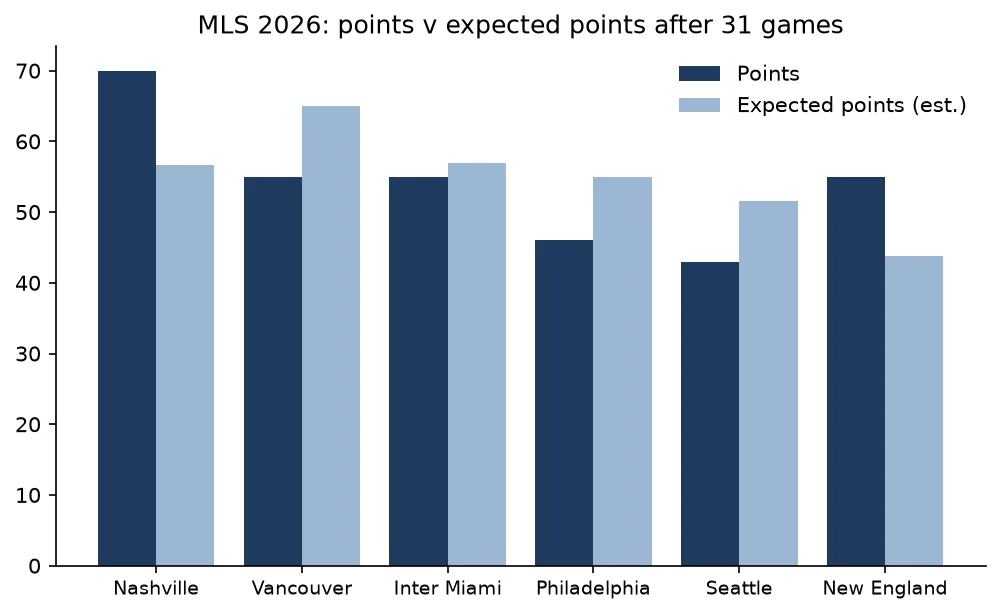
None of that is a reason to doubt them. They have conceded 23 goals in 32 games, the fewest in the league by a distance. But our model has been consistent about what kind of season it has been. On season-long chance quality, Nashville's football was worth about 57 points after 31 games, a very good total. They had 70 at that stage. That surplus of roughly 13 points was the largest in MLS.
So the honest version of the Shield story is that Nashville have been very good and very fortunate at the same time, and the trophy is fully deserved because the trophy rewards points, not process. The question the Beaumont Index asks is a different one: if you had to pick the team that plays the best football right now, who would it be?
Who plays the better football on our scale
On our opponent-adjusted world ranking, Nashville are now the top MLS side, 83rd in the world. Vancouver are second in MLS and 90th. Inter Miami are 92nd. The gap between the top three is tiny: a few hundredths of a goal per 90 minutes against an average top-five-league side, well inside the uncertainty bands we publish. Practically, the top of MLS is a three-way tie, and ratings like these shuffle week to week.
That is a change from last week, when Vancouver were narrowly first. It is worth being straight about why: Nashville's recent results have kept nudging their rating up, and our rating blends performance with results over time. That is a fair update, not a contradiction.
On our opponent-adjusted world ranking, Nashville are now the top MLS side, 83rd in the world.
But look beneath the headline rating and Vancouver remain the more convincing performers. After 31 games, their expected-points estimate was about 65, the highest in the league, against 55 actual points: roughly ten points short. Nashville's expected total was about 57. On a per-game basis, Vancouver were creating and preventing chances at a rate worth about 2.08 points a game, Nashville about 1.75. Vancouver have scored 67 goals and conceded 33, a goal difference of +34 that is second only to Nashville's +43.
Their style profile tells you why. Relative to the rest of MLS, Vancouver rank at or near the top for touches in the opponent's box, for shot volume and for deep completions, passes that arrive within striking range of goal. Each of those is about two standard deviations above the league average. That is the signature of a team that spends a lot of time in the right places and attempts a lot of shots from them. It is also the kind of profile that tends to be rewarded over larger samples, which is why we keep marking Vancouver as unlucky rather than overrated.
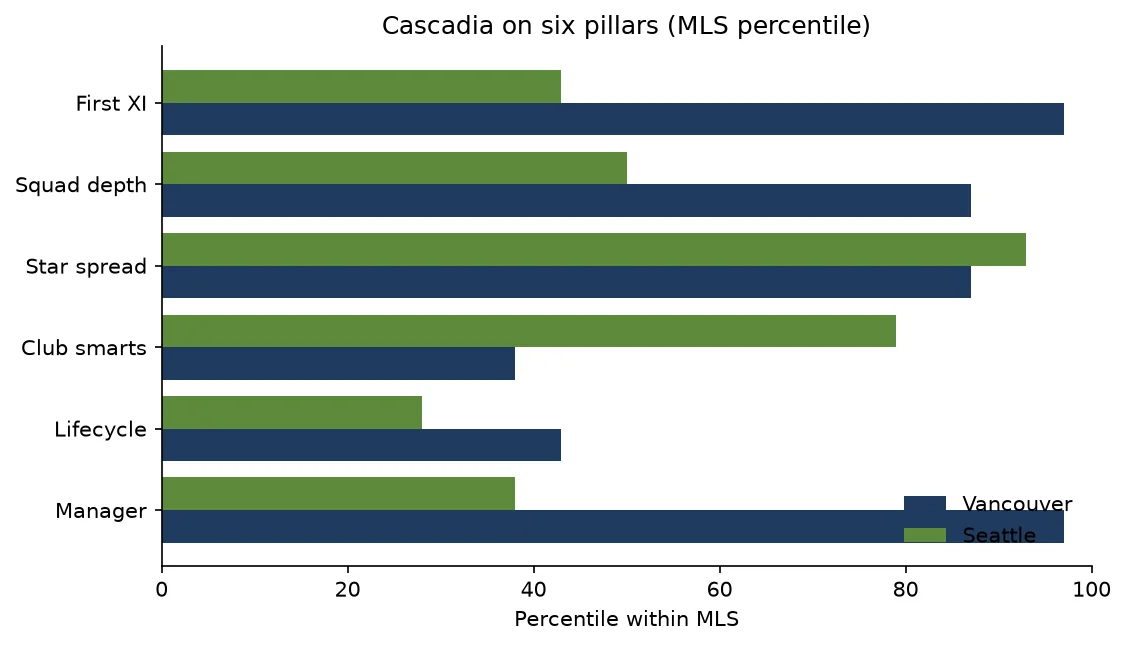
The pillar view backs it up. Within MLS, Vancouver sit in the 97th percentile for the quality of their first XI, the 87th for squad depth, the 87th for how widely their quality is spread through the team, and the 97th for the manager pillar. Nashville's first XI percentile is 73 and their depth is 43. On paper and on the pitch, the Whitecaps' squad is the more complete one.
So who plays the better football? Our honest answer is: the best results belong to Nashville, the best underlying performance belongs to Vancouver, and the headline rating says they are effectively level. If you want one sentence, it is that Vancouver are the team whose points most undersell them among the contenders.
Seattle: better than eighth
Now the other half of the derby, which is where the non-obvious part sits.
Seattle Sounders are eighth in the Western Conference on 43 points: 11 wins, 10 draws, 11 defeats, 41 goals scored and 40 conceded. That is a mid-table record, and in the table it puts them in the scramble around the play-in places with Colorado, Real Salt Lake and LA Galaxy.
On our ranking, though, Seattle are sixth in all of MLS and 131st in the world, second among Western clubs only to Vancouver and LAFC. After 31 games their expected-points estimate was about 51.5 against 43 actual, a shortfall of roughly eight and a half points. Only a handful of MLS clubs have been further short of what their football deserved.
Seattle's pillar profile is unusual. Their first XI is only around the 43rd percentile in MLS, which reflects an ageing and injury-hit core, and their lifecycle pillar, which reflects squad age and where key players are in their careers, is in the 28th percentile. But they score in the 93rd percentile for star spread and the 79th for club smarts. That is a club whose decision-making and depth of competent players have kept the underlying numbers healthy even when the headline XI has not been at full strength.
Put the two clubs side by side and the pillar chart shows the shape of Sunday. Vancouver lead on the first XI, depth and the manager pillar. Seattle lead on club smarts. Both are strong on star spread. It is not a mismatch; it is a strong side against a decent one that has been underpaid by the table.
What Sunday actually decides
Four things are live at BC Place.
The West's top seed. Vancouver are on 58, four points clear of FC Dallas with two games left. Dallas play at Sporting Kansas City on Saturday, before the Cascadia game kicks off. If Dallas win, Vancouver need a point or better across their last two games to be sure; a Vancouver win on Sunday would settle it outright in either case. Top seed matters in the MLS playoffs because it means home advantage in the round-one series and, potentially, through the conference.
Seattle's playoff place. Seattle are eighth on 43, level on points with Colorado, one ahead of Real Salt Lake and two ahead of LA Galaxy, the first team outside the places. Every one of those clubs has a game this weekend. Seattle's away record this season is four wins, six draws and six defeats, which is part of why they are in this position. A point at the West leaders would be worth a great deal.
The overall second place. Vancouver and New England are both on 58. New England's numbers flatter them even more than Nashville's: after 31 games their points were around 11 above our expected total. Behind Nashville, the race for the second-best record in the league is between a team our model rates as the best performer in MLS and one it rates in the bottom half of the league on underlying performance. Sunday, when New England host Inter Miami, is a fair test of which version holds.
The narrative of the season. If Vancouver win and Nashville beat the Red Bulls, the regular season ends with the two best clubs in MLS both looking like themselves: Nashville the record-chasers who have turned their chances into points at a remarkable rate, Vancouver the team creating more than anyone else. That is the playoff collision most people want to see.
How the derby tends to look
Vancouver have been strong at home all year: ten wins, two draws and four defeats at BC Place. Their recent form has been mixed: two draws, a win, a defeat and a win in the last five league games. Seattle's last five read win, defeat, draw, draw, defeat.
On the underlying numbers, Vancouver should be clear favourites. They create a lot, they keep the ball in dangerous areas, and the gap in our ratings is roughly a quarter of a goal per 90 minutes on a neutral pitch before home advantage. But derbies are low-margin games, and Seattle's profile, a team that concedes relatively little and has been unlucky in front of goal, is exactly the type that can frustrate a dominant side for 90 minutes. Expect Vancouver to have more of the ball in the final third and more of the shots. Do not be surprised if the result is closer than the territory.
Why this matters beyond MLS
The Beaumont Index exists to put every league on one scale, so it is worth asking where these clubs sit globally. MLS is rated around the 12th-strongest league in the world on our model. The top three MLS sides sit between 83rd and 92nd in the world, roughly the level of a solid top-half side in a strong second-tier European league or a mid-table club in a smaller top flight. Seattle at 131st are in a similar band.
That matters for two reasons. First, it says MLS's best are closer together than the table suggests. Second, it says the playoffs are likely to be close to a lottery among the top four or five. When three teams are within the uncertainty band of each other, a single knockout game is decided by finishing, goalkeeping and the bounce of the ball, the same things that produced Nashville's surplus and Vancouver's shortfall in the first place.
The pattern behind both clubs
The most interesting thing about this game is not the table. It is that it brings together two clubs whose seasons tell the same story from different heights. Vancouver have been about ten points short of their underlying numbers; Seattle about eight and a half. Together, that is roughly 18 to 19 points of football that never turned into results. In a 34-game season, that is the difference between Vancouver being a clear second in the overall table and Seattle being in the top four of the West.
Underperformance like that does not carry forward into the next game. It does not make Seattle due or Vancouver owed. What it tells you is that the process at both clubs is better than the outcome, and in knockout football process tends to show up in the long run, which is the one thing the playoffs do not give you.
What we'll be watching
Three things will tell us whether Sunday's game is a continuation of the season's pattern or a break from it:
- Vancouver's box presence. If they get their usual volume of touches in the area and shots, the result will usually follow. If Seattle keep them to low-quality efforts from distance, our model will mark it as a good defensive day rather than a Vancouver drop-off.
- Seattle's finishing. They have been short of their chances all season. A draw or win at BC Place would likely need them to finish better than they have done.
- Dallas on Saturday. If Dallas drop points at Kansas City, Vancouver can secure top seed with the pressure off and perhaps rotate. If Dallas win, the Whitecaps have every reason to go for it.
Nashville have the Shield and a shot at history. Vancouver have the best underlying football in the league. Seattle have a chance to show that eighth place undersells them. The Cascadia derby is a good place to find out which numbers hold.
Figures: club ratings, ranks and expected points come from the Beaumont Index model, with results to 25 October 2026 (31 games played). League table, form and fixtures are as of 30 October 2026, after 32 games. Expected points in MLS are estimated from each club's season-long average chance quality and should be read as indicative. Kick-off: Sunday 1 November, 20:30 UK, 12:30 in Vancouver.
FAQ
Can anyone catch Nashville for the Supporters' Shield?
No. Nashville have 71 points with two games left and the nearest clubs have 58, so the Shield is already theirs.
Who is the better team on the Beaumont Index, Vancouver or Seattle?
Vancouver, by about a quarter of a goal per 90 minutes. But Seattle rank sixth in MLS on performance, well above their eighth place in the West.
What does Vancouver v Seattle decide?
Vancouver can secure the West's top seed with a win. Seattle are fighting for a playoff place on 43 points.
When is Vancouver v Seattle?
Sunday 1 November 2026, 20:30 UK time, 12:30 in Vancouver.