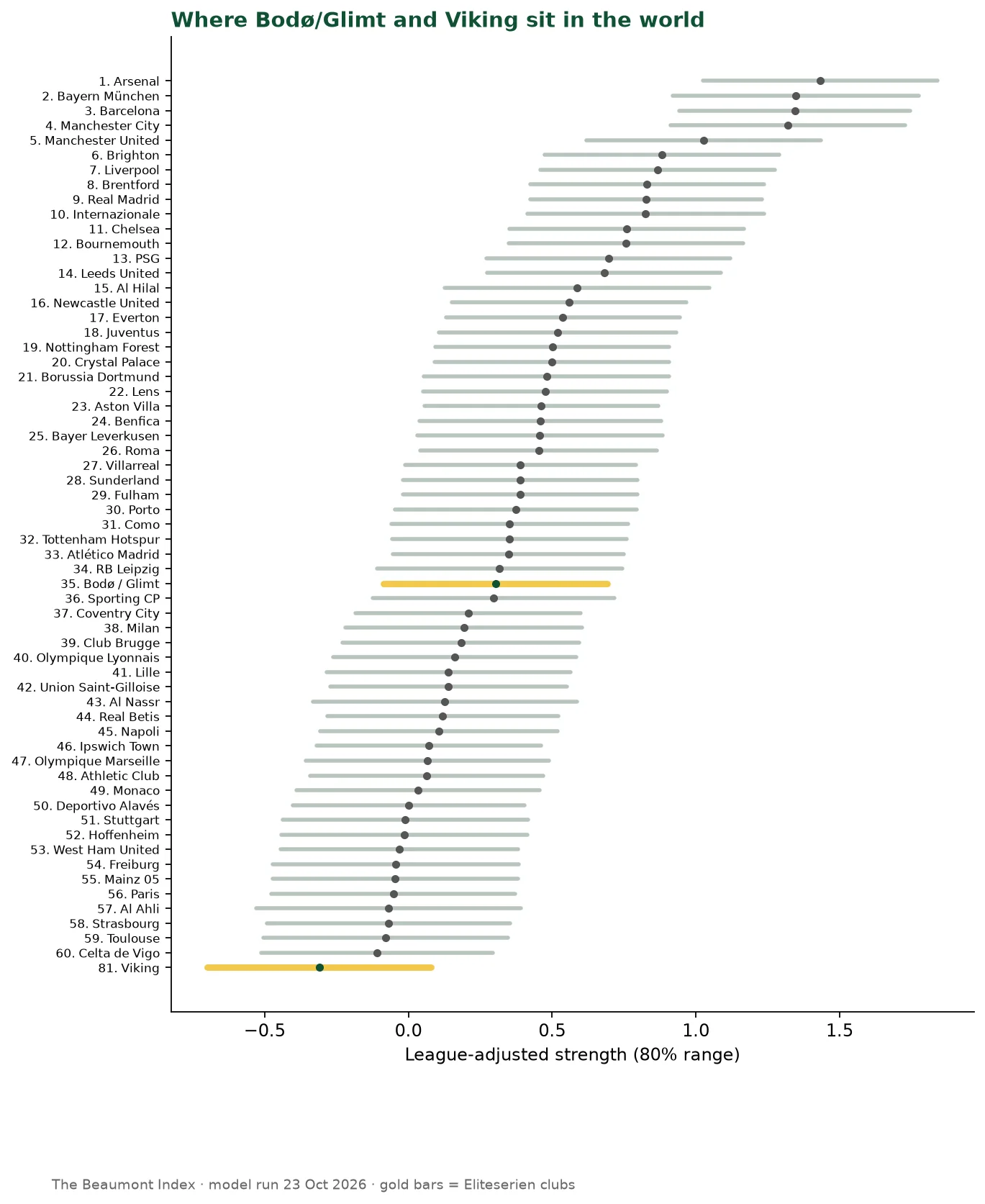
The short answerComo beat Lens 9–1 away in the Champions League on Wednesday night and wrote themselves into the record books. On our ratings, that result did not come from two clubs living in different worlds. In our latest full model run, Como sit 28th in the world at about +0.91 goals per 90 against an average top-five-league club. Lens sit 35th at about +0.72. The gap between them is roughly two-tenths of a goal a game. That is a small edge, the size of the gap between two neighbouring clubs in the same half of a strong league table. An eight-goal margin is what happens when a small edge meets a night in which one side controls the centre of the pitch and the other stops tracking runners. The scoreline is historic. The underlying gap was ordinary.
That is the reading that survives the noise. Everything else about the night — debutants, hat-tricks, record margins, a newly promoted Italian side dismantling a Ligue 1 club in its own ground — is true and worth stating carefully. None of it requires you to believe that Como are suddenly eight goals better than Lens, or that Lens are suddenly a bad club. One performance scale explains more than the scoreboard does.
What happened
The match was played at the Stade Bollaert-Delelis on Matchday 4 of the league phase. Como led after seven minutes. From a short corner, Máximo Perrone headed the ball down and Anastasios Douvikas finished from close range. Lens had moments of their own after that — a header over the bar, shots that forced saves — but they never settled a defensive shape that could live with Como's central combinations.
The second goal, in the 32nd minute, was open play and a low cross. Álex Valle delivered from the left; the goalkeeper missed it; Douvikas scored again. Eight minutes later Nico Paz finished a give-and-go with Douvikas through the middle of the pitch, and the half ended 0–3. The pattern was already clear: Como overloaded the centre, Lens watched the ball, and runners arrived unmarked.
The second half opened the same way. Lucas da Cunha made it 0–4 in the 47th minute from a Paz through ball on the transition. Marc-Oliver Kempf, unmarked after a set piece, headed the fifth from a Jesús Rodríguez Milla cross around the 53rd minute. Douvikas completed his hat-trick in the 57th minute from another Paz through ball into a central gap. Mattia Liberali made it 0–7 in the 62nd minute from a Ramón cutback that nobody tracked.
Lens finally scored in the 65th minute. Ruben Aguilar volleyed from outside the box after a Florian Thauvin involvement — a clean strike and the only answer Bollaert got all night. Como replied almost immediately. Martin Baturina made it 1–8 in the 69th minute from a Liberali pass. In stoppage time, 18-year-old Matteo Papaccioli, on for his European debut, finished a counter from another Liberali through ball to make it 1–9.
Seven different Como players scored. Douvikas had three. Paz had a goal and created several of the others. The substitutes kept attacking. The night was not a sequence of lucky deflections. It was a side that kept finding the same spaces.
Two clubs on one scale
The Index rates every club as goal difference per 90 minutes against an average club from Europe's top five leagues. Zero means a typical Premier League, LaLiga, Bundesliga, Serie A or Ligue 1 side.
Como, in our latest full run, sit at about +0.91. That is a strong big-five club: not quite European elite, but well above average, and fourth in Serie A on our numbers at the time of that run. Lens sit at about +0.72 — also a strong big-five club, second in Ligue 1 on the same run, and only a little behind Como once you put both on the same scale. The gap is about 0.19 goals per 90. On a neutral pitch we would expect Como to be slight favourites, not favourites by a landslide.
Both ratings come with wide ranges. Como's plausible world rank in that run ran from about 11th to about 44th. Lens's ran from about 17th to about 59th. The ranges overlap heavily. Either club could reasonably be the better one on a given month. We lean towards Como, and only slightly.
That is the first thing the scoreboard hides. A 9–1 looks like a mismatch between tiers. Our numbers say it was a mismatch between performances on a night, not between clubs on a season.
The ratings are also stale relative to Wednesday. The run sits on roughly eight domestic games a side and does not yet include this Champions League match, or the other league-phase games around it. When we next refresh, Como's rating will almost certainly rise and Lens's will almost certainly fall. Even then, an eight-goal swing in a single rating update would be extraordinary. The honest prior, going into the night, was a close game with a small away edge for Como — not a rout.
Why the margin ran away
A small ratings gap can still produce a large scoreline when one side's structural problems meet the other side's strengths. That is what the footage shows.
Como's game under Cesc Fàbregas is built through the middle. Paz sits as the creative hub: receiving between the lines, playing give-and-gos, and slipping through balls into the same central channels. Douvikas attacks those channels. Da Cunha and the wide players arrive late. When Lens's midfield line dropped or ball-watched, the pitch opened into the kind of game Paz wants to play.
Lens's problems were the ones coaches hate most because they are simple. Players watched the ball instead of the runner. Offside traps were disjointed. On the 32nd-minute goal the goalkeeper and the defence were both beaten by a low cross that should have been routine. On the set-piece goals — Douvikas from the short corner, Kempf unmarked at the far side — marking assignments dissolved. On the later open-play goals, cutbacks and through balls found teammates who had not been tracked from midfield.
None of that requires a conspiracy theory about Lens as a club. Good sides have nights like this when the opponent is clinical and the structure breaks. Bad nights look worse when the opponent keeps scoring rather than managing the game. Como did not manage the game. The substitutes, Liberali and Papaccioli, kept running in behind. That is a coaching choice as much as a finishing one, and it is why the scoreline reached nine rather than stopping at five.
The Lens reply, Aguilar's volley, was the one moment that looked like a different match. It changed nothing about the pattern around it.
What the records actually say
The records are real and should be stated with the right labels.
UEFA's own round-up lists Como's 9–1 as the biggest away win in Champions League history and as an eight-goal margin that equals the competition's overall record winning margin, matching Liverpool's 8–0 against Beşiktaş in 2007 and Real Madrid's 8–0 against Malmö in 2015. Como are also only the second side to score nine in a Champions League match, after Bayern Munich's 9–2 against Dinamo Zagreb in 2024. AP reported the same core fact from Lens: Como became the first away team to score nine in a Champions League game. beIN and ANSA carried the joint-biggest-margin and biggest-away-win framing on the night.
Those are competition records about a single match. They are not a verdict on Como's long-run level, and they are not a verdict that Lens belong in a lower tier. Record margins usually involve a strong side meeting a side having a collapse. The ratings say Como were the strong side by a little. The footage says Lens had the collapse.
Douvikas's hat-trick took him to six Champions League goals for the season and, on UEFA's count after Matchday 4, to the top of the scoring chart. That is a useful supporting detail. It is not the story. The story is a newly ambitious Italian club, in its first Champions League campaign, playing a coherent central game against a Ligue 1 side that could not hold a line.
Newly promoted, not newly invented
Como's path into this competition is part of why the night feels shocking. This is their first Champions League season. Fàbregas has built a side that already sits in the upper half of Serie A and has taken the league phase seriously from the first matchday. After four games they have nine points, 19 goals scored and a goal difference of +13, which put them fourth in the 36-team table overnight — inside the band that would go straight into the round of 16 if the phase ended now. Lens sit on three points, 33rd, with a goal difference of −12.
That table gap will get more attention than it deserves. Four games is still a small sample. Como's underlying domestic numbers before this week already said they were a top-half Serie A side with a rating in the world top 30. The Champions League results are catching up with that picture faster than most people expected, and Wednesday accelerated the catch-up violently. Lens's European numbers are running well behind the domestic rating we still hold for them. That is a warning for Lens, not yet a rewriting of who they are.
The useful comparison is not "Serie A surprise versus Ligue 1 mid-table." On our scale Lens were never mid-table. They were a solid Ligue 1 side rated close to Como. The useful comparison is "two clubs within a fifth of a goal of each other, one of which played with structure and one of which did not."
What a night like this can and cannot tell you
One match moves ratings only a little. It moves narratives a lot. The risk, for readers and for us, is mixing those two up.
What Wednesday can tell you: Como's attacking combinations through Paz and Douvikas are real in this competition, not a domestic mirage. Their bench is willing to keep scoring rather than close the game. Lens have a defensive-structure problem that was visible in the highlights package without needing a full tactical film: ball-watching, broken traps, unmarked runners at set pieces and in open play. Fàbregas's side is comfortable playing on the front foot away from home against a crowd that stayed loud long after the contest was over.
What Wednesday cannot tell you: that Como are now a top-ten side in Europe, or that Lens are a bottom-ten side in the league phase for the rest of the winter. Single-game goal difference is one of the noisiest signals in football. An eight-goal margin contains a large dose of opponent collapse. Our prior gap of about 0.19 goals per 90 remains the better guide to the next meeting between clubs of this type, until a full ratings refresh says otherwise.
There is also a selection effect. Record wins get written about. The quieter nights on which Como control a game 2–0, or Lens grind a 1–0, will look less important and will matter more for where both clubs sit in March.
What we think
Put the night back on one scale and it becomes clearer.
Como deserved to win, and deserved to win comfortably, on what the footage shows. They did not become a different species of club between October and November. They played like a +0.9 side against a +0.7 side that defended like a much worse one for an evening. The historic labels are earned. The inference that the Champions League has a new superpower, or that Ligue 1's European floor has fallen through, is not.
For Como the next tests are the ones that do not end 9–1. Maintaining a top-eight place in the league phase will take results against sides that do not leave runners free. Their home game against AEK Athens later this month is the kind of fixture a 28th-ranked club should usually win. The harder evenings will say more than Bollaert did.
For Lens the job is narrower and more urgent. The domestic rating we still hold for them says they are better than this European run. Getting back to that level starts with basic defensive jobs: track the runner, hold the trap, deal with the cutback. Aguilar's volley showed they can still produce a moment. Moments are not a structure.
The scoreboard said eight goals. The Index said two-tenths. On nights like this, believe the Index for the clubs, and believe the footage for the performance. Both can be true at once. That is the point of putting everyone on one scale.
FAQ
Was Como really eight goals better than Lens?
No. On the Beaumont Index the clubs were only about 0.19 goals per 90 apart (Como about +0.91, Lens about +0.72). The 9–1 was a performance-scale night, not an eight-goal quality gap.
Where do Como and Lens rank on the Index?
In our latest full model run Como were 28th in the world and Lens 35th, both strong big-five clubs, with heavily overlapping 80% ranges.
Is 9–1 a Champions League record?
UEFA listed it as the biggest away win in Champions League history and an eight-goal margin matching the competition record. Como are only the second side to score nine in a Champions League match.
Does this rewrite Lens as a weak European side?
Not on our numbers. Lens were a solid Ligue 1 side (second in the league on that run). One collapse does not move them into a lower tier until a full ratings refresh says so.