The short answerAlex Scott’s 2025-26 Premier League season ranks in the top fifth of midfielders for defensive actions and interceptions. Lamine Camara posts a similar ball-winning profile in Ligue 1 at a lower reported fee. Bournemouth’s own rating (1721, 16th in the world) and +28 opponent adjustment help explain a £100m ask; Camara is the value alternative with more adaptation risk.
Liverpool are reported to be weighing a midfield addition, with Bournemouth’s Alex Scott and Monaco’s Lamine Camara the two names most often paired. Separate reports from Germany and from Fabrizio Romano put both on Liverpool’s shortlist for a central midfielder who can start, not just cover. Scott is also linked with Chelsea, with fees around the £90m to £100m mark floated for the England international. Camara was close to Chelsea on deadline day before that deal collapsed, and is discussed at a lower fee. Nothing is agreed. The Index question is simpler than the rumour mill: what does roughly £100m buy, and which profile actually fits?
Transfer windows invent false binaries. Scott or Camara is useful as a comparison of profiles, not as a claim that Liverpool must pick one of these two men by Friday. Plenty of other midfielders will enter the conversation. The reason these two are worth a full Index piece now is that the reporting has converged, the fee talk for Scott has reached nine figures, and Bournemouth’s own numbers make that fee intelligible rather than absurd.
Start with the club Scott would leave. Bournemouth are not a selling club in distress. They are rated 1721, 16th in the world and eighth in the Premier League on our scale. Their opponent adjustment this week is +28 rating points — one of the biggest lifts in the division — even though their schedule ranks only 15th of 20 for toughness. Results have been unkind: they are -4.9 points behind what their football deserved. Paying nine figures for their midfielder is a tax on how good the side around him has been underneath the table.
Alex Scott: Premier League-ready ball-winner
Scott is 23, right-footed, on a contract to June 2028. In 2025-26 he played 3,143 Premier League minutes across 37 games. Among the league’s central midfielders he ranked in the 82nd percentile for successful defensive actions (8.13 per 90), the 86th for interceptions and the 72nd for duels won. He is not a high-volume creator: expected assists sat around the median. He is a midfielder who wins the ball and keeps the side facing the right way.
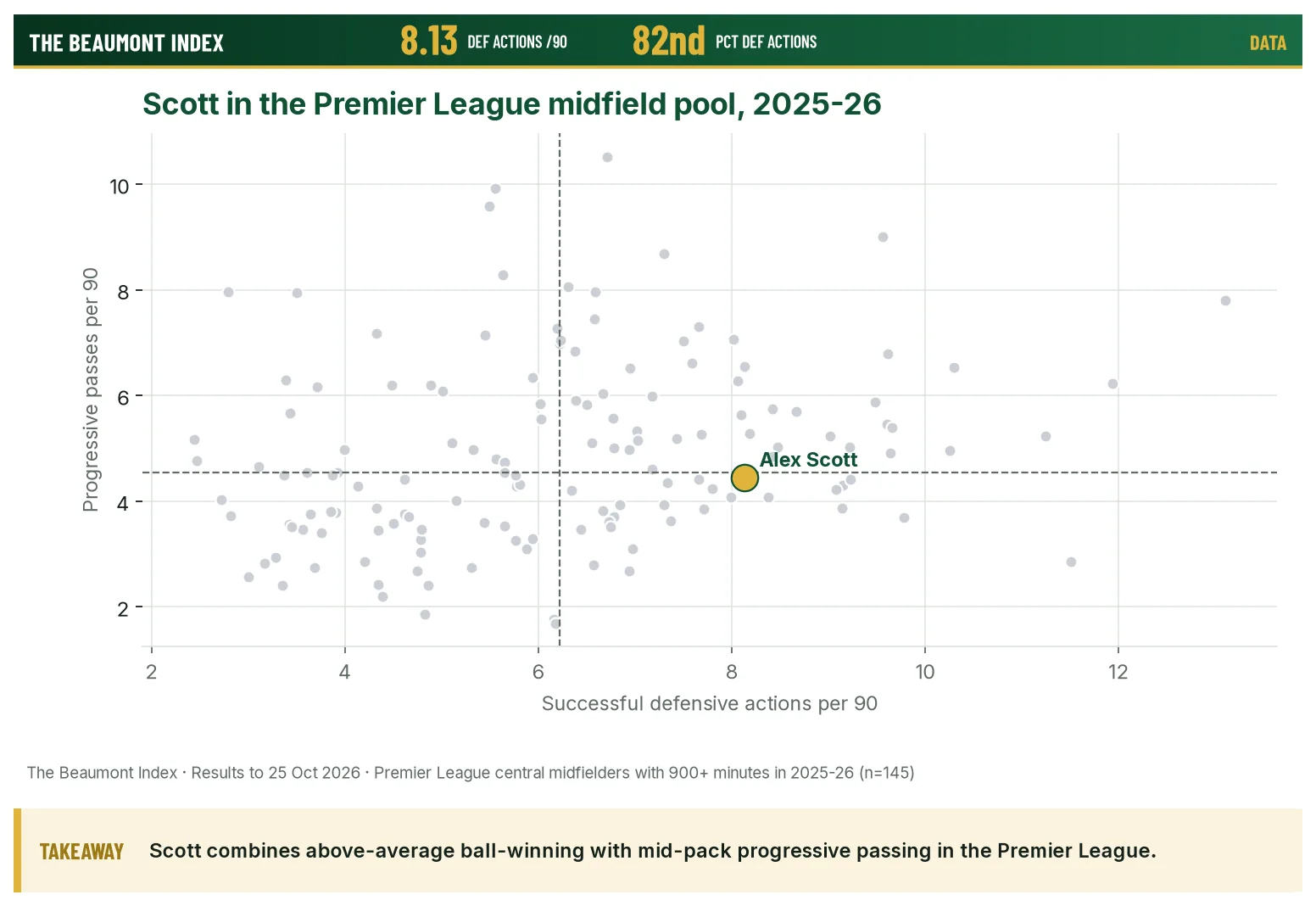
This season’s sample is small, 599 minutes over seven games, so we hold it loosely. The early signals are stronger, not weaker: he is in the 90th percentile for duels won and the 70th for progressive runs among Premier League midfielders with 270 minutes. He already knows Andoni Iraola’s pressing rules from Bournemouth. That is the premium. You are not buying adaptation time. You are buying a player who has already done the job in this league for a coach who is now at Anfield.
Lamine Camara: the value case
Camara is 22, on a contract to June 2029 at Monaco. In 2025-26 he played 2,033 Ligue 1 minutes. He ranked in the 85th percentile for defensive actions, the 89th for interceptions and the 78th for duels won in the French midfield pool. He also created more than Scott: expected assists in the 81st percentile. Progressive runs were a relative weakness.
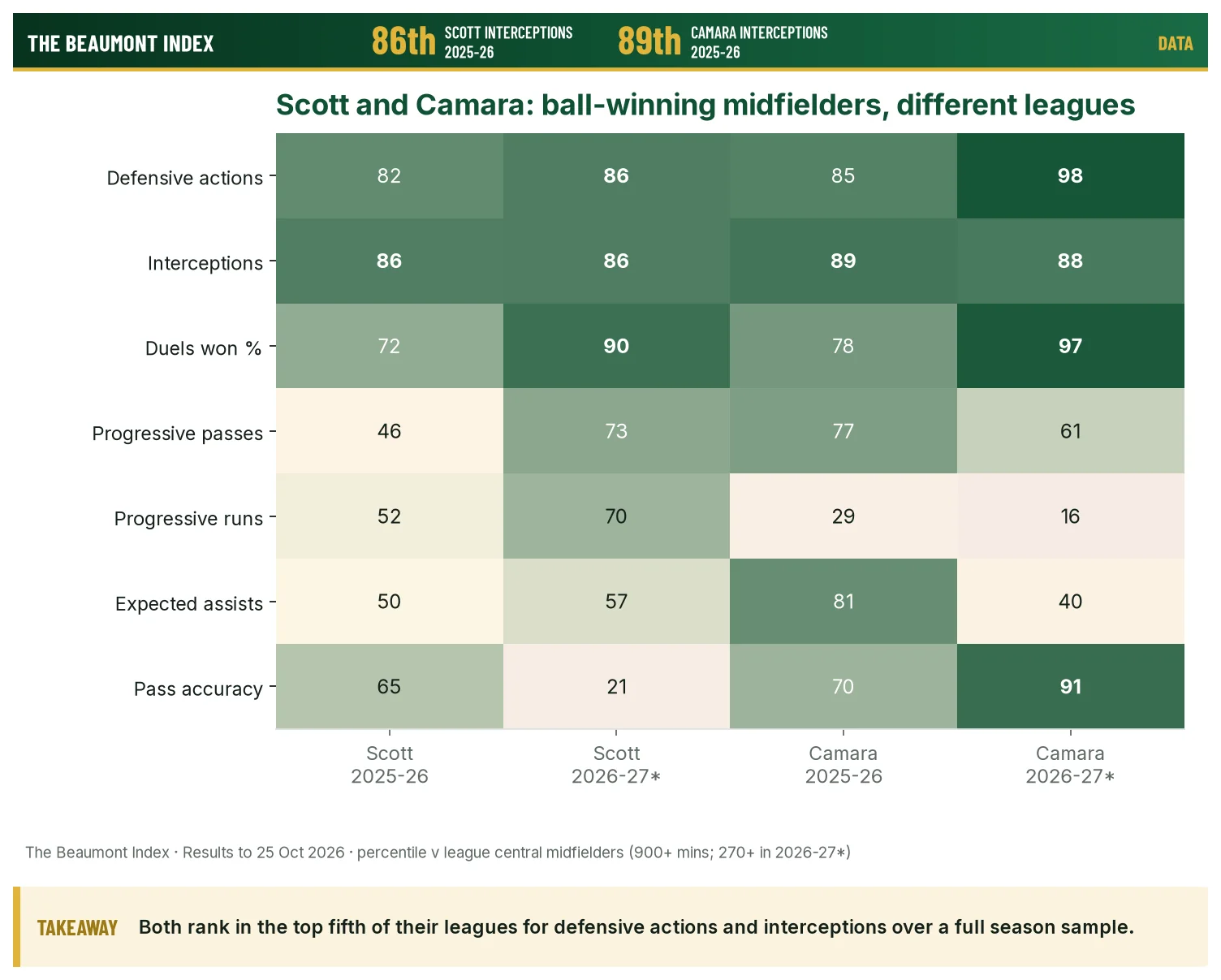
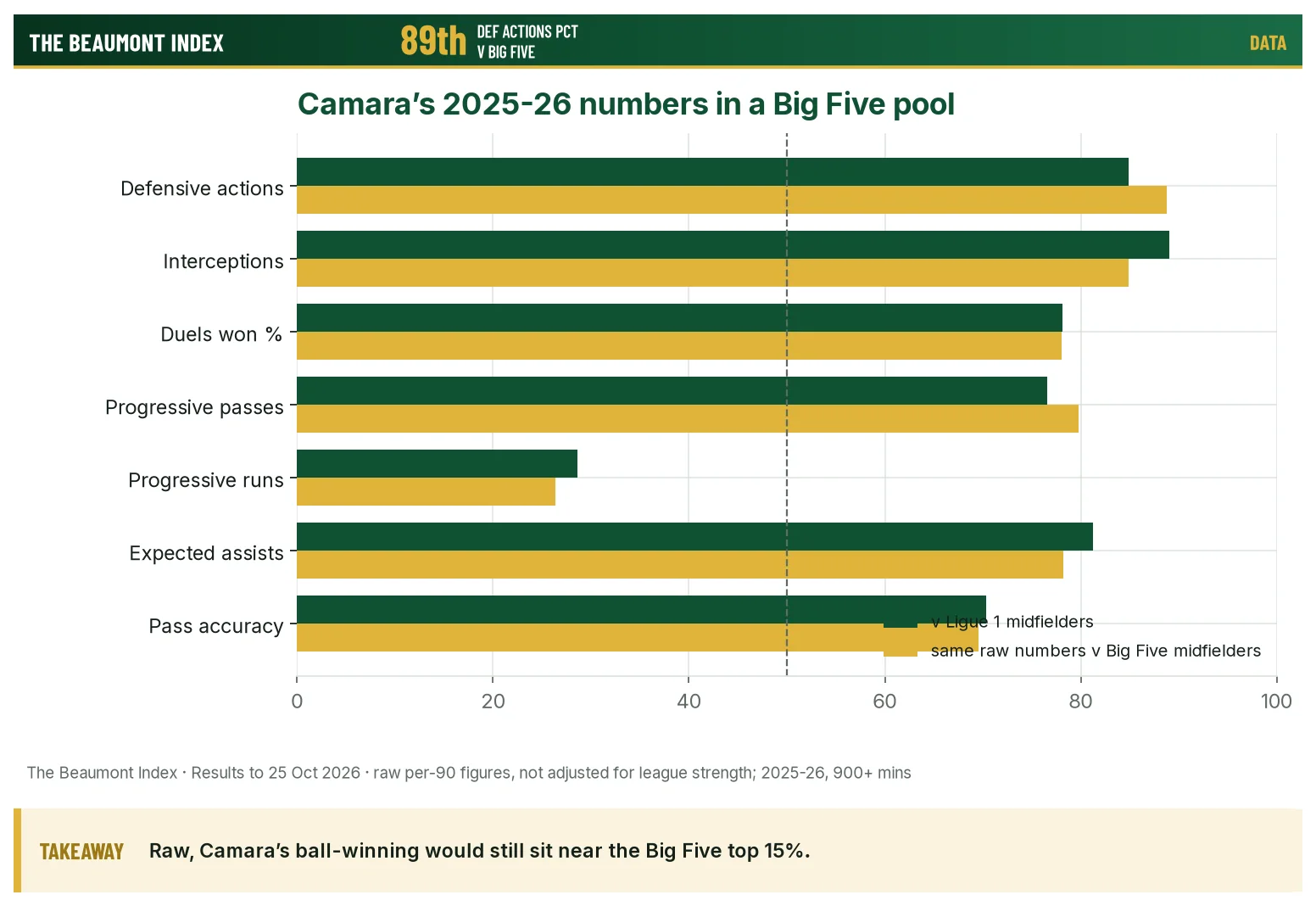
The step-up test is the useful one. Place Camara’s raw 2025-26 per-90 numbers in a pool of every central midfielder with 900 minutes in Europe’s top five leagues and he still sits in the 89th percentile for defensive actions and the 85th for interceptions. Those raw numbers would not survive the move unchanged. They do say he starts from a high base. This season at Monaco, in 683 minutes, his duel-winning and defensive actions look even stronger in the Ligue 1 pool, with progressive running still quiet.
This season’s sample is small, 599 minutes over seven games, so we hold it loosely.
What £100m is actually buying
Price is not a rating, but it forces a comparison. Reports put Scott in the £90m to £100m conversation. Camara’s collapsed Chelsea deal was reported around half that. On our club ratings, Bournemouth (1721) are a stronger environment than Monaco (1646), and Scott has already proved himself in the Premier League under the coach Liverpool now employ. That is why the market asks for nine figures. Whether the football premium matches the fee is the open question.
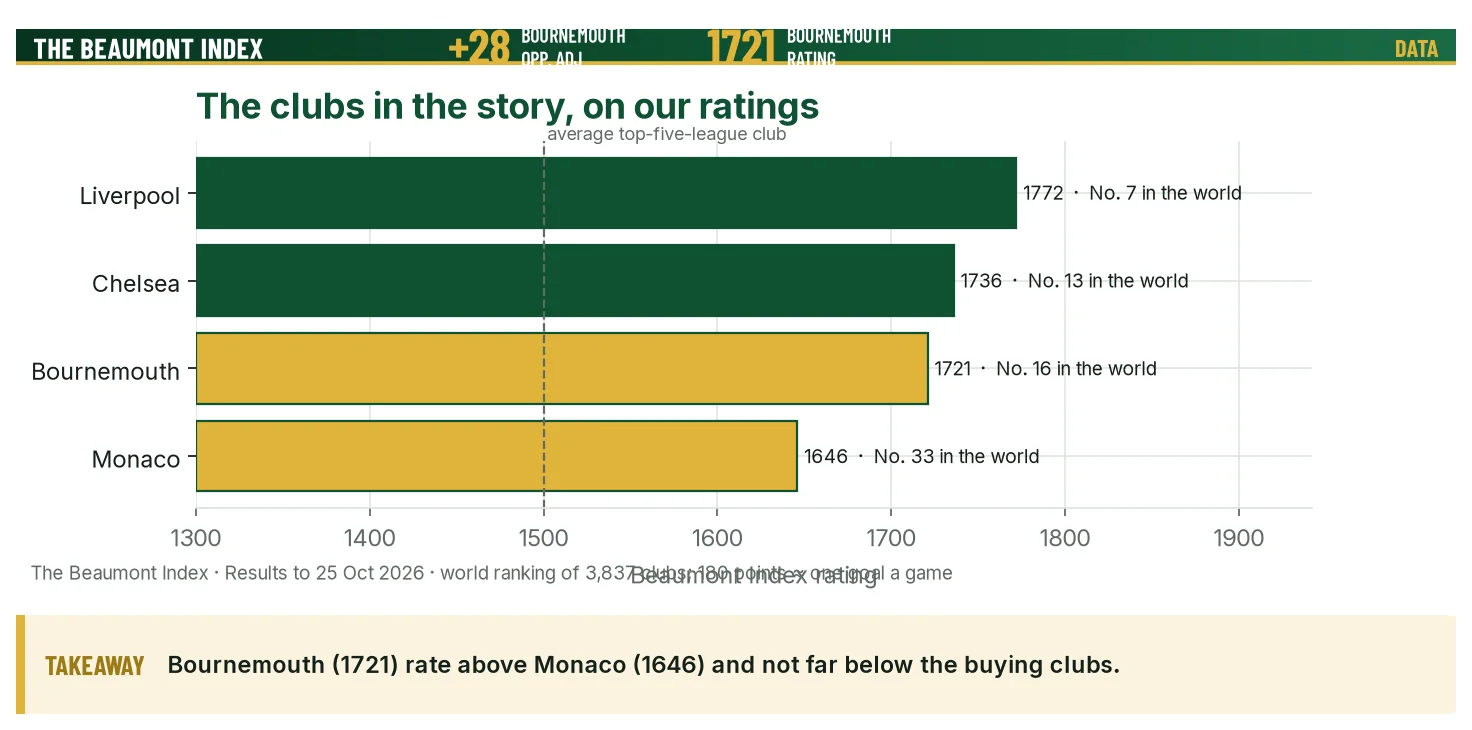
Liverpool, at 1772, do not need a project. They need a midfielder who can press, win duels and let Mac Allister or Gravenberch play. Scott maps onto that job with less translation risk. Camara maps onto a similar defensive profile at a lower reported cost, with more adaptation risk and a little more chance creation. Chelsea’s reported interest in Scott, and their burnt fingers on Camara, are part of the market noise. They do not change the profiles.
How the reports line up
Florian Plettenberg has named Scott and Camara as Liverpool’s leading central-midfield targets, with Felix Nmecha of Dortmund admired but not prioritised. Fabrizio Romano has separately described Liverpool tracking both players and planning a serious midfield addition for 2027, possibly as early as January if the right deal appears. Chelsea’s reported verbal progress on Scott’s personal terms, and their anger over the collapsed Camara deal in the summer, sit in the same news cycle. Two independent reporting lines put both players in Liverpool’s thoughts. That is the press bar. It is not a signing.
The Index does not broker deals. It can say what the football profiles are. Scott is the high-certainty Premier League press midfielder. Camara is the high-upside Ligue 1 destroyer with a bit more chance creation and a lower reported fee. Bournemouth’s level on our scale — and the +28 opponent-adjustment lift — is the hidden character in the Scott story: you are not prising a midfielder out of a struggling side. You are prising one out of a club whose football has been better than its points.
Iraola’s fingerprint matters more for Scott than for almost any other target. A player who has already pressed, covered and carried in that structure arrives with less of the usual six-month tax. That is worth money. Whether it is worth the thick end of £100m is a club decision about wage shape, squad age and alternative uses of the fee. Our job is to show that the premium is about club context as much as about the midfielder.
The verdict
Scott is the fit. Camara is the value. £100m is the Bournemouth tax. If Liverpool want the midfielder who already speaks Iraola’s language and has a full Premier League season of top-fifth ball-winning, Scott is the cleaner answer, and the fee reflects Bournemouth’s own level as much as the player. If they want a younger, cheaper version of the same defensive engine and will accept a season of adaptation, Camara is the rational alternative. Paying nine figures only makes sense if the coaching continuity is the point of the deal.
None of this is a transfer prediction. Fees move and January windows invent their own logic. The Index contribution is narrower: if Liverpool spend near £100m on a central midfielder this cycle, the Bournemouth context explains why Scott can command that money, and Camara’s Ligue 1 profile explains why a lower fee for a different skill mix remains a coherent alternative. We will revisit both when the next builds land.
What would change our mind? If Scott’s duel and interception numbers fall out of the top third over a full half-season, the premium shrinks. If Camara’s progressive running stays in the bottom fifth after a move, he becomes a pure destroyer and needs a different partner. Until then, the Index reads this as a choice between certainty with a markup and upside with a discount, not a choice between good and bad midfielders.
FAQ
Are Liverpool signing Alex Scott or Lamine Camara?
Nothing is agreed. Separate reports name both on Liverpool's midfield shortlist. Scott is also linked with Chelsea. We analyse the players, not the deal.
Why would Alex Scott cost around £100m?
Reported asking territory sits around £90m to £100m. Bournemouth are a strong Premier League side on our ratings whose football has been better than its points, so any buyer is paying for a starter at a club that does not need to sell.
How do Scott and Camara compare?
Both are young, right-footed ball-winning midfielders. Scott has a full Premier League season and already knows Iraola's system. Camara posts similar defensive numbers in Ligue 1 and creates a little more, at a lower reported fee.