The short answerManchester City lead Brighton by five points going into Saturday's game at the Etihad, but on the Beaumont Index the gap in underlying performance is about one point. City have the largest surplus of points over expected points in the Premier League. Brighton have the league's best goal difference, are ninth in the world on our ratings, and are rising faster than any club in the top eight. This is not top v third. It is two sides much closer than the table says, meeting three days after Brighton were the better team and lost on penalties.
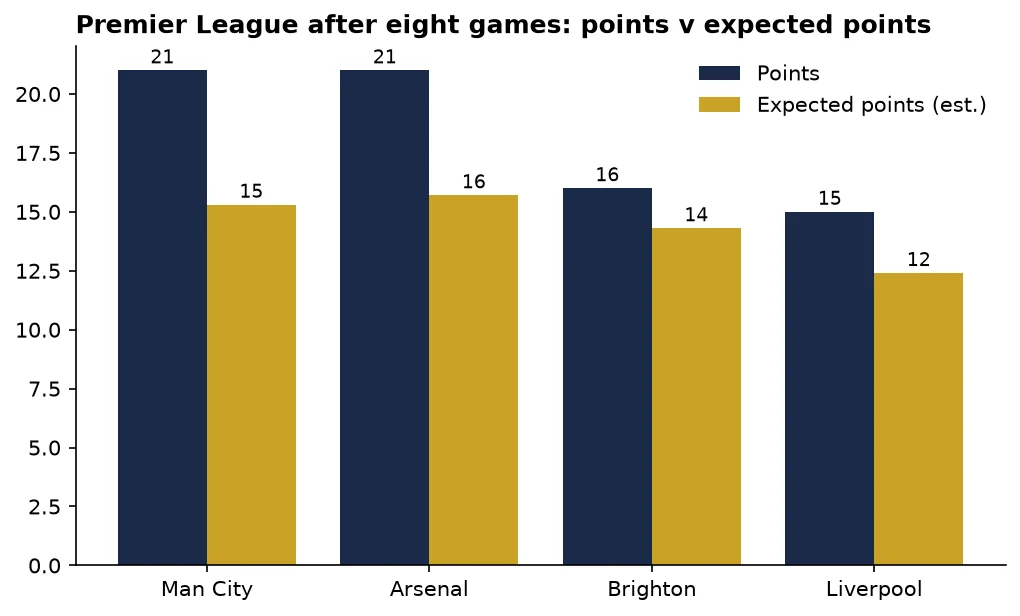
Most previews will frame Saturday as the leaders seeing off a challenger for the second time in a week. City beat Brighton 4-3 on penalties in the Carabao Cup on Wednesday after a 2-2 draw, and they sit top on 21 points, level with Arsenal and five clear of Brighton. Read the table and it looks like a gap. Read the numbers underneath and it mostly disappears.
What the table hides
After eight Premier League games, City had 21 points: seven wins and one defeat, the 2-1 loss at Aston Villa last weekend. Their chances for and against, measured shot by shot, were worth about 15 points. That surplus of nearly six points is the biggest in the league, just ahead of Arsenal's. On our model, City have been very good and somewhat fortunate.
Brighton had 16 points from chances worth about 14. That is a surplus of under two points, inside the range we treat as normal. So the five-point gap in the table becomes roughly a one-point gap in expected points: 15.3 against 14.3.
The goal difference column points the same way. Brighton have scored 23 and conceded seven, a goal difference of +16 that is the best in the Premier League. City are on +11 and Arsenal on +8. Brighton have the league's most prolific attack, and only Arsenal and Leeds have conceded fewer.
None of that makes Brighton the better side. Our ratings still have City ahead. But it does make Saturday a much closer contest than the standings suggest.
How the ratings compare
On our opponent-adjusted world ranking, City are fourth in the world and second in the Premier League, behind Arsenal. Brighton are ninth in the world and fourth in the league, effectively level with Liverpool. The gap between City and Brighton is about 84 rating points, a little under half a goal per 90 minutes on a neutral pitch.
The direction of travel is the interesting part. Our ratings track a trend, the change in a team's underlying level over recent months. City's is steady. Brighton's is rising by more than half a goal per 90 minutes, the steepest climb of any club in the Premier League's top eight. Among all 20 clubs only Hull City, the promoted side, have risen faster, and they started from much lower.
On our opponent-adjusted world ranking, City are fourth in the world and second in the Premier League, behind Arsenal.
Put plainly: City are the better team today, but Brighton are the team closing the gap fastest.
Two very different squads
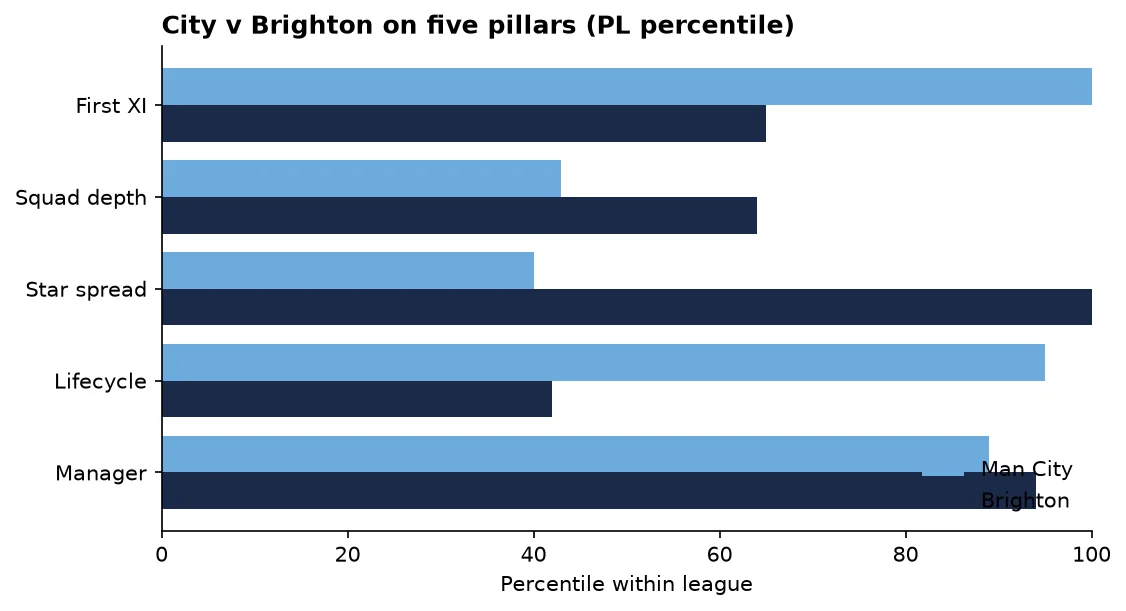
Our pillars break each club's strength into parts, ranked against the rest of the league.
City are what you would expect. Their first XI is in the 100th percentile in the Premier League: the strongest starting team in the division on our measure. Their lifecycle pillar, which reflects squad age and where key players are in their careers, is in the 95th percentile, and their manager pillar in the 89th. The soft spots are squad depth, in the 43rd percentile, and star spread, in the 40th. City's quality is concentrated in a strong core rather than spread through the squad.
Brighton look like the opposite. Their first XI is in the 65th percentile, solid rather than elite. But star spread, how widely quality is distributed through the squad, is in the 100th percentile, the best in the league. Depth is in the 64th, and the manager pillar is in the 94th, higher than City's. Brighton win by having many good players and a coach who gets more from them than the squad's raw quality suggests.
That contrast shows up in the style data. City rank near the top of the league for dribbling, at nearly three standard deviations above the Premier League average, and for possession and deep completions, passes that arrive within striking range of goal. Brighton's profile does not stand out on any single measure. Their strength is collective.
What happened on Wednesday
Wednesday's cup tie was a useful preview, with caveats. Both managers rotated heavily. City rested several key players; Brighton made changes too. Brighton led twice, through Malick Yalcouyé and Georginio Rutter, and City came back both times, through Mateo Kovacic and a deflected free-kick from Rayan Cherki that went in off Vitor Reis. City won the shootout 4-3, with Gerónimo Rulli saving from Yasin Ayari and Lewis Dunk.
Several reports judged Brighton the better side for most of the game. Fabian Hürzeler said afterwards that his team had enough chances to win and that City had luck on their side, and that Saturday was a chance for revenge. We do not have match-level expected-goals data for the cup game in our current run, so we will not put a number on it. But the pattern fits the league data: Brighton creating plenty, City's results running ahead of the chances.
The Arsenal comparison
It helps to put City next to the other club on 21 points. Arsenal, the champions, are top of our world ranking, ahead of City by about 54 rating points, or three-tenths of a goal per game. Like City, they have run ahead of their chances: 21 points from about 16 expected after eight games. Both clubs at the top of the Premier League are winning more than their football would usually earn.
That is not unusual early in a season. The best teams often convert close games at a higher rate than average, partly through finishing quality and goalkeeping that the shot data cannot fully capture. But it does mean the top two are less far clear than the table suggests. On expected points, the gap from first to third is under one and a half points, and Brighton are closer to both leaders than the table implies.
The difference between City and Arsenal on the trend measure is also worth noting. Arsenal's rating is falling slightly, City's is steady, and Brighton's is rising quickly. If those trends continue, the gap at the top on performance will narrow over the next month, whatever the table does.
What Saturday decides
The table stakes are straightforward. A City win would put them eight points clear of Brighton and keep them level with or ahead of Arsenal, who visit Liverpool on Sunday. A Brighton win would cut the gap to two points and put them within touching distance of the top two.
The more interesting stakes are what the result does to the narrative. If City win, it will be read as the leaders putting a challenger in its place. On our numbers, that would be a sensible result, but not a decisive one: a team with a one-point expected gap does not stop being close because of one game. If Brighton win, the table will start to look like the ratings, and the title race will suddenly have a third name in it.
Team news matters. City are expected to restore the players rested on Wednesday, including captain Rúben Dias, Joško Gvardiol and Erling Haaland. Brighton have a longer injury list, with Kaoru Mitoma, Evan Ferguson and Pascal Struijk among the players out. Given Brighton's strength is depth and spread, they are better placed to absorb absences than most sides, but losing Mitoma removes one of their most direct threats.
How the game tends to go on these numbers
City are at home and stronger on our ratings, so they are favourites. The gap of a little under half a goal per 90 minutes, plus home advantage, makes them the side more likely to win, but a draw or Brighton win would not be a surprise.
City's dribbling and possession mean they will probably have more of the ball. Brighton's route is through the quality of their chances: they have scored more than anyone in the league without needing to dominate possession. City have also been more open than usual recently, conceding twice at Villa Park and twice again on Wednesday. If Brighton get into the box, they have shown on Wednesday that they can hurt City.
Why this matters beyond the Premier League
The Beaumont Index puts every club in the world on one scale. On that scale, three of the world's top ten are Premier League clubs: Arsenal first, City fourth, Brighton ninth. Liverpool are seventh. Brighton's place in that group would have seemed unlikely a few years ago. It is built on recruitment and coaching, the two things our pillars reward most in a club without the resources of the league's biggest spenders.
For anyone looking at the Premier League from abroad, Brighton are a reminder that the table after eight games is a noisy guide. The club in third has better underlying numbers than its points, and the club in first has worse.
What we'll be watching
- City's chance quality against. If Brighton create as much as they did on Wednesday against a full-strength City defence, that tells us their rise is real.
- Brighton's finishing. They have the league's best goal difference. A cold day in front of goal at the Etihad would test whether that number is sustainable.
- Arsenal at Anfield on Sunday. The table at the top could look very different by Sunday evening.
City are top, and deserve to be favourites. But the five-point gap they take into Saturday is mostly luck, and the team chasing them is improving faster than anyone near them.
Figures: club ratings, ranks, expected points, trends and pillars come from the Beaumont Index model, with results to 25 October 2026 (eight Premier League games). Table and cup result as of 30 October 2026. Kick-off: Saturday 31 October, 15:00 UK.
FAQ
Who is the better team on the Beaumont Index, Man City or Brighton?
City, by a little under half a goal per 90 minutes. City are fourth in the world, Brighton ninth.
Are City lucky to be top?
After eight games City had the biggest surplus of points over expected points in the Premier League, close to six points.
How close are City and Brighton really?
On expected points after eight games, about one point apart, compared with five points in the table.
When is Man City v Brighton?
Saturday 31 October 2026, 15:00 UK time, at the Etihad Stadium.