
The short answerReady as a regular starting left-back or left wing-back in the Danish Superliga, the Eredivisie, the Championship or the Belgian Pro League, not as a locked-in Premier League starter. The clubs that make sense on role and depth are Viborg, Heerenveen, Stoke City and Cercle Brugge. None of that is a transfer tip. Brommapojkarna sit outside every multi-club ownership network we can document, so there is no internal pathway.
The afternoon that gave Brommapojkarna a club record almost gave Oliver Zandén a goal, and then it didn't. Grimsta was 0–0 with Mjällby on 8 November, a Sunday in November with two games still to play, and the point took BP to 35, one more than they managed in 2024. SVT Sport and Fotbollskanalen both had him starting at left-back, arriving in the box, and walking away empty. "It feels like I have more goal chances than I have had in my entire career," he told SVT, "so it is just bitter not to get the ball in." That is a good line for a highlights package. It is a better line for a Scout, because it is the season in miniature. The counting column says he has been creating. The chances say he has been arriving. Those are not the same job.
That is the question this piece is built to answer. Not whether a 25-year-old who has already played Ligue 1 can still play football — two seasons as BP's first-choice left-back have settled that — but what kind of next step the numbers actually support, in which role, and for which kind of club.
The short answer
Ready as a regular starting left-back or left wing-back in the Danish Superliga, the Eredivisie, the Championship or the Belgian Pro League, not as a locked-in Premier League starter. He would compete for minutes on the left of a back four, or as the more defensive, progressive option in a back five. The clubs that make sense on role and depth are Viborg, Heerenveen, Stoke City and Cercle Brugge. None of that is a transfer tip. Brommapojkarna sit outside every multi-club ownership network we can document, so there is no internal pathway to lean on. The club announced a "longer contract" when he arrived from Toulouse in January 2025; Swedish reporting, including Fotbolltransfers, has that deal running through the 2027 season. He already had a Ligue 1 chance. Toulouse's own records give him five league appearances, including a start against Paris Saint-Germain. This Scout is about the player he has become since, not a second try at that cameo.
What two Allsvenskan seasons at left-back actually say
The 2026 sample is a proper one. Our 10 November event snapshot, through the Mjällby draw, has him on 28 league appearances and 2,681 minutes — every Allsvenskan round BP have played, at almost 96 minutes a game. Public match reports confirm he started that 8 November game. He has one league goal and five assists. He is 25, left-footed, and 183 cm, a height that matches both the event file and public biographical listings. The position string is the honest one: left-back, and left wing-back when the shape asks for it.
Against Allsvenskan full-backs with 450 or more league minutes — a pool of 47 players, using the primary full-back roles — the 2026 rates have a very clear spine. He wins his defensive duels at a rate better than 89 per cent of that pool, and his overall duel success is better than 98 per cent. Aerial duels won sit in the 92nd percentile. Progressive passes are in the 96th, forward passes in the 92nd, crosses in the 85th. Interceptions are in the 79th. Progressive carrying is ordinary, around the median. And then the split that should stop anyone reading only the assist column: his five assists put him in the 87th percentile for assists per 90, and his expected assists per 90 sit in the 21st.
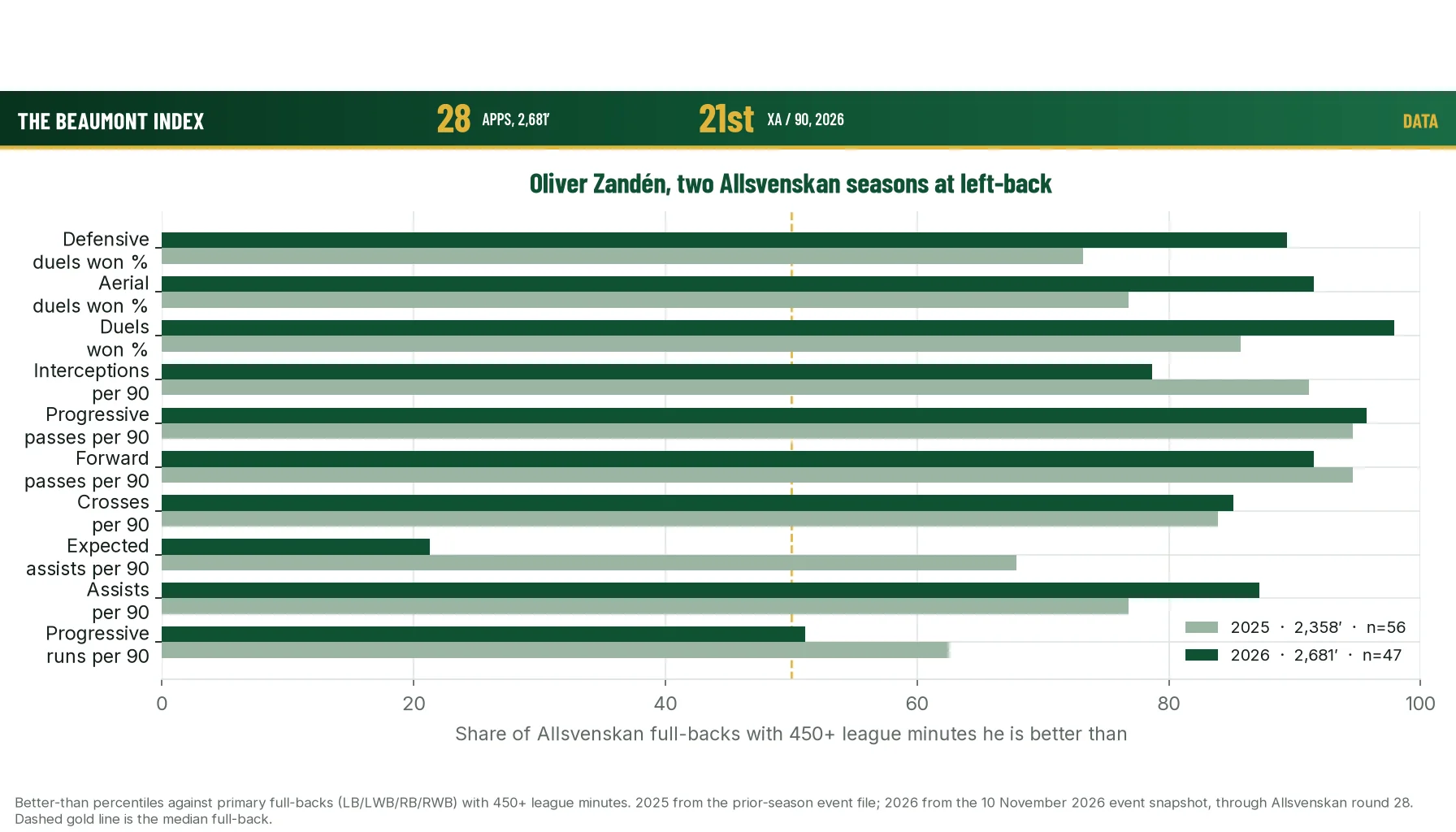
Last season makes the same case with a more honest attacking number. In 2025, his first year back in Sweden, he played 2,358 league minutes in 24 appearances, with three assists. Against that season's full-back pool of 56, his progressive and forward passing were already in the mid-90s, his crossing in the mid-80s, his interceptions in the 91st percentile. Expected assists were in the 68th, and the three assists sat close to the 2.9 the chances said he should have. Defensive duel success was good rather than elite, in the 73rd. Aerial duels were in the 77th.
The 2026 season has not made him a creator. It has made him a harder defender and a slightly more ordinary carrier, while the passing volume has held. Expected assists have fallen from 0.11 per 90 to 0.06. Actual assists have gone the other way, from three to five, on only 1.76 expected. That is the wrong kind of luck to buy. A club that signs the assist column is buying a finishing streak that happened around him. A club that signs the duel-winning and the progressive passing is buying the two-season spine.
The size of the step, and what travels
Honesty starts with the league, not the player. On our league-strength scale — goal difference per 90 against an average club from Europe's top five leagues, ratings built on 10 November, results to 10 November — the Allsvenskan sits at about −1.27. The Danish Superliga and the Eredivisie sit at about −1.01. The Championship is about −0.86. The Belgian Pro League is about −0.65. Ligue 1 is about −0.16. The Premier League is about +0.61. The step from BP's league to Denmark or the Netherlands is about a quarter of a goal a game. To the Championship it is about four-tenths. To Belgium it is about six-tenths. To Ligue 1 it is a little over a goal. To the Premier League it is about 1.9 goals per game. Those are not rounding errors, and they are not all the same jump.
Brommapojkarna themselves are not a soft landing inside that Allsvenskan. They sit 11th after 28 games, on 35 points, and our rating has them about 1.47 below an average Big Five club — a mid-table side, close to their place in the table. He has produced these numbers without the protection of a title-chasing midfield. He has also produced them in a league whose average afternoon is not a rehearsal for Stoke, let alone for a Premier League wide attacker. The useful test is the raw one we can actually run: take his 2026 per-90 rates from the 10 November snapshot and rank them, unchanged, among full-backs with 450 or more minutes in the leagues a step up.
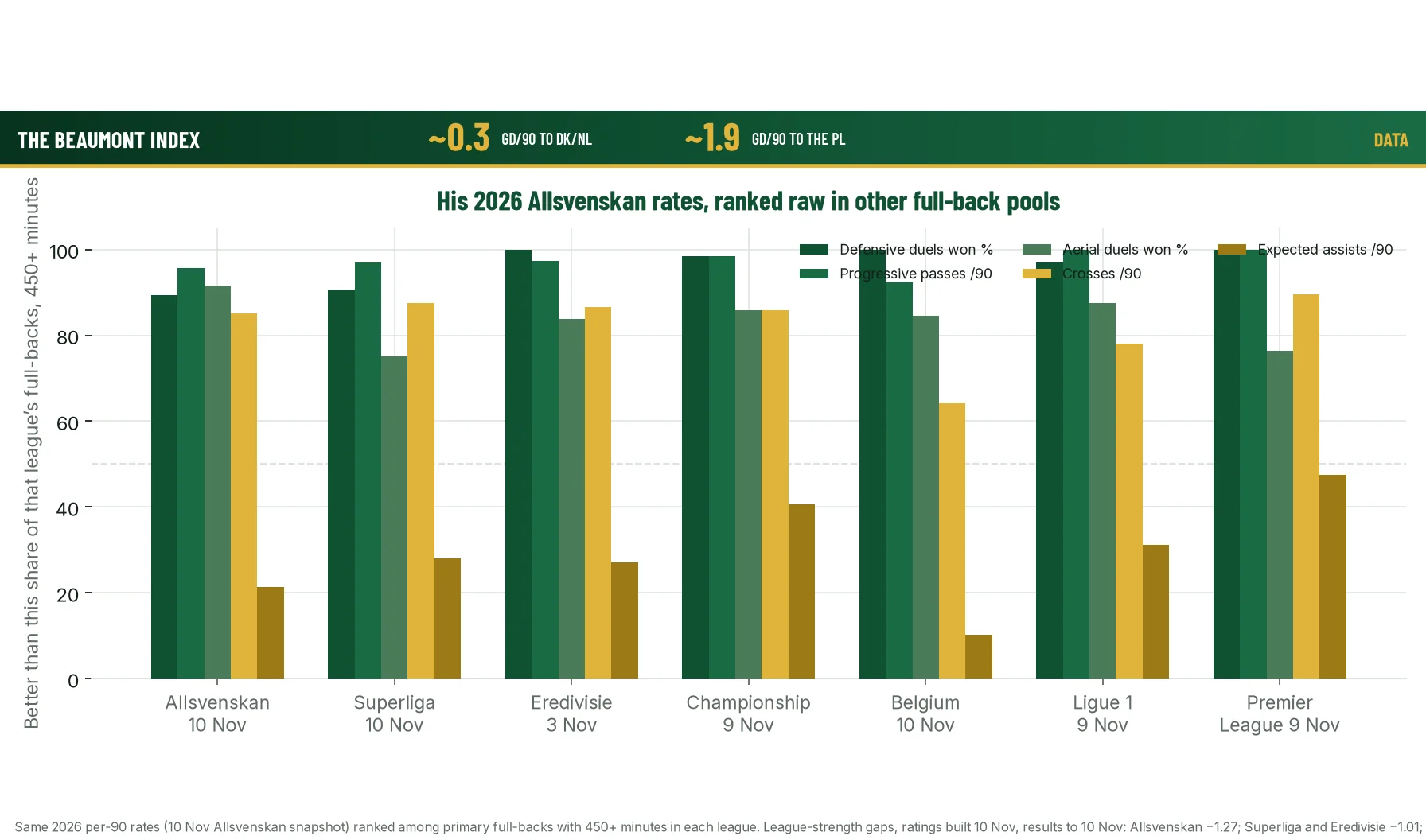
Defensive duel success and progressive passing still sit at the top of those pools. In the Superliga, the Eredivisie, the Championship and the Belgian Pro League, the duel-winning rate ranks between the 91st and 100th percentile. Progressive passes are in the 92nd to 98th. Aerial duels won stay comfortably above the median, between the mid-70s and mid-80s. Crossing volume mostly holds. Expected assists do not. The same 0.06 per 90 sits in the 28th percentile of Superliga full-backs, the 27th in the Eredivisie, the 10th in Belgium, and only climbs towards the middle of the Championship and Premier League pools because those leagues' full-backs do not create at a high rate either.
Read that carefully. It does not mean he cannot pass forward in a bigger league. The passing volume, ranked raw, still looks like a regular left-back in Denmark, the Netherlands, England's second tier or Belgium. It means the thing he is best at — winning the duel and then playing forward — still looks like the job, and the thing the assist column is advertising already looks ordinary before the step. A club that needs a left-back to be its main chance-creator will be disappointed. A club that needs a left-back to be hard to beat, useful in the air, and willing to play forward is looking at the right player.
The same raw ranks, dropped into Ligue 1 and Premier League full-back pools from the 9 November snapshots, are flattering on the defensive and passing metrics and still weak on expected assists. They are also the least honest place to stop. A gap of a goal, or of almost two, is not something a raw percentile can swallow. Those ranks are a starting point, not a forecast of his first season in a top-five league. We will not pretend otherwise. That is why the recommendation below is a regular start in a league a step up, not a locked Premier League role.
Ownership pathway: there isn't one
Before any "where he fits" section, the network check. Brommapojkarna do not appear in any multi-club ownership or formal cooperation group we can document. There is no City Football Group spur, no Red Bull ladder, no Belgian or Dutch sister club waiting with a registration slot. The natural next destination is not an internal one. Any move into Denmark, the Netherlands, England or Belgium would be an open-market negotiation, not a hop along a network. That is worth stating clearly, and then leaving alone. The clubs below are role and minutes fits, not clubs Zandén is on a path toward, and not a list of clubs that have been in touch.
Four clubs where the minutes exist
The rule for this section is strict. No invented fit scores. No implied interest. Just role, reason, and the incumbents he would be competing with for minutes, checked against the event snapshots dated above.
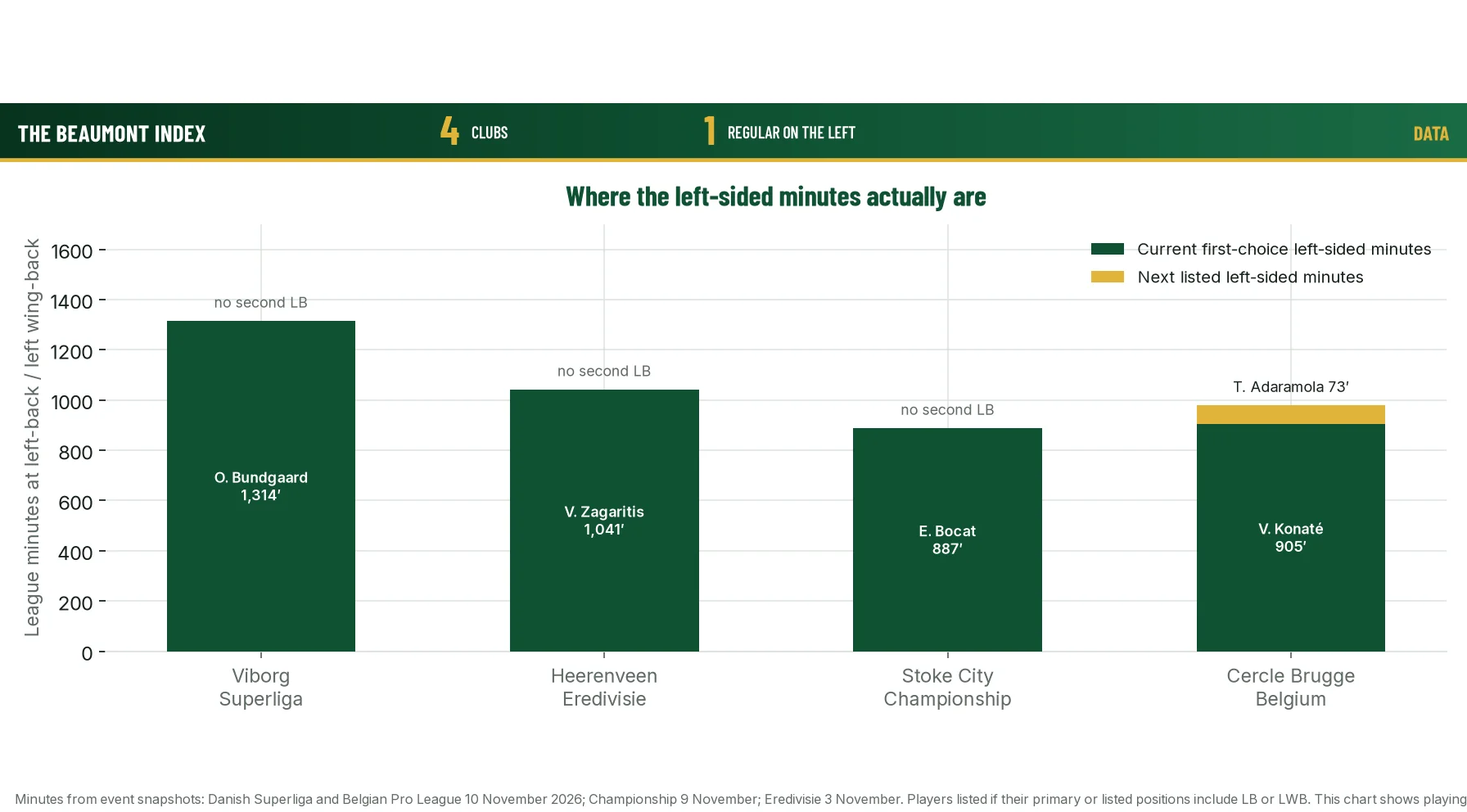
Viborg — regular left-back, Danish Superliga. Oscar Bundgaard has 1,314 league minutes at left-back in the 10 November Superliga snapshot, and there is no second listed left-back with meaningful time. Viborg sit fifth in our ratings after 14 games, about 0.61 below an average Big Five club — a clear step up from BP, in a league only a quarter of a goal stronger than the Allsvenskan. Zandén already knows Danish football: Toulouse loaned him to Randers in January 2024, with an option to buy that ran to the end of that year. Randers did not take it up, which Fotbolltransfers reported when BP announced the signing, and we are not going to send him back there as if nothing was learned. Viborg is a different club, with a gap on the left, in a league whose full-back pool his duel-winning and progressive passing already sit at the top of.
Heerenveen — regular left-back, Eredivisie. Vasilios Zagaritis has 1,041 league minutes at left-back in the 3 November Eredivisie snapshot, and again there is no second listed left-back with meaningful time. Heerenveen sit sixth in our ratings after 12 games, about 0.39 below an average Big Five club — a bigger environmental step than Viborg, in a league of similar overall strength to the Superliga. The job is a starting left-back's, not a development loan. Zandén would be competing for those minutes, not walking into a locked XI only because the cover list is empty. The empty cover list is why the minutes exist.
Stoke City — regular left-back, Championship. Eric Bocat has 887 league minutes at left wing-back or left-back in the 9 November Championship snapshot, and no second left-sided full-back is listed with league time. Stoke sit fifth in our ratings after 15 games, about 0.54 below an average Big Five club. The Championship is a larger step than Denmark, about four-tenths of a goal a game from the Allsvenskan, and a harder physical league than the one he has just finished almost every minute of. That is the point of the recommendation: a regular left-back in a league that will test the aerial and defensive numbers, not a quiet place to hide them. He would be competing with Bocat, or for the games Bocat does not start.
Cercle Brugge — regular left-back or left wing-back, Belgian Pro League. Valentin Konaté has 905 league minutes at left wing-back or left-back in the 10 November Belgian snapshot. Timothy Adaramola has 73. That is a starter and almost no cover. Cercle sit eighth in our ratings after 11 games, about 0.62 below an average Big Five club — close to the league's own step from Sweden, which is the largest of the four recommended jumps, at about six-tenths of a goal a game. Belgium is also the league where his raw expected-assist rate looks weakest. That is useful information, not a reason to drop the club. It is a reason to sign him there as a defender who plays forward, not as a wing-back whose job is to finish the attack.
Limitations
A Scout that only sells the upside is a brochure. The limits on Zandén are real, and they should be written in the same voice as the praise.
The assist column is the wrong advertisement. Five assists on 1.76 expected assists is a finishing streak around him, not a creation profile. In 2025 the assists and the expected assists agreed. In 2026 they do not. Buy the duels and the progressive passing. Do not buy the assist tally.
He has already had a Ligue 1 chance. Toulouse announced his arrival from Elfsborg in July 2022, and later recorded five Ligue 1 appearances, including a start against Paris Saint-Germain, plus a French Cup outing. He did not establish himself. A loan to Randers followed, with an option that was not taken up, and then the move home to BP. Injuries were part of that story — BP's own announcement said the Danish loan was affected by "occasional injuries," and Zandén later told Fotbolltransfers he had been dealing with setbacks for two years. The 2026 player is fitter, older, and a better defender than the one who left Elfsborg. He is still a player who has already failed to stick in a top-five league. That does not close the door. It stops us from writing the Ligue 1 or Premier League step as if it would be his first encounter with that level.
The league step still matters, even when the raw ranks look kind. A quarter of a goal a game is a real step. Six-tenths is a larger one. Almost two, into the Premier League, is a different conversation. Raw percentiles will compress. This piece will not turn a flattering raw rank in a Premier League full-back pool into a starter's forecast.
Carrying and dribbling are supporting acts. Progressive runs sit around the median of Allsvenskan full-backs in 2026, down from the 63rd percentile in 2025. Dribble volume is ordinary; completion is respectable, in the mid-70s. Clubs that need a left-back to be the side's main ball-carrier in transition will find less here than clubs that need him to win the first contact and then play forward.
The sample is Swedish, plus a short, older French one. Two Allsvenskan seasons as a regular are better evidence than one, and still thinner evidence than two seasons in the Eredivisie or the Championship. Until he plays regularly against better wide attackers, the translation remains a reasoned estimate.
Two rounds remain. The 10 November snapshot stops after round 28. BP still have Halmstad at home on 22 November, and a final round after that. The minutes and the counting stats can still move. The percentiles in this piece will not be silently back-filled if they do.
Defending in a bigger league needs the tape, and this piece has not used it. SVT published a clip of the missed chances at Grimsta, and the written account of that afternoon is taken from those public reports. The judgements on his season are driven by the event data and the league-strength model, not by a private video notesheet. Anyone buying the aerial and defensive numbers should still watch him against a winger who will not give the duel up.
There is no ownership soft landing, and the contract still has a year and a bit to run after this season. Repeating the point because it changes the risk: any club that wants him will have to buy him from Brommapojkarna on the open market, with a deal that public reporting has running through 2027. That is neither a free transfer nor a five-year bind. This piece will not invent a price.
The verdict
Oliver Zandén is not a secret, and he is not a finished Premier League left-back. He is something more useful than either of those headlines: a 25-year-old who already had a look at Ligue 1, came home, and has now posted two Allsvenskan seasons as a first-choice left-back whose spine is the duel, the aerial contest, and the forward pass. The five assists in 2026 are the least reliable part of the page. The 89th-percentile defensive duel success, the 96th-percentile progressive passing, and the fact he has played essentially every Allsvenskan minute through 28 rounds are the most reliable.
Ranked raw in the leagues a step up, those defensive and passing rates still look like a regular left-back in Denmark, the Netherlands, the Championship or Belgium. The expected assists do not. The league-strength gaps say those are the right rooms to test him in first. The minutes charts at Viborg, Heerenveen, Stoke City and Cercle Brugge say the rooms have air in them. Brommapojkarna have no network pathway into any of those leagues. The contract runs through 2027. Nothing in this Scout implies a fee or a live chase. What it implies is simpler. If a club a step above the Allsvenskan needs a left-back who will start, win the first contact, and play forward, Zandén is already doing that job. The only honest remaining question is how much of that spine survives a harder winger, not whether the assist column was telling the truth. It wasn't. The rest of the page was.
FAQ
Who is Oliver Zandén?
A 25-year-old left-footed left-back who plays for Brommapojkarna in the Allsvenskan, 183 cm, now in his second season as first choice after a short Ligue 1 spell at Toulouse and a loan at Randers. He has 2,681 league minutes through 28 rounds in 2026, with one goal and five assists.
Is he ready for a bigger league?
As a regular starting left-back or left wing-back in the Danish Superliga, the Eredivisie, the Championship or the Belgian Pro League, not as a locked-in Premier League starter. The Allsvenskan-to-Premier-League step is about 1.9 goals a game on our league-strength scale. Event rates are from the 10 November 2026 snapshot.
Which clubs fit, and is there an ownership pathway?
On role and depth: Viborg, Heerenveen, Stoke City and Cercle Brugge. None of that is a transfer tip. Brommapojkarna sit outside every multi-club ownership network we can document, so there is no internal pathway. Public reporting has his contract running through the 2027 season.