The short answerChelsea are fifth on 13 points and United 16th on seven. On the Index they are 13th and 14th in the world, separated by 0.02 goals per 90 minutes. Chelsea have about three points more than their chances usually earn; United had about five fewer even before losing 3-0 to Bournemouth. We do not publish a win probability.
Saturday's lunchtime game at Stamford Bridge looks lopsided on paper. Chelsea are fifth with 13 points from eight games. Manchester United are 16th on seven, a point above the relegation zone, without a win in eight games in all competitions. Their last two games were a 4-1 defeat at Como in the Champions League and a 3-0 home loss to Bournemouth. Michael Carrick's position is the main story around the club, and the public row with Bruno Fernandes, who was left on the bench against Bournemouth, has not helped.
The natural way to preview this game is as a crisis fixture: a struggling giant visiting a side in the top five. Our ratings do not support that framing. They see two teams that are almost identical in quality, whose results have gone in opposite directions. This piece sets out why, what would have to be true for the table to be right, and what to watch on Saturday.
Level on the Index
Chelsea are rated 1732, 13th in the world. United are rated 1728, 14th. On our scale, roughly 180 rating points are worth a goal per 90 minutes, so a four-point gap is worth about 0.02 goals per game. In practical terms, that is no gap at all.
Every rating comes with uncertainty, and we publish it. Our 80% range for both clubs runs from 7th to 29th in the world. The two ranges are not just overlapping; they are the same. Within the Premier League, on performance alone, Chelsea are sixth and United seventh. Arsenal, Manchester City, Liverpool, Brighton and Aston Villa sit above them both.
So the useful question this week is not why United are so bad. It is why two teams this close are eleven places and six points apart, and whether that will last.
Where the points went
For every team, we estimate how many points its chances for and against would usually earn. It is not a prediction. It is a way of asking how much of a team's record is explained by the quality of the football and how much by finishing, goalkeeping and the bounce of the ball.
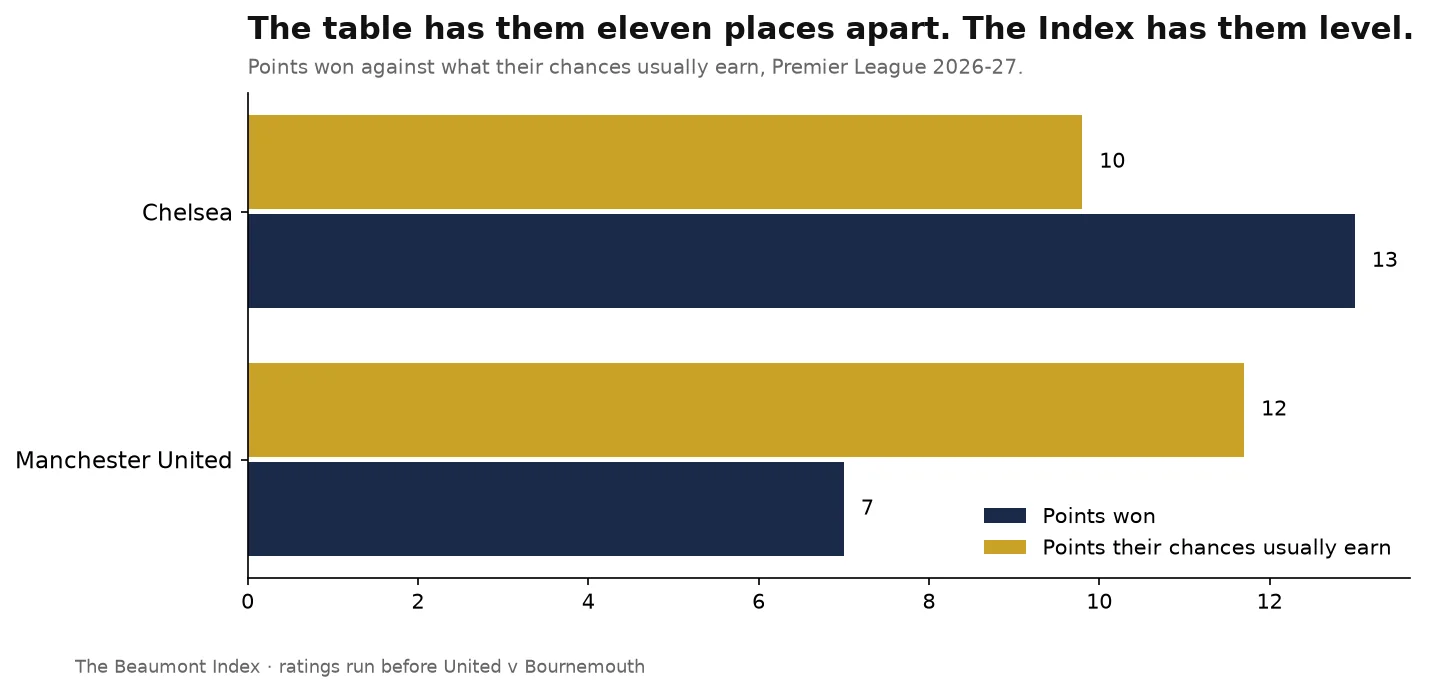
Chelsea have 13 points from chances that would usually earn about 10. United have seven from chances that would usually earn about 12. That is roughly three points of good fortune on one side and five of bad on the other: an eight-point swing between two teams our ratings separate by four rating points.
It is why two teams this close are eleven places and six points apart, and whether that will last.
Put the same numbers per game and the picture is sharper. United's chances have been worth more per game than those of all but five Premier League sides. Chelsea's rank 12th on the same measure. If you only looked at the quality of the chances each side creates and concedes, you would expect United to be in the top six and Chelsea in mid-table. The table shows the reverse.
United's problem, on these numbers, is not creating the right positions. It is turning them into goals and keeping the bad moments out of their own net. That matters for Saturday, because the first kind of problem is usually harder to fix than the second. A side that is not creating chances needs a new plan. A side that is creating them and not scoring often needs nothing more than time.
One caveat matters. Our latest run does not yet include United's 3-0 home defeat by Bournemouth. That was a bad performance as well as a bad result, and it will cost United rating points when it is added. It does not change the shape of their first seven league games, which is what this analysis is built on.
The pendulum
The more striking pattern only shows up when you go back two seasons.
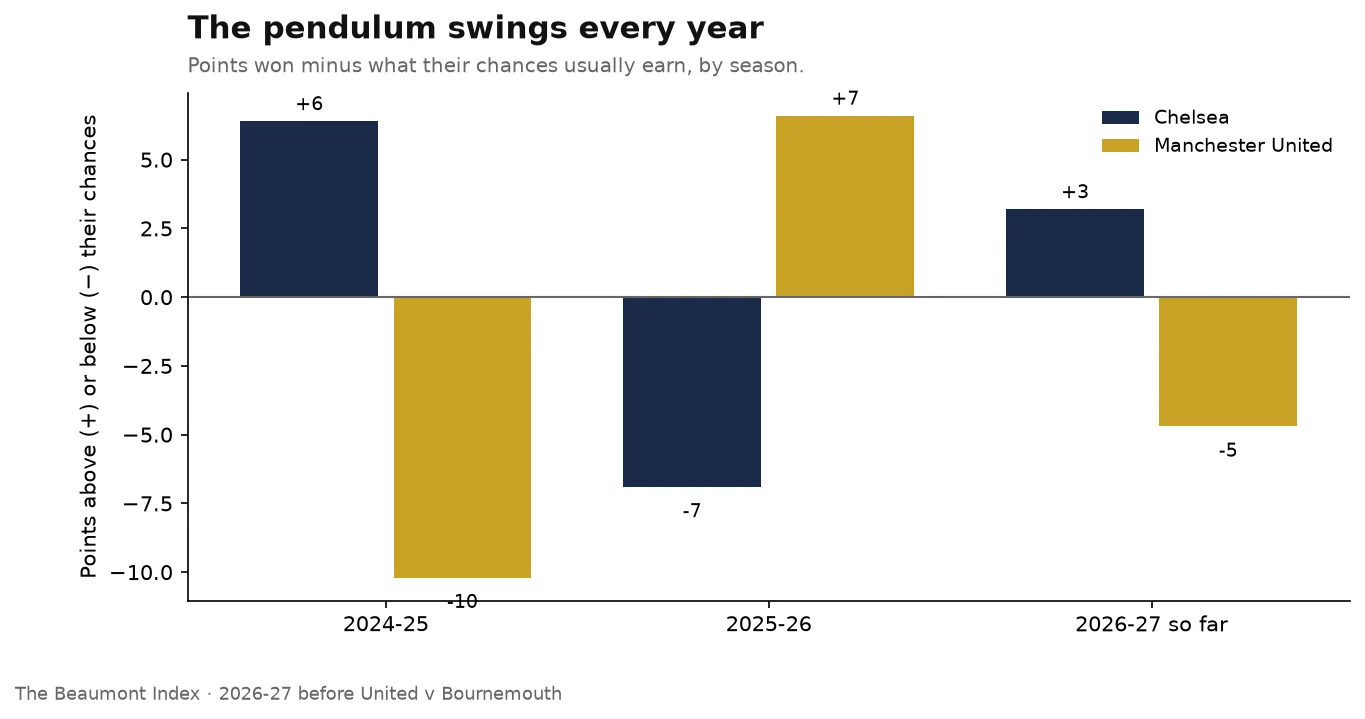
In 2024-25, United finished about ten points below what their chances usually earn. Chelsea finished about six points above theirs. Last season it flipped completely. United won 71 points from chances worth about 64, roughly seven above. Chelsea won 52 from chances worth about 59, roughly seven below. This season it has flipped again.
That swing is the most important thing to understand about this fixture. Each season, the club on the right side of the gap has been described as being on the rise, and the club on the wrong side as being in trouble. Managers' reputations have moved with it. But the underlying gaps have not behaved like a stable skill. They have reversed every season.
That does not mean luck explains everything. It means that when a team's points and its chances disagree by five or more over a handful of games, our first assumption is that the chances are the better guide to what happens next. Over three seasons, both of these clubs have proved that assumption right.
What the schedule hides
Chelsea's position deserves credit too, and it is not all fortune. They have faced the second-toughest set of opponents in the division so far, behind only Leeds. United's run of opponents ranks seventh. Our ratings adjust for opponent strength, and that adjustment helps Chelsea: they have kept their rating while playing good teams.
The worry for Chelsea is direction. Our trend measure compares this season's level with last season's. Chelsea's is down by about 0.27 goals per 90, enough to be labelled falling. United's is down by about 0.17, which we class as steady. Chelsea also arrive after the derby defeat by Tottenham, in which Cole Palmer was sent off, and a League Cup exit on penalties at Anfield on Wednesday.
Two very different squads
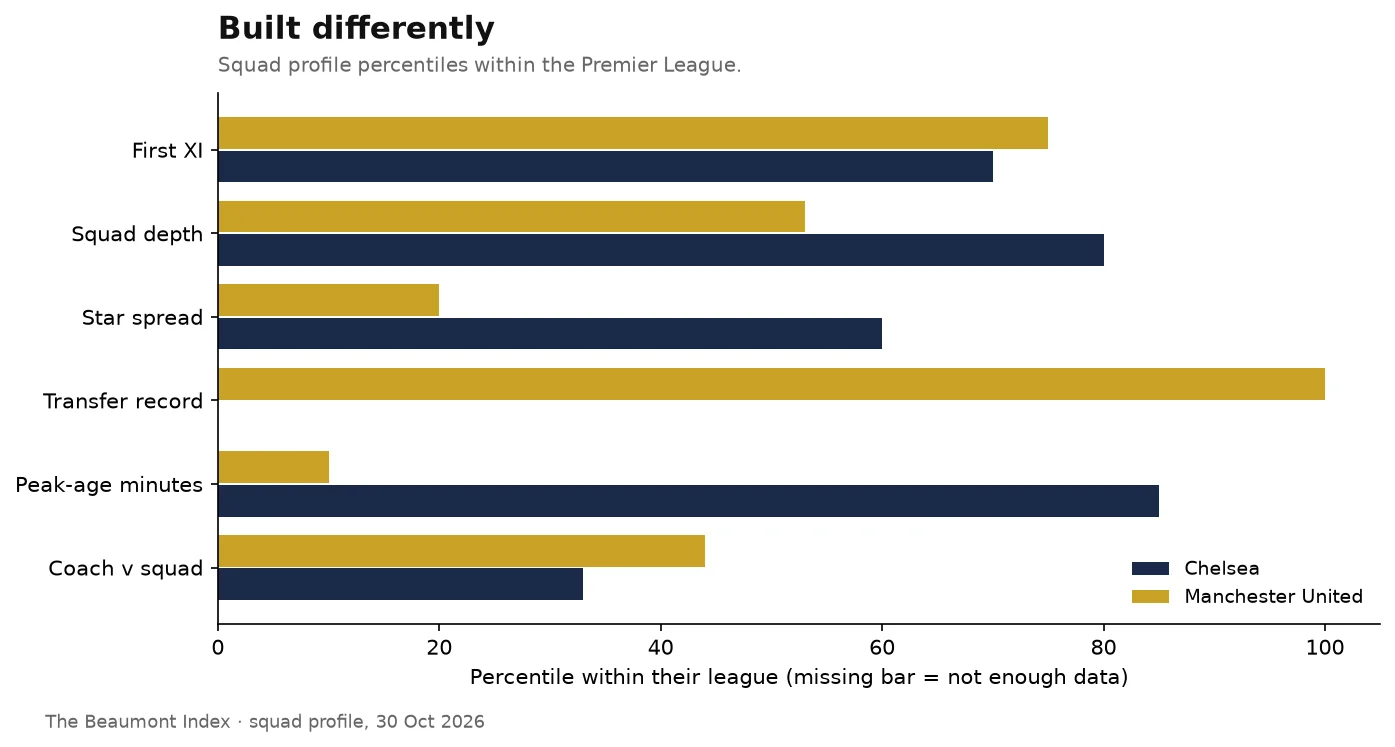
Our squad profile breaks a club into six parts. It shows two clubs that arrive at the same overall level in very different ways.
Chelsea's strength is depth. Their quality beyond the first eleven sits in the 80th percentile of the league, which fits a large, young squad. Their usual starting eleven is in the 70th percentile. Their most distinctive on-field trait is youth: the minutes-weighted age of their side is far below the Premier League norm. They also keep the ball more than almost anyone and play very few long balls.
United look like the opposite. Their first eleven is slightly stronger, in the 75th percentile, but their depth drops to the 53rd. Their star spread is in the 20th percentile, which means the team leans heavily on one or two players for its quality. That is why the Fernandes situation matters more than a normal selection story: when quality is concentrated, losing or benching one player costs more. United's minutes also go less to players in their peak years than almost any other side in the league; they sit in the 10th percentile on that measure.
Two other measures stand out. United's transfer record is the best in the league on our scoring, in the 100th percentile. And neither coach scores well on our measure of how a team has performed under its current head coach compared with what the squad suggested: Chelsea are in the 33rd percentile, United the 44th. Neither club, on these numbers, is getting more from its squad than it should.
On the pitch, United's most distinctive trait is shot volume, well above the league average. One side builds slowly and keeps the ball. The other gets the ball into shooting positions, takes a lot of shots and has not been rewarded for it.
What would make the table right
To be fair to the table, there are ways it could be telling the truth. Three things would point that way.
First, if United's chances are not as good as they look. Our chance measures are built from shot quality, and a side that takes many shots from slightly worse positions than average can look better on volume than it really is. United's shot volume is very high, so this is the main risk to our reading.
Second, if United's problems are about the dressing room as much as the pitch. Ratings measure what happens in games. They do not measure a squad that has stopped believing in its coach. The last two results, 4-1 and 3-0, were heavy enough to suggest that something more than finishing has gone wrong.
Third, if Chelsea's finishing is a real skill. A young squad with high-quality forwards can finish above average for a long time. Last season's numbers argue against it, but this is a different squad.
We do not think any of these is likely to be large enough to justify a gap of eleven places. But each is a real reason to hold our view loosely.
The history
Chelsea have won only two of their last 17 Premier League meetings with United, drawing eight and losing seven. United did the league double over Chelsea last season, including a 1-0 win at Stamford Bridge in April. That is a long record, but most of it involved different squads and different coaches, and our ratings give it no weight.
What to watch on Saturday
Three things will tell us more than the score. Whether United keep creating good chances away from home, under pressure, against a side that likes the ball. Whether Chelsea, who keep possession more than almost anyone, can turn that into chances of the quality their finishing has been converting. And who plays for United: a team that relies on a small number of players is very sensitive to selection.
A United win would look like a shock to anyone reading the table. To our ratings it would not be. A Chelsea win would fit both the table and the pattern of their season so far. We will not put a percentage on it. What we can say is that the gap between these sides is far smaller than eleven places, and that one result will not tell you which of these two seasons is the real one.
See the full Premier League ratings.
FAQ
Where are Chelsea and Manchester United in the table?
Before Saturday, Chelsea are fifth on 13 points and United 16th on seven, one point above the relegation zone.
Who is rated higher on the Beaumont Index?
Chelsea, but only just: 13th in the world against United's 14th, a gap of about 0.02 goals per 90 minutes.
Are Manchester United unlucky?
On our numbers, yes. Their chances for and against would usually have earned about 12 points, not seven, and that was before the 3-0 loss to Bournemouth.