Ratings and world ranks in this piece come from before our 25 October 2026 ranking update. Current figures are on each club's page.
The short answerSpurs deserved their first win at Stamford Bridge since 2018. They had 69% of the ball, 15 shots to seven and dominated the air. Chelsea's set-piece weakness and Alonso's no-striker gamble cost them. Even so, the Index still rates Chelsea above Spurs, and Chelsea remain ahead of what their football deserves.
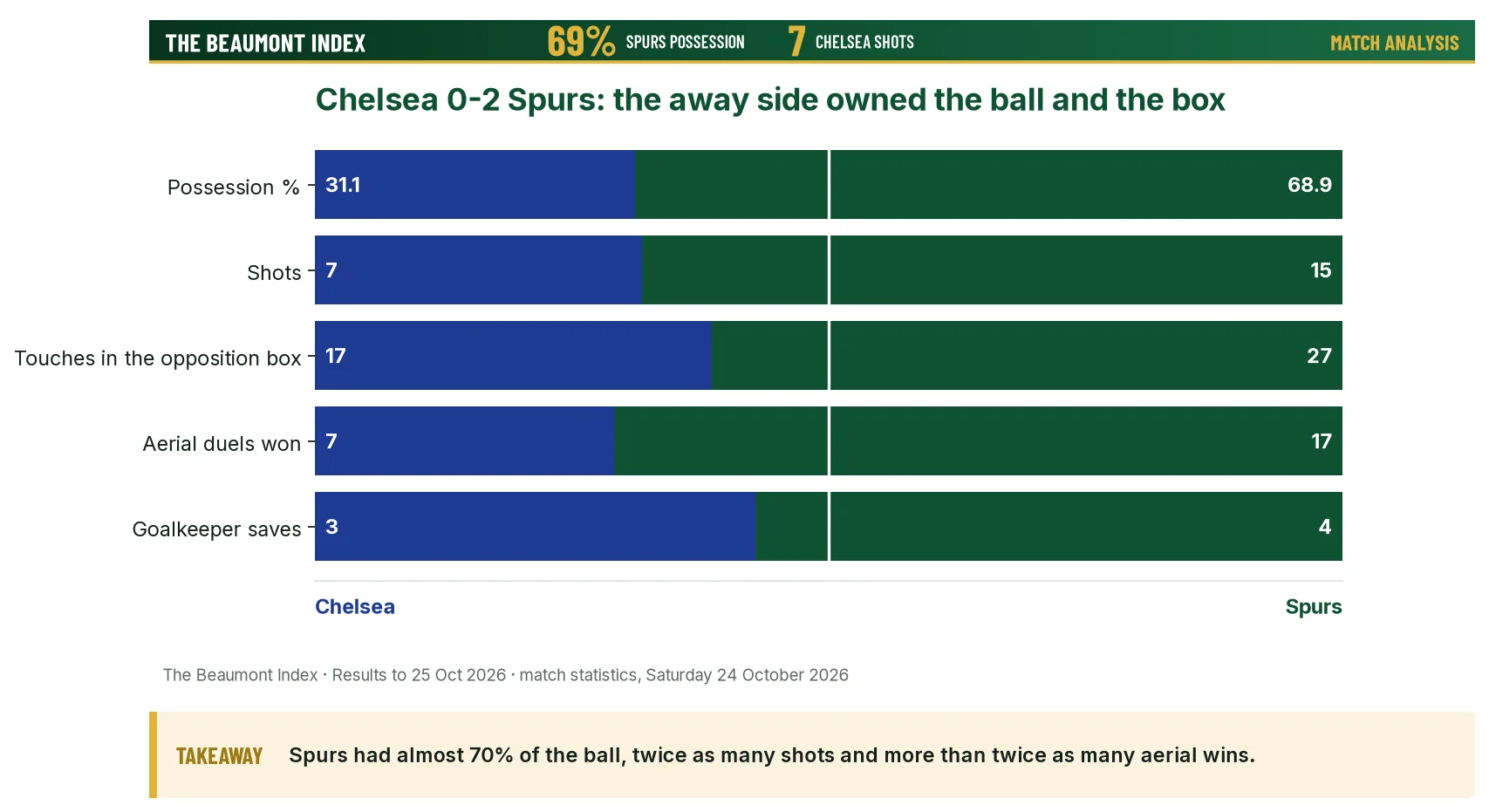
Tottenham had won one of their previous 36 league visits to Stamford Bridge. On Saturday night, in torrential rain, they won the 37th 2-0, and the scoreline undersold them. Roberto De Zerbi's side had 69% of the ball, 15 shots to Chelsea's seven, 27 touches in the Chelsea box to 17, and 17 aerial duels won to seven. The goals came late: a Mike Penders own goal from a corner in the 77th minute, and a solo run and finish from Mathys Tel in the 87th. In between, Cole Palmer was sent off for a second yellow card.
This is a morning-after piece, so it comes with a health warning. Chelsea's goalkeeper punched the ball into his own net, and their best player was sent off. Both things change a match. But what had happened before the 77th minute matters more for what comes next for both clubs, and that is where this piece starts.
How the game played out
Spurs had the ball in Chelsea's half for long spells, with their full-backs high and their midfielders passing around Chelsea's front line. Chelsea's attacks were mostly single runs and early balls, not sustained possession.
The opener came from a Spurs corner. Penders, making his first league start because Emi Martínez fractured his jaw against Everton last week, came for the ball with Jan Paul van Hecke challenging him. The ball came off his hand and went in, despite Maxence Lacroix's attempt to keep it out on the line. Chelsea's own report, the BBC and Spurs' report all describe it that way. Penders is only the second Chelsea goalkeeper to score a Premier League own goal, after Petr Čech in 2009.
The second goal belongs to Tel. He picked the ball up inside his own half on the left, held off Josh Acheampong, accelerated past him, cut inside Lacroix and hit a low right-footed shot into the bottom corner from around the edge of the area. It was, according to the club, his 50th league appearance for Spurs and a sign of how much space ten-man Chelsea had left behind their midfield by then.
The set-piece problem is now a pattern
Treat the own goal as a one-off if you like. Chelsea's record at set pieces says you should not. They have now conceded eight set-piece goals in the Premier League this season, double any other club. A goalkeeper on his league debut, in the rain, against a tall Spurs side that won 17 aerial duels to Chelsea's seven, was always going to be tested. Spurs kept putting balls into his area, and on the 77th minute it worked.
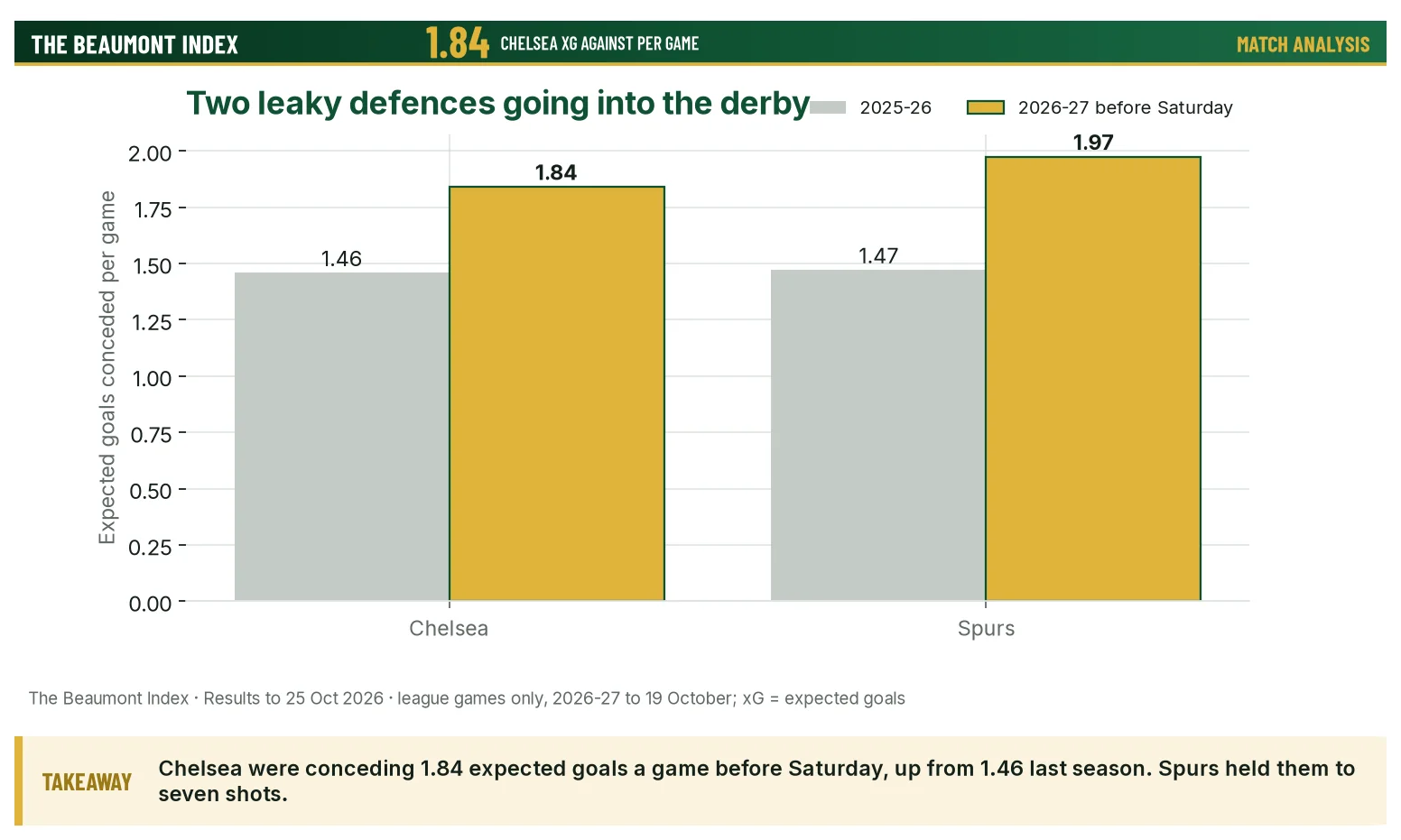
Our numbers add a broader point. Before Saturday, Chelsea were conceding 1.84 expected goals a game in the league, up from 1.46 across last season. Expected goals measure the quality of the chances a team allows, so that is a defence that has got clearly worse, not just unlucky. They were hit for 2.64 expected goals at Arsenal and 2.47 at Brentford. Xabi Alonso's side began the season in a back three and have moved to a back four for the last three league games. On Saturday Spurs created little in open play for long periods, but they never had to defend for their lives either.
They have now conceded eight set-piece goals in the Premier League this season, double any other club.
Alonso's selection gamble
With João Pedro injured, Alonso chose not to play a recognised centre-forward. Morgan Rogers played through the middle, 19-year-old Geovany Quenda made his first start on the wing, and Danny Welbeck began on the bench. The idea is easy to see: more runners, more pace, and a front line that could press Spurs' build-up and break quickly.
It did not work. Without a reference point up front, Chelsea's long balls had nobody to aim at, and Spurs' centre-backs were rarely stretched. Seven shots was Chelsea's lowest total in a league game this season and their fewest at home since January. Chelsea's own report notes that Palmer and Jordan Henderson forced good saves from Antonín Kinský in the first half, and the Index does not dispute that Chelsea had moments. But they were moments, not a plan.
Palmer's evening summed it up. He was booked for barging into Mateus Fernandes after Fernandes had stopped one of his driving runs. Sky's commentators argued it could have been a straight red. Nine minutes later, three minutes after the opener, he caught Conor Gallagher late in midfield and Chris Kavanagh showed him a second yellow. Chelsea's most creative player had spent much of the night chasing a game that was not coming to him.
De Zerbi's Spurs are starting to look like his teams
For Spurs this was the second win in six days, after Monday's 3-1 against Coventry, their first league win of the season. Before that week they had gone six league games without a win. They had been beaten 3-0 at Brentford on the opening day, conceding chances worth 4.89 expected goals, and they had conceded 1.97 expected goals a game before Saturday, worse than last season's 1.47.
What changed at Stamford Bridge was control. De Zerbi's teams are built to keep the ball deep, draw the opposition press and then play through it. Spurs averaged 32 possessions in attack a game before Saturday, well up on last season's 25, so the style was already arriving. On Saturday it arrived in full. Almost 70% possession away at a top-four side is not a fluke of game state, because the score was 0-0 for 77 minutes.
The defensive side is as important. Holding Chelsea to seven shots means Spurs defended largely by keeping the ball. They won the aerial battle 17 to seven, and Kinský needed to make four saves all night. If Spurs can defend like that against Chelsea, their awful start looks less like the real level of the team and more like a side still learning a new system.
What the Index says now
Here is the part that cuts against the mood. Even after this defeat, Chelsea are 3.2 points ahead of what their performances deserve, one of the bigger surpluses in the league. They have 13 points from eight games, but their football has been worth 1.22 points a game, 12th best in the Premier League. Saturday did not make Chelsea a worse team. It brought their results closer to what their football has been worth all season.
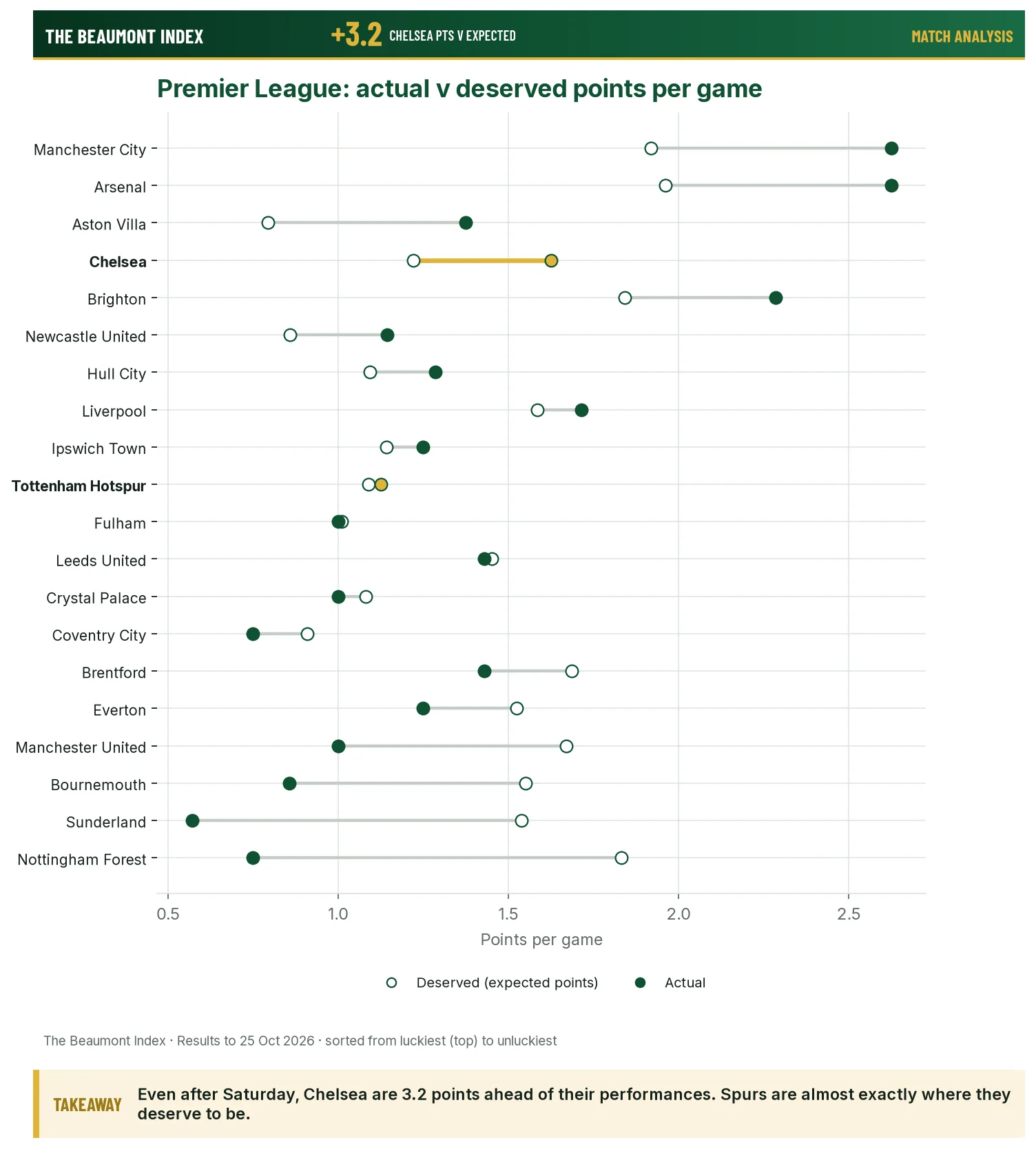
Spurs are almost exactly where they should be: +0.3 points against expectation, from 1.09 expected points a game. That matters because last season they finished 8.3 points below their expected total, one of the unluckiest seasons in the league. Two wins in a week have not made them lucky. They have stopped being unlucky.
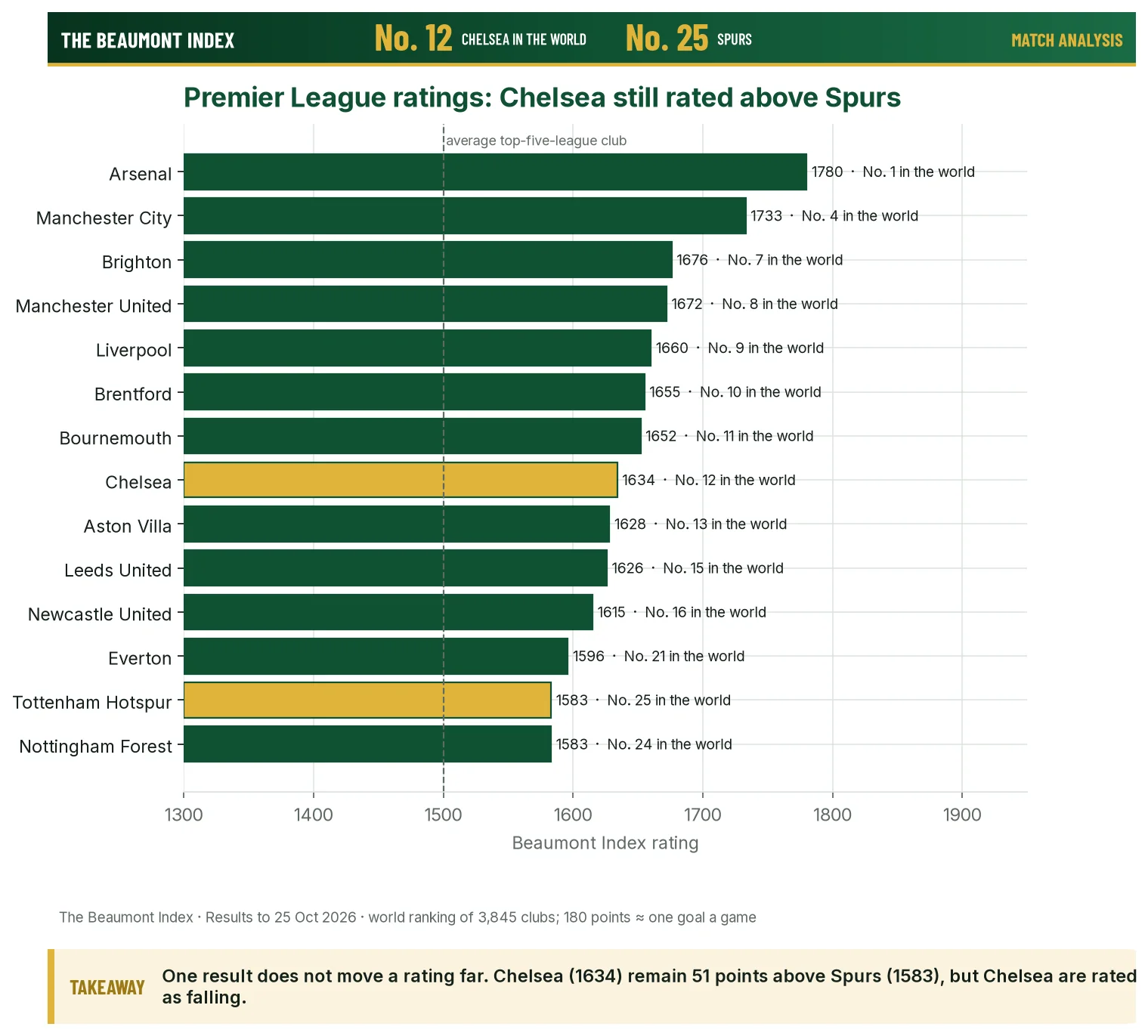
Ratings move slowly by design, and one match does not overturn months of evidence. Chelsea are rated 1634, 12th in our world ranking, and still 51 points above Spurs at 1583, 25th. Around 180 points is worth a goal a game, so the gap is about a third of a goal. The difference is direction. Chelsea are rated as falling, Spurs as steady.
What comes next
Chelsea host Liverpool in the Carabao Cup on Wednesday, without Palmer for the next league game through suspension, and with a goalkeeping decision to make. The bigger fix is structural: a defence conceding clearly better chances than last season, a set-piece record that is now a pattern, and a front line that needs a centre-forward. They are fourth, but the numbers say that position is ahead of the football.
Spurs are 12th, four points behind Chelsea, after the best week of De Zerbi's time in charge. The Index does not read too much into one result, even one this emphatic. But the shape of Saturday's win, more than the scoreline, is the strongest evidence yet that the possession game he was hired to build is starting to work. If it holds, Spurs' table position will start to catch up with their football rather than the other way round.
FAQ
What was the score in Chelsea v Tottenham?
Chelsea 0-2 Tottenham on Saturday 24 October 2026 at Stamford Bridge. Mike Penders scored an own goal in the 77th minute and Mathys Tel scored in the 87th. Cole Palmer was sent off in the 80th minute for a second yellow card.
Did Spurs deserve to win at Chelsea?
Yes. Spurs had 69% possession, 15 shots to seven, 27 touches in the Chelsea box to 17 and won 17 aerial duels to seven. The goals came late, but the pattern of the game favoured Spurs throughout.
Are Chelsea better than their league position?
No. Chelsea are fourth with 13 points, but their performances have been worth fewer points than that. Even after this defeat they are more than three points ahead of what their football deserves.