Ratings and world ranks in this piece come from before our 25 October 2026 ranking update. Current figures are on each club's page.
The short answerNot on the season so far. Before Sunday, United's football was worth 1.67 points a game, the sixth-best rate in the Premier League, and they were 4.7 points short of what it deserved. But the 3-0 home defeat to Bournemouth was a poor performance, not bad luck, and the Fernandes row is a risk no model measures.
Manchester United lost 3-0 at home to Bournemouth on Sunday, and it could have been worse. Michael Carrick dropped his captain, Bruno Fernandes, and never brought him on. Rayan, Marcus Tavernier and Evanilson scored, United went eight games without a win in all competitions, and Old Trafford booed its own players off. United are 16th, a point above the relegation zone, with seven points from eight league games.
So here is the question that matters for Carrick and for whoever makes the decision about him. Is this really a 16th-placed team? Or, after a fortnight like this, is it something worse? The Index has a clear answer on the first eight games, and a warning about the ninth.
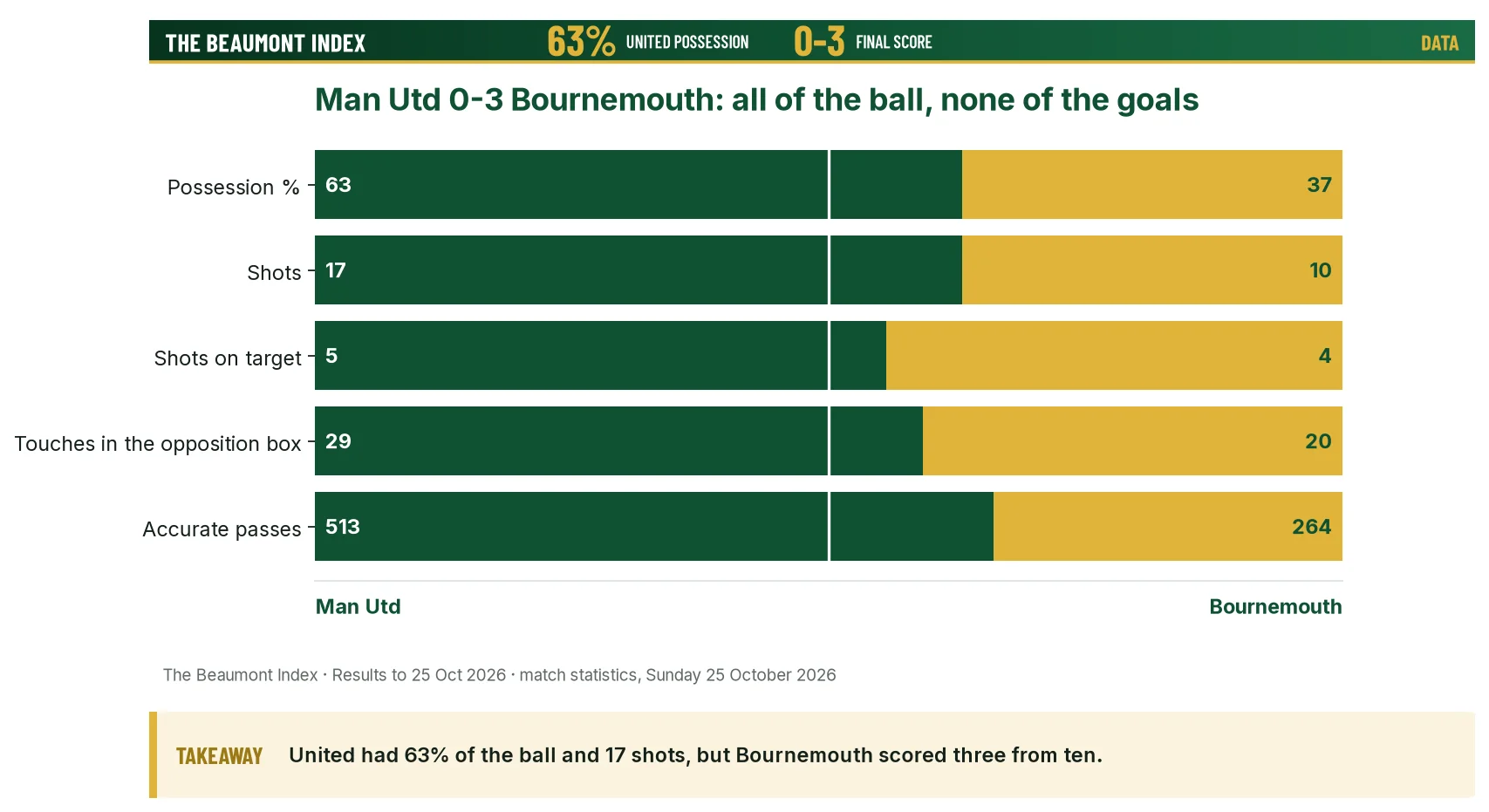
How Bournemouth took Old Trafford apart
United had the ball: 63% of it, 513 accurate passes to 264 and 17 shots to ten. None of that told the story. Bournemouth were the more dangerous side from early on, and when they scored it was because United handed them the chance.
The opener came in the 38th minute. Ayden Heaven made a wild challenge on Evanilson, was booked, and Justin Kluivert's free-kick from the right was allowed to drop to Rayan, unmarked at the far post, who volleyed it in. Five minutes later Leny Yoro slipped near his own area, Adrien Truffert took the ball and squared it, and Tavernier slid it into an empty net. Carrick defended both players afterwards, calling the first a dubious free-kick and the second "just a slip".
The half-time change was Matheus Cunha for Youri Tielemans, not Fernandes. It did not help. Evanilson had a goal ruled out for offside within seconds of the restart after a loose Harry Maguire pass, and Rayan wasted another good chance. Lisandro Martínez came on for Heaven, and soon afterwards a long ball from Lewis Cook sent Evanilson racing towards goal. Senne Lammens came out, Evanilson got there first, went round him and curled a superb finish in from a tight angle on the right. That was the game.
The detail that should worry United most is the type of chance each side created. Many of United's 17 shots came from outside the box. Bournemouth, with ten, scored three and missed three more big chances. Possession without penetration is a pattern that the numbers can hide for a while. On Sunday it was obvious.
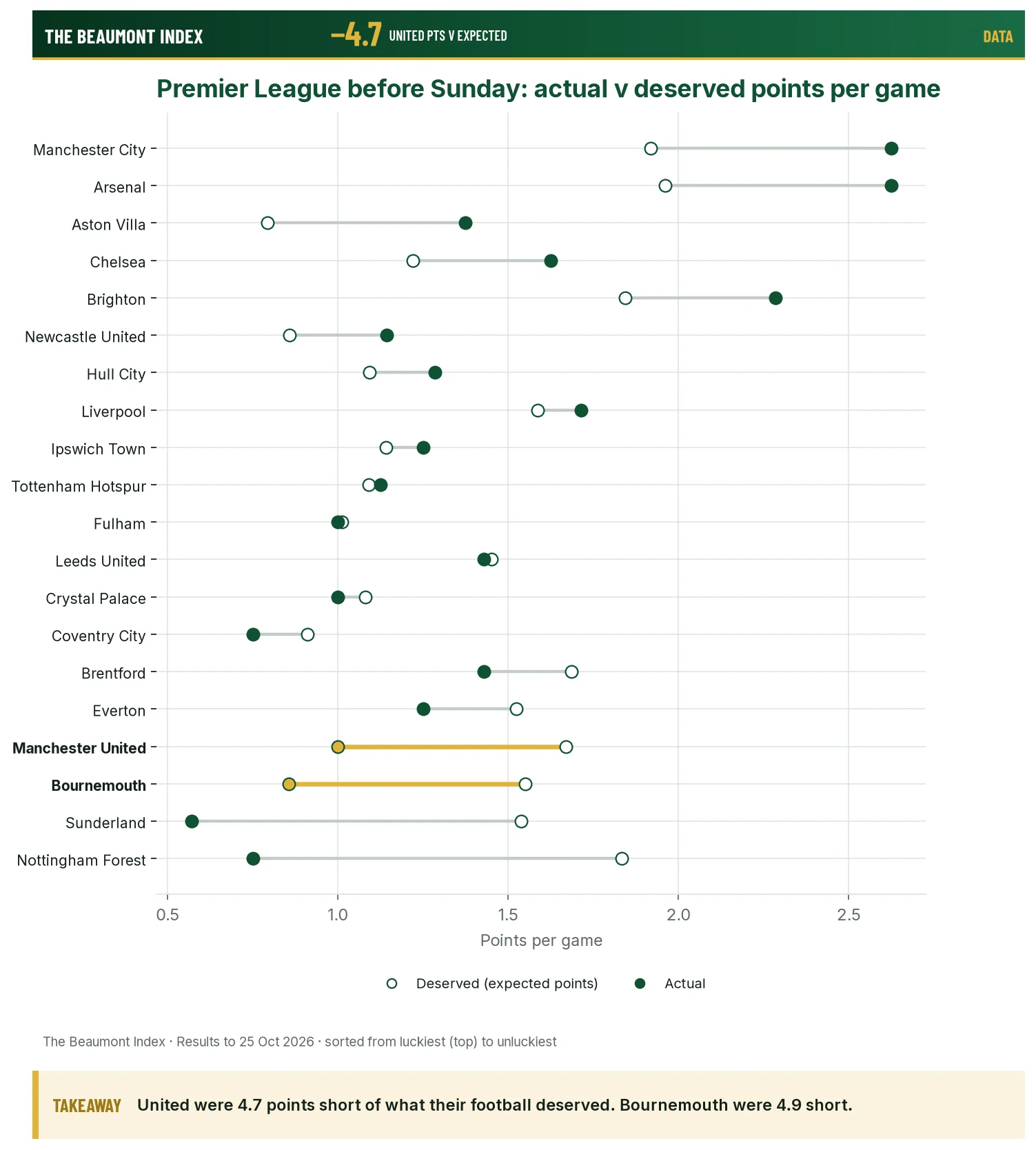
Bournemouth deserve their share of the credit. They arrived with three straight wins in all competitions, including a 3-0 win over AC Milan on Thursday, and left with four. Before Sunday they were in the same position as United, 4.9 points short of what their football deserved. Now, with nine points from eight games, their results are starting to catch up.
The half-time change was Matheus Cunha for Youri Tielemans, not Fernandes.
What the numbers said before Sunday
This is where the Index pushes back against the table. Before Sunday, United had seven points from seven league games. Our expected-points measure, which looks at the quality of the chances a team creates and concedes and asks what that would normally earn, valued their football at 11.7 points. That is 1.67 points a game, the 6th best rate in the Premier League.
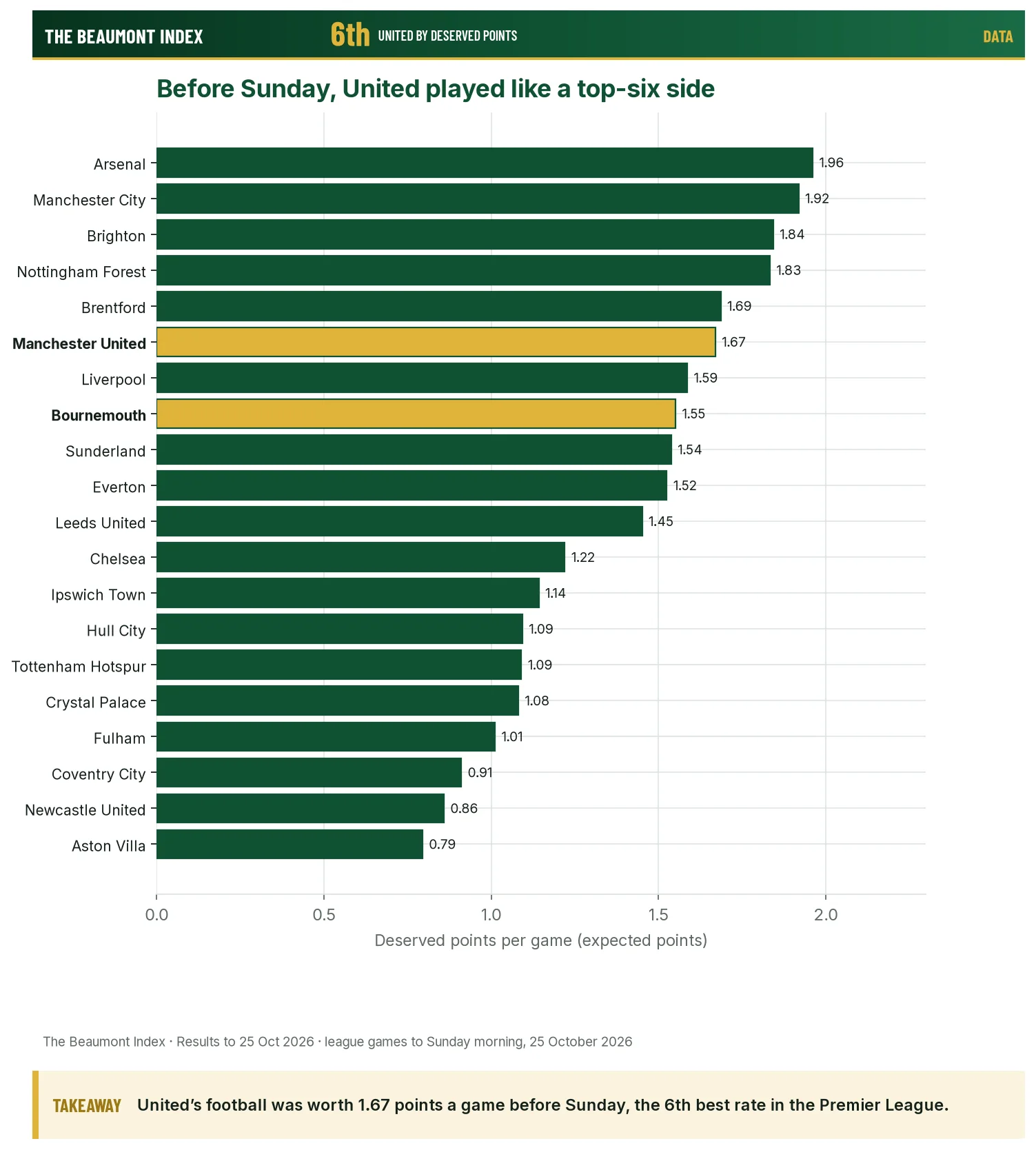
Put simply, United were 4.7 points short of what their football had earned. Only Nottingham Forest and Sunderland were further behind their performances, and Bournemouth were just ahead of United on the same list. That is why our preview called this a meeting of two teams the table had got wrong. On Sunday one of them finally got what it deserved, and it was not United.
The ratings say the same thing. United are rated 1750, the 5th-highest in the Premier League and 10th in our world ranking. Their style profile shows a team that takes a lot of shots, one of the highest volumes in the league. That is a side that has been creating plenty, not one being overrun every week. On the evidence of the first seven games, United's underlying level was closer to the top six than the bottom four.
So is it worse than 16th?
Not on the evidence of the season so far. But Sunday was a bad performance, not just a bad result, and that matters. Until now, United's problem had been finishing and fine margins: good chances missed, soft goals conceded. Against Bournemouth the chances themselves were poor, and the defending was worse. One match will not move a rating far, because ratings are built to be patient. If performances like Sunday's become the norm, the numbers will follow the table down. If they do not, the table is likely to move back towards the numbers.
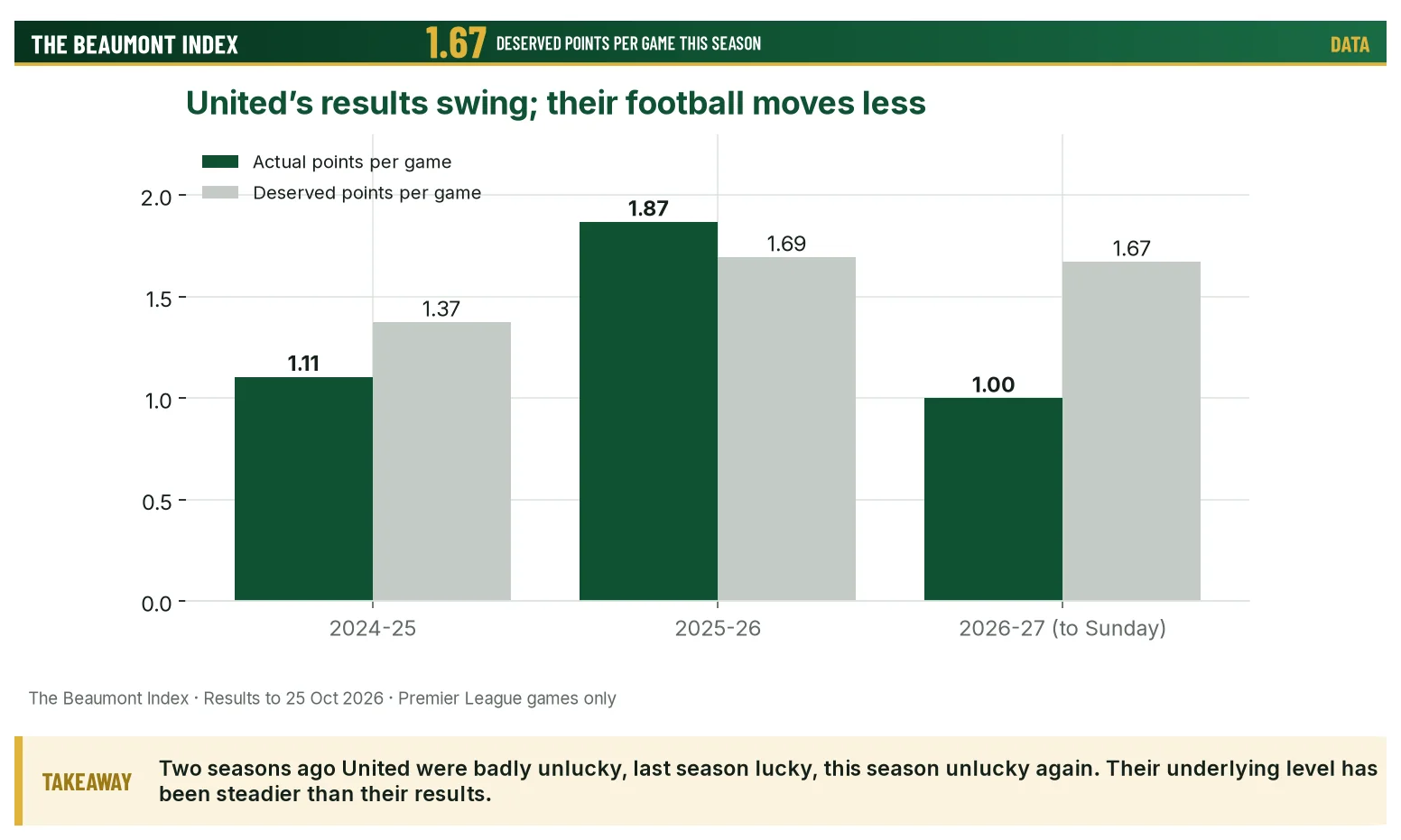
History is useful here. Two seasons ago United took 42 points from football our model valued at 52.2, ten points short. Last season they swung the other way, collecting 71 points from football worth 64.4. Results have moved around far more than the quality of the football. This season, for the first seven games, they were back on the wrong side of the line.
The club profile in the Index shows where the real weak points are. United's first XI ranks highly in the league, but their star spread, which measures how evenly quality is shared across the squad, is near the bottom, and their manager score sits in the bottom half. A team that leans heavily on a few players is exposed when one of them, in this case the captain, is suddenly out of the side.
The Fernandes question
That is the part of Sunday the numbers cannot measure. The build-up to the game was dominated by Fernandes's public criticism of the team's tactics after last Wednesday's 4-1 defeat at Como in the Champions League, and Carrick's decision to leave him out. Carrick said the call was about changing "the course of play". He also said: "What's next? I really don't know."
A dressing room in that state can turn a team that deserves more into one that gets less. On Sunday, for the first time this season, United played like the side the table describes. Whether it was a one-off or a turning point will depend on what happens off the pitch this week as much as on it.
What it means for Carrick
We have looked at this before. Across 6,876 head-coach spells, teams tend to peak long after the point when most managers are sacked, and the clubs that judge managers on performances rather than results usually make better decisions. Before Sunday, United's performances were running well ahead of their results, which is the strongest argument for patience.
Sunday weakens that argument, but does not destroy it. The case against Carrick now rests less on the underlying numbers and more on the dressing room, the captain and the mood in the stands. The case for him still rests on seven league games in which his team played like one of the better sides in the country and did not get the points. If United's football keeps looking like the first seven games, their position will improve. If it looks like Sunday, the table will turn out to have been right.
FAQ
What was the score in Man Utd v Bournemouth?
Manchester United 0-3 Bournemouth on Sunday 25 October 2026 at Old Trafford. Rayan scored in the 38th minute, Marcus Tavernier in the 43rd and Evanilson in the 71st.
Where are Manchester United in the Premier League?
United are 16th with seven points from eight games, one win, four draws and three defeats, a point above the relegation zone. They have gone eight games without a win in all competitions.
Are Manchester United better than their league position?
Before Sunday, yes. Their football was worth the sixth-best points rate in the Premier League, and they were 4.7 points short of what it deserved. The defeat to Bournemouth was a much weaker performance.