Ratings and world ranks in this piece come from before our 25 October 2026 ranking update. Current figures are on each club's page.
The short answerManchester United, Fulham and Burnley should not sack Michael Carrick, Álvaro Arbeloa or Nicky Hayen on this autumn's results. Across 6,876 head-coach spells, the median completed spell lasted four months but teams peaked at a median of 16.3 months, and all three clubs' performances are running ahead of their results. Judge them at 16 months, on performances.
Update, 25 October 2026: Burnley sacked Nicky Hayen on 24 October, shortly after their 4-1 defeat at Lincoln City left them 22nd in the Championship. He won one league game in his 14 matches in charge, and the club confirmed his dismissal in a statement. This analysis was written before he was sacked and is otherwise unchanged. The Carrick and Arbeloa sections still stand.
Let me begin with an argument that will make me unpopular in at least three postcodes. Michael Carrick, Álvaro Arbeloa and Nicky Hayen are, at the time of writing, all under the kind of pressure that tends to end in a statement thanking someone for their efforts. I don't know whether any of them is a good coach. Neither, I'd suggest, does anyone else. Not yet.
That isn't fence-sitting. It's a claim about evidence, and it comes from counting. Our study looked at 6,876 head-coach spells covering about 346,000 matches since December 2022. Two numbers came out of it, and when you put them side by side they describe a sport behaving rather strangely.
Number one: four months
The median completed spell lasted four months. Not four seasons. Four months. Of the completed spells in the study, about 36% were over inside three months, and almost 63% inside six. By the one-year mark, nine in ten were done.
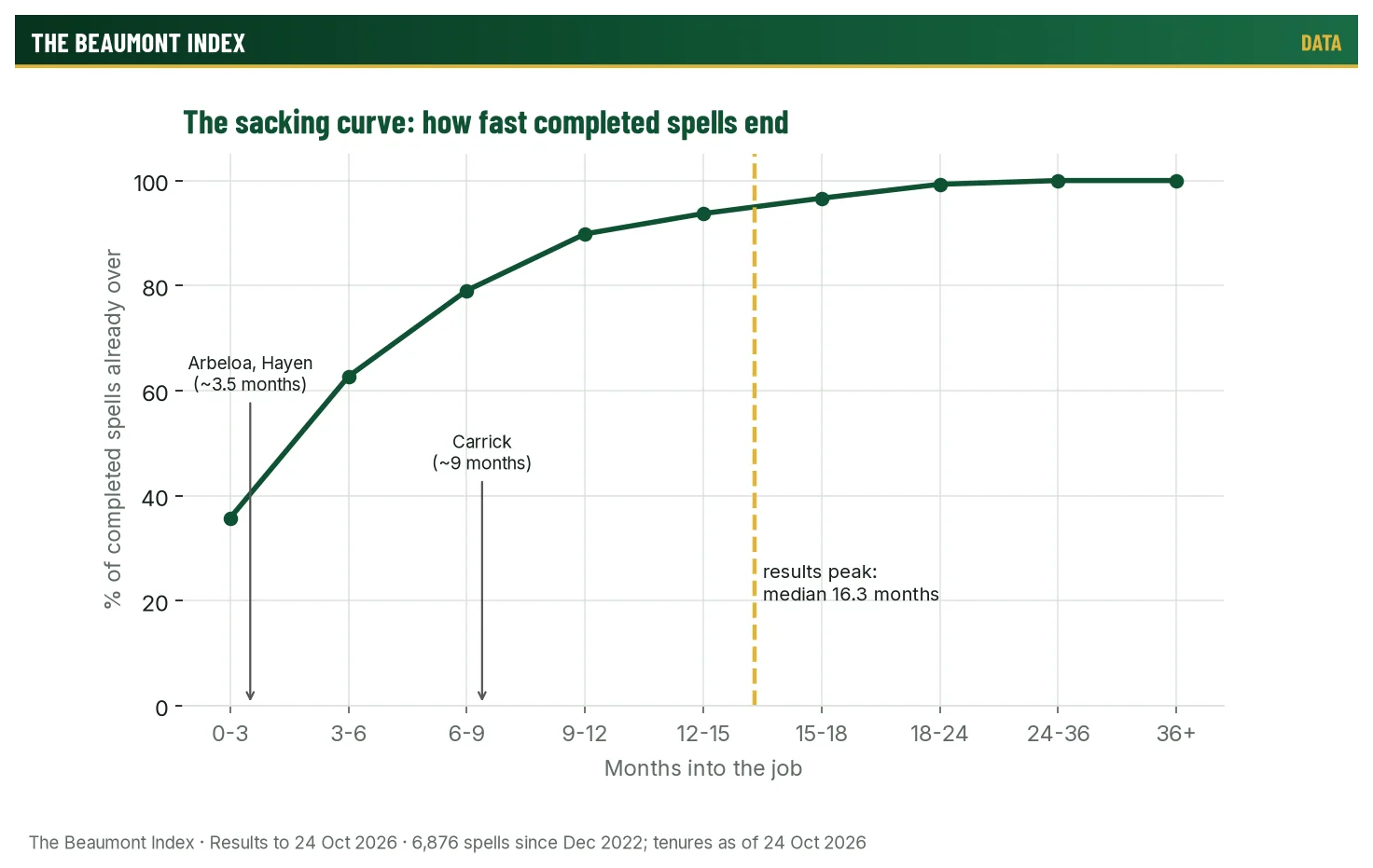
I should be careful here, because "completed" is doing a lot of work. A spell that is still running isn't in that figure, and long-serving coaches are disproportionately still running. The four months describes the spells that ended, not every spell. But that's exactly the point. When football ends a spell, it usually ends it early.
Number two: sixteen months
The second number comes from the spells that lasted long enough to measure properly. For each one, we found the stretch where results were furthest ahead of what the squad would be expected to achieve. The median of those peaks was 16.3 months into the job. For a meaningful share, 27% of the spells we could measure, the peak came after two years.
You can argue about why. New coaches need a transfer window or two. Players need time to learn patterns that don't come naturally. Some of it is surely just that bad coaches get sacked before they can have a peak, so the survivors look better than average. I take that point seriously, and it is the main reason this is an essay and not a law. But even allowing for it, the gap between four and sixteen is too big to be an accident.
The second number comes from the spells that lasted long enough to measure properly.
Now, the three names
Michael Carrick took interim charge at Manchester United on 13 January 2026 and was made permanent in May. That puts him at a little over nine months. In the curve above he is past the point where four in five completed spells have ended, and well short of the median peak. On the Index, United are rated 1672, about a goal a game better than an average top-five-league club, and our latest run had them about three points worse off than their performances deserved. That doesn't save him from a bad run. It does suggest the bad run is less bad than it looks.
Álvaro Arbeloa was appointed at Fulham on 7 July. Nicky Hayen took over at Burnley on 10 July. Both are around three and a half months in. Both clubs were, in our latest run, behind their performances: Fulham by about three points, Burnley by nearly four. If either is sacked this autumn, it will be inside the window where the study says sackings cluster, and a full year before the window where it says teams peak.
What the peak curve actually looks like
It's worth looking at the shape, not just the middle. Of the 1,909 spells we could follow for two years, only 250, about 13%, peaked inside the first six months. Almost 40% peaked between 18 months and three years. The early months are the least likely time for a team to be at its best under a new coach, and they are exactly when most decisions get made. If you wanted to design a system for firing people just before they come good, you would struggle to beat this one.
Performances, not results
If time is the first thing football gets wrong, the second is what it measures. A results table tells you what happened; it's a poor guide to what will happen. So here's how the three clubs look on what their football has earned. Manchester United's performances were worth 1.67 points a game in our run, against 1.00 actually won. Fulham's were worth 1.01, against 0.71. Burnley's were worth 0.96, against 0.73.
Those three aren't equally reassuring, and it would be dishonest to pretend they were. Carrick's case is the strongest: a team rated 1672, playing like a top-six side, losing games it should be winning. Arbeloa's is reasonable: a Fulham side playing like a mid-to-low Premier League team and being rewarded like a bottom one. Hayen's is the weakest, because Burnley's football is only worth about a point a game even before the bad luck. But in each case the gap points the same way. Results are worse than the football, and results are what get coaches sacked.
Put the expected rates side by side and the three cases separate. United's football has been worth 1.67 points a game, the sixth-best expected rate in the Premier League. Fulham's has been worth 1.01. Burnley's, in a different division, has been worth 0.96, under a point a game before any bad luck is counted. That's the uncomfortable detail in Hayen's case. The case for patience there rests on the study, not on his team's luck turning.
The obvious objection
"But some coaches are just bad." Yes. Some are. The study can't tell you which ones, and I'm not going to pretend it can. What it can tell you is that the decision is usually being made before the evidence exists. A chairman who sacks a coach at four months is not reacting to the coach's peak, because the peak hasn't happened. He is reacting to noise, form and the crowd. Those are real pressures. They are not the same thing as information.
What a sensible club would do instead
None of this means a coach should be untouchable. It means the review should happen when the evidence exists. A club that wanted to act on this study would set its first serious review somewhere between 12 and 16 months, and would bring expected points, not just the league table, into the room. It would ask whether the team is creating more than it concedes, and whether that's improving. If the answer is no on both counts at 16 months, the decision is easy and well informed. If the answer is yes, the club has probably avoided paying for a new coach, a new squad rebuild and another four-month gamble.
That costs patience, which is the scarcest thing in football. But the alternative is making the same expensive decision, early, again and again.
The exception that proves the rule
The best counter-example in our eight leagues is in Norway. Kjetil Knutsen has been head coach of Bodø/Glimt since 1 January 2018. On the Index, his side are rated 1566, the best in Norway. One club proves nothing on its own. But if you set out to design an experiment in patience, it would look rather like Bodø.
So here's my unpopular position, stated plainly. Carrick, Arbeloa and Hayen should all be kept. Judge coaches at 16 months, not four. Judge them on performances, not results. If both are bad at 16 months, by all means, thank them for their efforts. Until then, the clock everyone is watching is set to the wrong time.
FAQ
How long do football managers last?
In our study of 6,876 head-coach spells since December 2022, the median completed spell lasted four months.
Should Manchester United sack Michael Carrick?
On the evidence in this essay, no. United's performances in our run were worth 1.67 points a game against 1.00 won, and Carrick is still about seven months short of the median peak.
When do managers' teams peak?
Results relative to expectation peaked at a median of 16.3 months into the job.
How long has Michael Carrick been Manchester United head coach?
Since 13 January 2026 (interim, made permanent in May 2026), a little over nine months as of 24 October 2026.