The short answerPyry Hannola, 25, is a Finnish central midfielder at FK Haugesund. In 2025, playing for a side that finished with nine points, he ranked better than 98% of Eliteserien central midfielders for dribble success and 90% for expected assists. In the second tier this season he is in the top 7% on four creative measures. The open questions are his recent loss of a starting place and a poor loan spell in Poland.
Most step-up reports have to guess. A player dominates a second division, and the scout's job is to estimate how much of that survives one level higher. With Pyry Hannola we do not have to guess as much, because he has already played the level above. He did it in the hardest possible circumstances: in midfield for the 2025 Haugesund side that took nine points from 30 Eliteserien games, the lowest total in the league's history.
Bad teams are usually where midfielders' numbers go to die. You see less of the ball, you play in your own half, and the passes you do make go to team-mates who are losing. Hannola's numbers did not die. On the measures that describe a creative midfielder, they stayed among the best in the division. That is the non-obvious part of this report, and it is why he is the strongest step-up case in our current lower-league sample, ahead of players with flashier headline numbers.
Haugesund are now top of the OBOS-ligaen with two rounds left, two points clear of Strømsgodset. If they finish the job, Hannola will get a second go at Eliteserien next season. This report sets out what the evidence says he would bring, what the league step costs, and the three blind spots that stop us calling it settled.
Who he is
Hannola was born in Rovaniemi on 21 October 2001 and turned 25 last week. He is 185 centimetres tall and a central midfielder who can also play deeper. He left Finland for Midtjylland's academy at 16, came back to HJK Helsinki in 2020, and built his senior career at SJK Seinäjoki, where he made close to 130 appearances. He spent the spring of 2025 on loan at Stal Mielec in Poland, went back to SJK briefly, then signed for Haugesund in the summer of 2025 on a contract that runs to the end of 2028. He has 32 caps for Finland across the youth levels, from under-16 to under-21.
That career path matters. He is not a teenager about to be discovered. He is a player in his prime years whose best evidence is spread across four leagues, and the job here is to weigh each one properly.
The pattern: he makes chances wherever he plays
We compare every player only with players in the same position, in the same league, in the same season, with at least 270 league minutes. For Hannola that means central midfielders. Four measures describe his game best: how often his dribbles succeed, how often his passes lead to a shot, the expected-assist value of those passes, and how accurate his passing is in the final third.
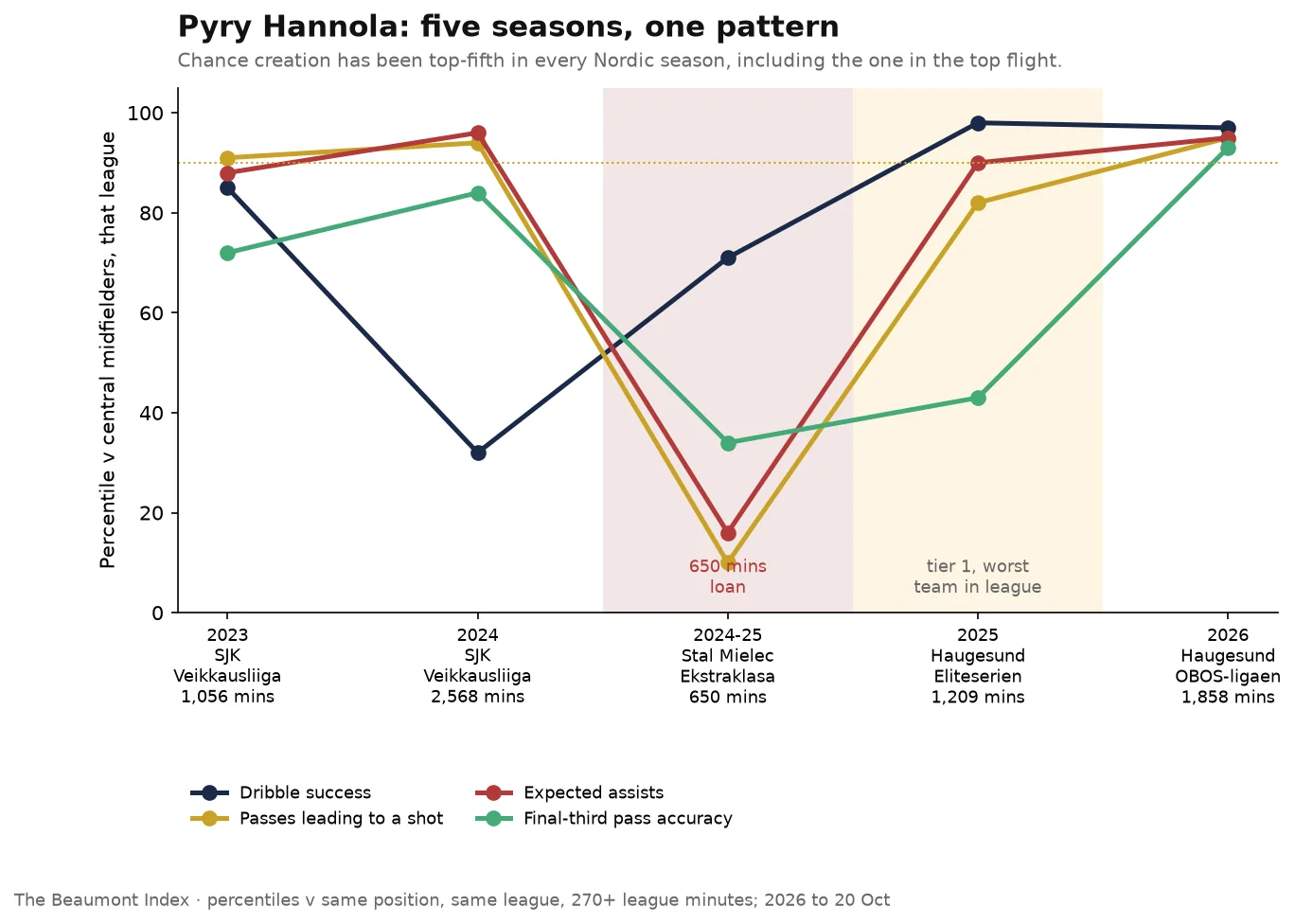
This season, in the OBOS-ligaen, he is better than 97% of the 49 central midfielders in our pool for dribble success, 95% for passes leading to a shot, 95% for expected assists and 93% for final-third pass accuracy. On its own, that is a very good second-tier season and nothing more. Plenty of players top a second-division chart once.
He is a player in his prime years whose best evidence is spread across four leagues, and the job here is to weigh each one properly.
The history is what makes it interesting. In 2023 at SJK, on 1,056 minutes, he ranked in the 91st percentile for passes leading to a shot and the 88th for expected assists. In 2024, his fullest season at 2,568 minutes, the same two measures were in the 94th and 96th. In 2025 at Haugesund, a full division above anything he had played in Finland, they were in the 82nd and 90th. Now they are in the 95th and 95th. Across four Nordic seasons and two countries, his chance creation has never fallen out of the top fifth of his league.
Dribble success tells a similar story with one exception. It was high in 2023 (85th), very high in 2025 (98th) and very high now (97th). The dip was 2024, when SJK used him further forward and he ranked in the 32nd percentile. That is what you would expect: an attacking midfielder takes on defenders in tighter spaces and loses the ball more. When he plays in his natural central role, he keeps it.
The step he has already made
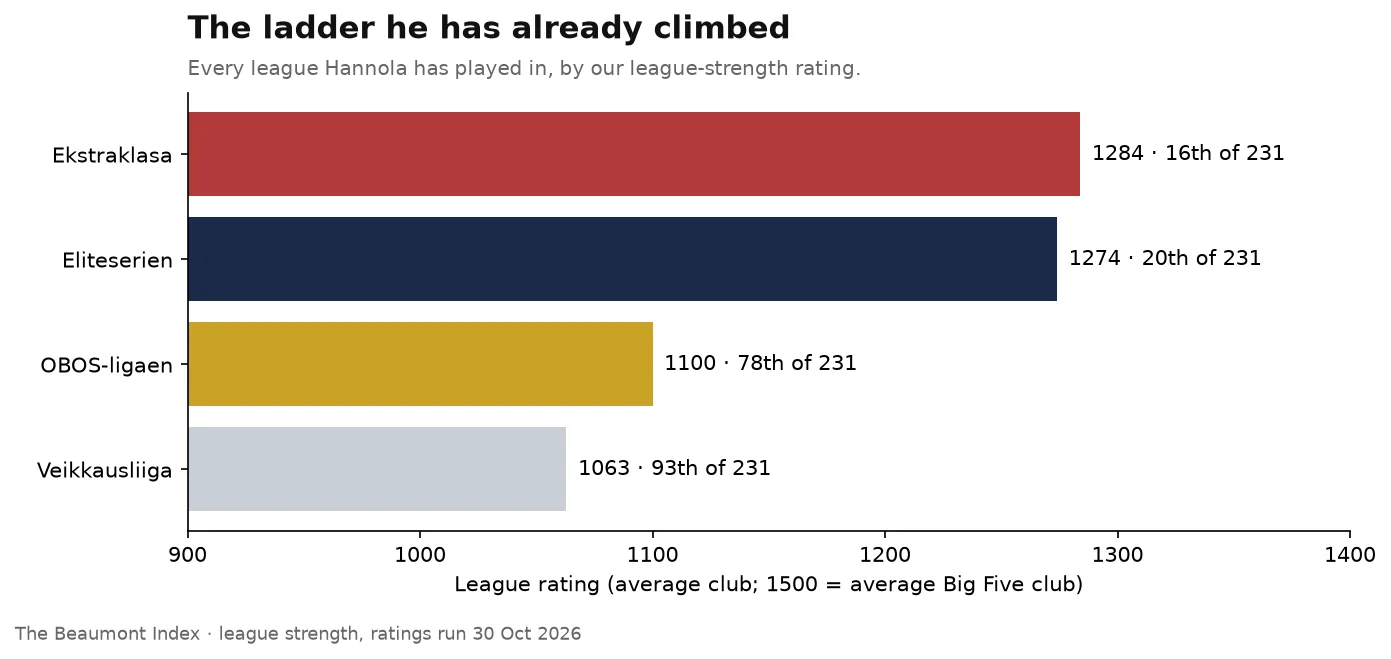
The usual step-up problem is translation. A percentile in a weak league is not worth the same as a percentile in a strong one, so we rate the leagues themselves. Of the 231 leagues we cover, Eliteserien ranks 20th, the OBOS-ligaen 78th and the Veikkausliiga 93rd. Our ratings put the gap between Eliteserien and the OBOS-ligaen at about 0.95 goals per 90 minutes for an average club. The gap from the Veikkausliiga to Eliteserien is bigger still, about 1.15.
That second number is the one that matters for this report. In summer 2025 Hannola moved up by more than a goal per game in league strength, joined the worst side in that league, and his creative numbers barely moved. His expected-assists percentile went from 96 in Finland to 90 in Norway. His dribble success rose. The only clear drop was final-third pass accuracy, from the 84th percentile to the 43rd, which is the most predictable cost of moving up: defenders close faster, and the hard passes get harder.
Most scouts would discount a tier-one season played for a team that lost 25 of its 30 games. We think it should be read the other way. Haugesund's chances in 2025 were worth about 21 points on our numbers, and they took 9. Some of that was finishing and goalkeeping at both ends. It also means Hannola's passes were going to forwards who were not converting. Expected assists measures the quality of the chance he created, not whether a team-mate scored it. On a better team, those numbers are more likely to rise than fall.
What he does with the ball
Put together, the profile is a ball-carrying creator from central midfield rather than a classic No. 10. He receives in the middle third, takes a man on when he has to, and keeps the ball when he does. The next action is usually a pass that ends in a shot. He is not a high-volume goalscorer: one league goal this season in public records. His value is in the pass before the shot and in not losing the ball in the zone where turnovers hurt most.
That fits the way Eliteserien's better sides play. The league's stronger teams press high and spend long spells in the opposition half. A midfielder who can beat the first man and keep the ball under pressure is worth more in that setting than one who only passes sideways safely.
The team around him
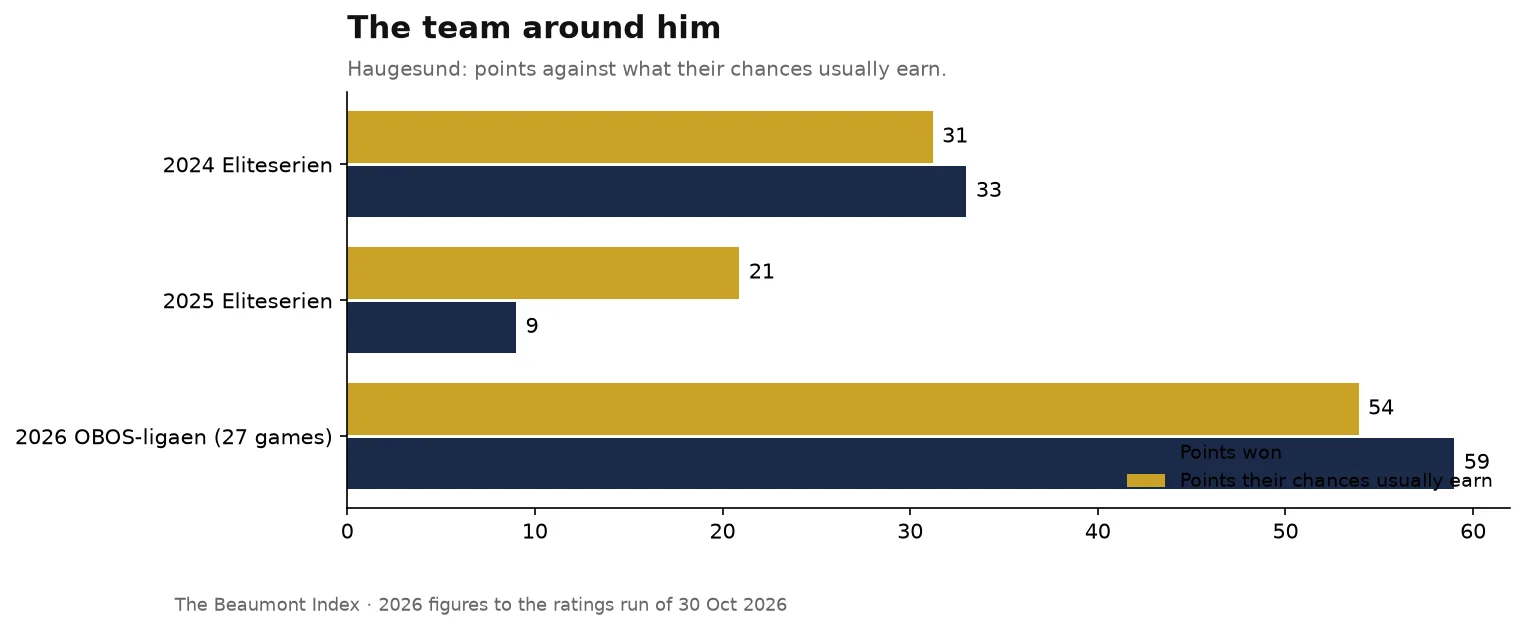
Haugesund's 2026 season has been a success by any measure. In our latest run they had 59 points from 27 games, from chances worth about 54, and are now top on 62 after 28. On performance alone our ratings place them fourth in the division, not first, and their rating is rising. In other words, they have been a good side that has also been a little lucky. Hannola has been part of the core of that team for most of the season.
That matters for the step-up question in a specific way. If Haugesund go up, they will not be the worst team in the league again. They will probably be a lower-half side with a better squad than 2025. That is the kind of setting where a midfielder who creates chances and keeps the ball can take a large share of the team's attacking work.
Blind spot one: he has lost his place
This is the biggest caveat, and it would be dishonest to bury it. Public match records show that Hannola's last full league start came against Sogndal on 5 September. Since then he has mostly come off the bench, often for less than half an hour, and he was an unused substitute against Hødd last weekend. He did start in central midfield and play the full 90 minutes in the cup defeat at Tromsø on 28 October.
We do not know why. It could be tactical, form, fitness or a coach preferring a different balance as the promotion race tightened. Our percentiles run to 20 October, so they cover the period of reduced minutes, but most of his 2026 minutes came from the starts earlier in the season. A player who is losing his place in a second-tier side is not, on current evidence, forcing his way up a level. Any club watching him should want to know the reason before anything else.
Blind spot two: Poland
The spring 2025 loan at Stal Mielec is the one spell that breaks the pattern. In 650 Ekstraklasa minutes, he ranked in the 10th percentile for passes leading to a shot and the 16th for expected assists. Ekstraklasa is the strongest league he has played in, 16th of 231 on our ratings, so this is not a small point.
There are mitigating factors. It was a short loan, in a new country, at a club that was struggling: Stal Mielec finished that season with 31 points from chances worth about 49, the biggest shortfall of any club in that Ekstraklasa season. His dribble success was still in the 71st percentile. But a sceptic could argue that the one time he played in a league as strong as the one he would be targeting, his creative output collapsed. We think the Eliteserien season is the better guide because it was longer and more recent. We cannot prove it.
Blind spot three: what we cannot see
Our player data is strongest on what a midfielder does with the ball. It is weaker on what he does without it. We are not claiming Hannola is a strong defensive midfielder, and nothing in these four strengths says he is. A team that needs its central midfielders to win the ball back high up the pitch should test that separately.
Minutes also differ between sources. Our league data, which caps each match at 90 minutes, lists 1,858 for him this season. Public records show fewer, roughly 1,600 to 1,700. The percentiles are per 90 minutes, so the difference does not change the rankings much, but it is another reason to treat the sample as solid rather than huge.
The verdict
Hannola is not a hidden star. He is something more useful to a recruitment department: a player whose strengths have shown up in every Nordic season he has played, including one in a league a full goal per game stronger than the one he is in now, for a team that could barely compete. That is the evidence most step-up cases lack.
The most natural step is the one in front of him. If Haugesund win promotion, our numbers say he can do the creative job in Eliteserien, because he has already done it there. For an Eliteserien side outside the top four, he would be a sensible target as a ball-carrying central midfielder. A move beyond that, to a stronger Scandinavian league or back to Poland, would need two things first: a run of starts again, and a full season of creative numbers that hold up a level higher.
The short version: the chance creation is real and travels. The minutes since September and the Polish spell are the questions. Watch who starts in Haugesund's midfield in the last two rounds.
FAQ
Who is Pyry Hannola?
A 25-year-old Finnish central midfielder at FK Haugesund in Norway, formerly of SJK Seinäjoki, with a contract to the end of 2028.
Has he played in Eliteserien before?
Yes. In 2025 he played 1,209 Eliteserien minutes for Haugesund and ranked better than 98% of the league's central midfielders for dribble success and 90% for expected assists.
What are the concerns?
He has mostly been a substitute since early September, and his creative numbers fell sharply during a short loan at Stal Mielec in Poland in 2025.