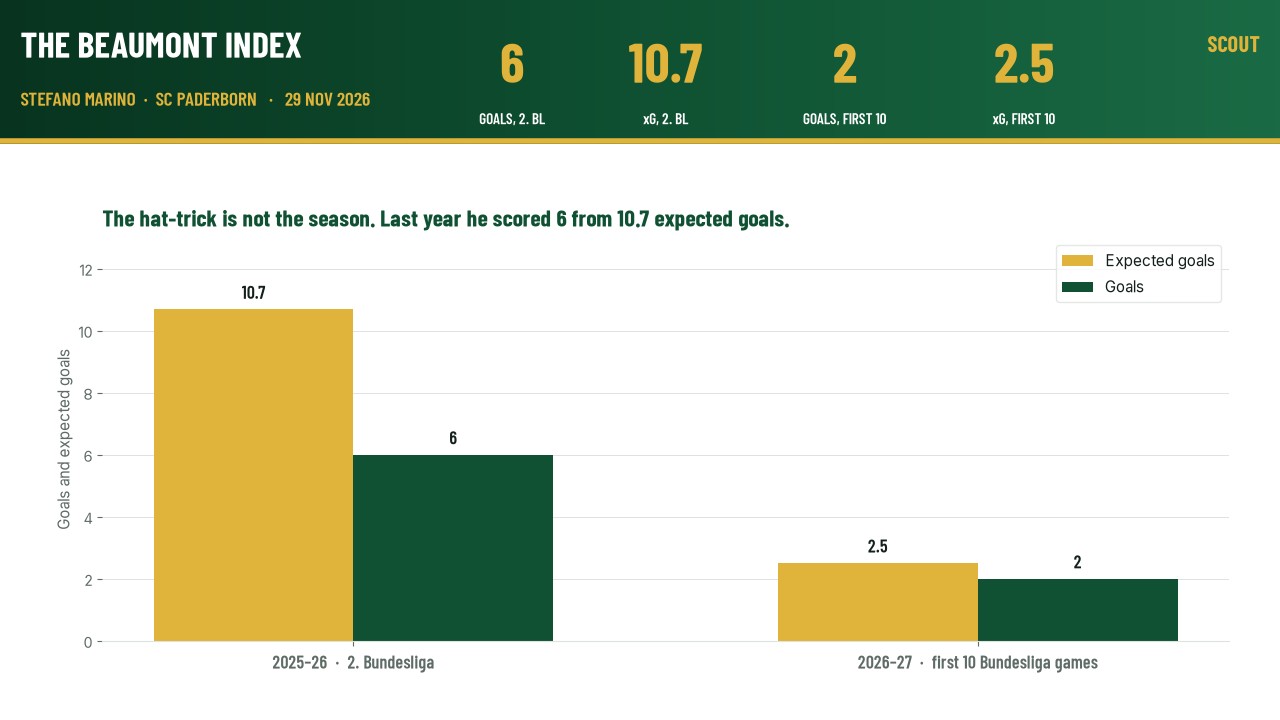
The short answerStefano Marino's hat-trick in Paderborn's 8-1 win over Schalke takes him to five Bundesliga goals, but it does not rewrite his season. Through 10 games he had 2 goals from 2.5 expected goals, at 2.0 shots per 90, in the bottom quarter of the league's centre-forwards. Last season, in the second tier, he scored 6 from 10.7 expected goals at 3.4 shots per 90. Paderborn is the right size of job for now.
Three goals, and a season that was already there
Paderborn beat Schalke 8-1 at the Home Deluxe Arena on Saturday 28 November, and Stefano Marino scored the second, the third and the fifth. The first of those, in the 39th minute, came after Steffen Tigges found him on the edge of the area and he worked the ball out of his feet before finishing into the far corner. The second, in first-half stoppage time, was a left-footed shot from a low Laurin Curda cross. The third, in the 57th minute, arrived on the counter: a return pass from Ruben Müller, a right-footed finish, and the first Bundesliga hat-trick a Paderborn player has ever scored. He had taken four shots. He was withdrawn two minutes later, after 59 minutes.
The afternoon also rewrote the club's own records. It was Paderborn's biggest Bundesliga win, and it doubled the eight league goals they had managed in the first 10 games of the season. Jano ter Horst had opened the scoring in the 21st minute. Tigges, Deniz Zeitler and Gabriel Vidović, from the spot, also scored, and Felix Götze added the eighth deep in added time. Adil Aouchiche scored Schalke's only goal, in the 59th minute. On our numbers, Paderborn created 4.9 expected goals to Schalke's 1.1, from 24 shots to 8.
Both sides had been promoted. On our 24 November world ranking, after those first 10 games and before Saturday's result, Paderborn sat 16th in the Bundesliga and 274th in the world. Schalke sat 17th and 291st. Paderborn had 10 points, about three more than our expected points said they should. Schalke had seven, and were running about four points behind theirs. The 8-1 was a meeting of two newly promoted sides near the bottom of the table, not a night against one of the league's stronger defences. It is still a hat-trick, and it is still a statement. It is not, by itself, a new season.
Marino is 22, born on 12 March 2004, and Paderborn's centre-forward. He is 186 centimetres and wears number 30. He is German, and he joined the club in 2025 from Hannover 96's reserve side. Two years ago that reserve side was in the 3. Liga, Germany's third tier. He played 27 league games there, 1,293 minutes, and scored twice.
The 10 games underneath the hat-trick
Through 23 November, before Schalke arrived, Marino's Bundesliga season was a quiet one. He had played all 10 of Paderborn's league games, 680 minutes, and scored 2 goals from 2.5 expected goals. Both were non-penalty goals. He had taken 15 shots, 2.0 per 90, and put 33% of them on target. His expected goals per 90 was 0.33. Touches in the box were 3.4 per 90.
Among the 24 Bundesliga centre-forwards with at least 450 minutes at that point, those figures sat in the bottom quarter. The 0.33 expected goals per 90 was 19th of 24, the 25th percentile. Shot volume and box presence were the same: 19th of 24, the 25th percentile. Goals per 90, at 0.26, were 18th. Key passes were last in the group, 0.13 per 90. Expected assists were 0.01 per 90, 23rd of 24. The one number that already looked like a higher-level centre-forward was the dribbling volume: 2.7 per 90, 4th in the same group, the 88th percentile, though only 45% of those dribbles came off, which is ordinary.
That is the profile the hat-trick has to be read against. He was not being starved of minutes. He was a regular in a promoted side that had scored eight times in 10 games, and he was producing chance quality and shot volume in the bottom quarter of the league's centre-forwards. He was finishing those chances in line with them, or a fraction behind: 2 goals from 2.5 expected goals is not a drought, and it is not a streak. Saturday changed the goal total. It does not, on its own, change that 10-game picture of how often he was shooting, or from where.
After the 8-1 he has 5 league goals from 11 appearances, and 19 shots. Add the 59 minutes he played against Schalke to the 680 and the shot rate rises to about 2.3 per 90. That is still a long way below last season.
Last season he had the chances. He did not take them all.
The more important comparison is not the first 10 games against the 11th. It is this Bundesliga season against the one he has already had.
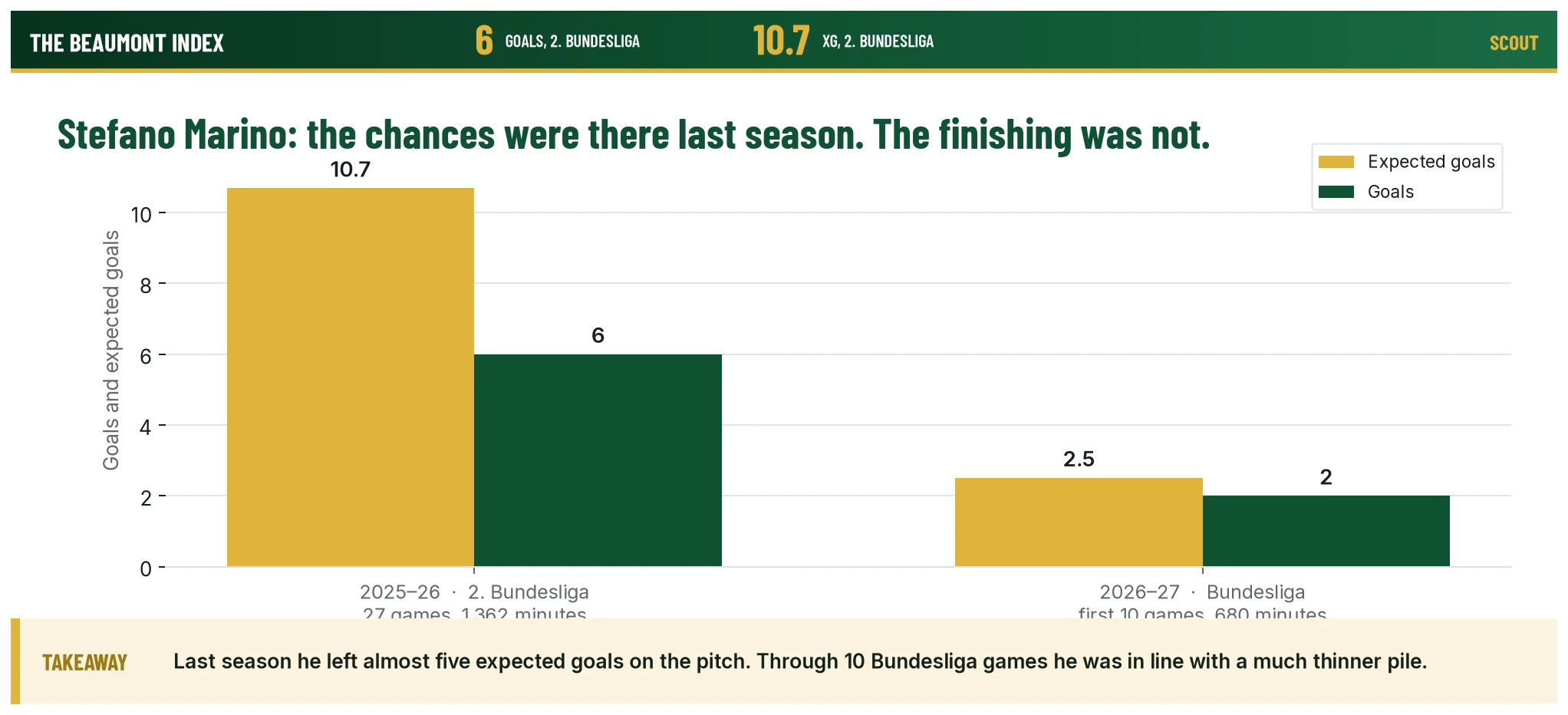
In 2025–26, in the 2. Bundesliga, Marino played 27 league games for Paderborn, 1,362 minutes, and scored 6 goals from 10.7 expected goals. All 6 were non-penalty goals. He took 51 shots, 3.4 per 90, and put 43% of them on target. His expected goals per 90 was 0.71. Touches in the box were 4.0 per 90. Assists were 0, with 0.5 expected assists across the season, and key passes were 0.13 per 90, the same modest creating rate he has now.
Among the 57 2. Bundesliga centre-forwards with at least 450 minutes, that 0.71 expected goals per 90 was first. The 3.4 shots per 90 was 3rd, the 96th percentile. The 10.7 expected goals was 7th, the 89th percentile. The 6 goals were only 17th, the 72nd percentile. He was generating elite chance volume for the level, and he was not finishing it. The gap, almost five expected goals, is the honest record of that season. A player can have a year like that and still be a good bet, if the chances were real and the finishing then catches up. He can also have a year like that and remain a player who creates a No.9's pile without scoring a No.9's goals. Saturday does not yet tell us which one he is.
The shot accuracy last season was ordinary, right on the median for that group, at 43%. Aerials were ordinary too, with 39% won. Dribbles were a strength even then, 2.9 per 90, 8th among those centre-forwards. The creating numbers were a weakness then, and they are a weakness now. Nothing in the profile says he is a link forward. The profile is a box centre-forward who needs a side that puts him in the area, and who, last season, was getting there often enough to lead the division's centre-forwards in expected goals per 90.
Paderborn were promoted at the end of that season. The step he has already taken is the one this Scout has to judge.
Two steps, and what the jump in league strength actually is
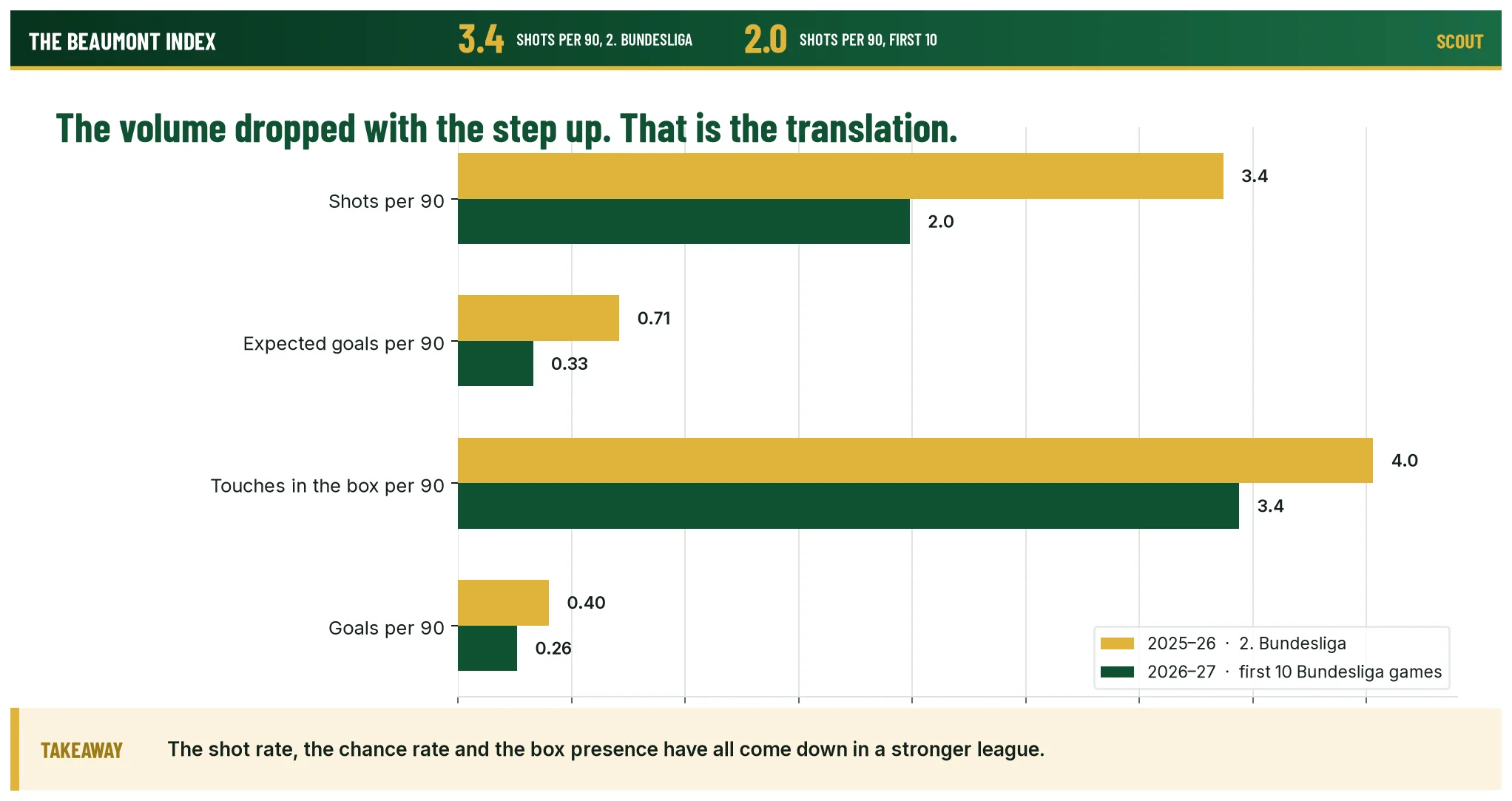
Two years ago Marino was in the 3. Liga with Hannover 96 II. Last season he was in the 2. Bundesliga with Paderborn. This season he is in the Bundesliga, the fourth-strongest league we measure.
On our 24 November league table, the 3. Liga is the 46th-strongest competition we measure. The 2. Bundesliga is 19th. The Bundesliga is 4th, behind only the Premier League, La Liga and Ligue 1. The step from the third tier to the second is about six-tenths of a goal per 90 at league level. The step from the second tier to the first is about a goal per 90. In two seasons the weekly opposition has jumped by about a goal and a half per 90. That is a genuine translation problem, not a change of shirt.
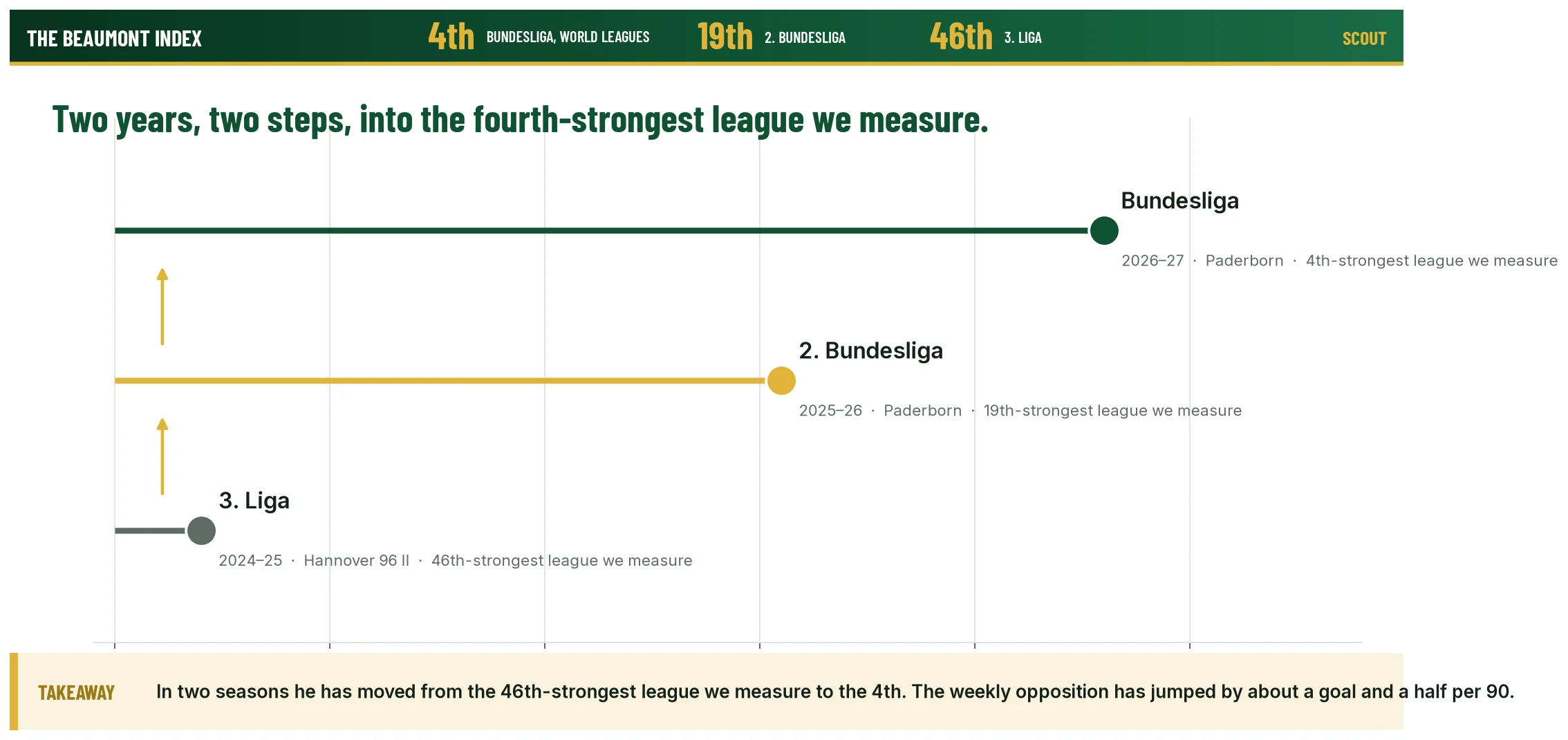
A drop in shot rate, chance rate and box presence is what that jump should look like, at least at first. His shots have gone from 3.4 per 90 to 2.0, his expected goals from 0.71 per 90 to 0.33, his touches in the box from 4.0 per 90 to 3.4. The chance rate has more than halved. The box rate has come down only a little, which is the more encouraging of the three, because it says he is still finding the area, even if the shots that come from it are fewer and, so far, lower in quality. The finishing, through 10 games, was in line with that thinner pile. The hat-trick then arrived against a promoted side we had 17th in the league, on an afternoon when the chances were already heavily with Paderborn.
The next level, in the usual sense of this series, is not another division. He is already in the Bundesliga. The question is what kind of centre-forward he can be in it. On the evidence of the first 10 games, and of the season behind him, he is not yet a first-choice No.9 at a mid-table side or better. He is a young centre-forward at a promoted club, with elite second-tier chance volume already on the record, a finishing season that lagged those chances, and a live Bundesliga rate, before Saturday, in the bottom quarter of the league's centre-forwards. The job he is already doing at Paderborn is the right size of job. The hat-trick does not, yet, make a case for a larger one.
That is also why the 8-1 has to be kept in its place. Schalke were, on the 24 November ranking, the 17th-strongest side in the division and had been running behind their expected points. A centre-forward who converts four shots into three goals on an afternoon like that has taken what was in front of him. He has not shown, in 11 games, that he will be given that many clear looks every week, or that last season's unfinished 10.7 expected goals was a finishing problem that has now been solved.
What the profile already tells us, and what still has to change
The strengths are clear enough, and they have been consistent. He attacks the box. He takes a high volume of dribbles for a centre-forward, and he did that in the second tier as well as in the first 10 Bundesliga games. Last season the chance volume was genuine, first among the division's centre-forwards with a regular run of minutes, and it did not depend on penalties. He is 22, in a promoted side, and he has already gone from a reserve team in the third tier to starting in the fourth-strongest league we measure. That path is not common, and it is not an accident of one afternoon.
The weaknesses are consistent too. He does not create for others. Key passes and expected assists have been low in both of the last two seasons, and in the Bundesliga sample they were at the bottom of the centre-forward group. Aerials are ordinary in success, around 37–39% won, even at 186 centimetres. Shot accuracy was only median in the second tier and lower, 33%, in the first 10 Bundesliga games. And the finishing last season, the one with the big chance pile, did not keep pace with the chances. A hat-trick against Schalke does not erase almost five unfinished expected goals in a full second-tier season.
Three things would change the view. If, over the next run of Bundesliga games, his expected goals per 90 and his shot rate start to climb out of the bottom quarter, toward something closer to a mid-table centre-forward's volume, the translation begins to look like a settling period rather than a new level. If he keeps taking the chances he is given, and the 5 goals are no longer a 2-from-2.5 season plus one burst, last year's finishing gap becomes easier to treat as a lag and not a pattern. And if the box presence stays near last season's 4.0 per 90, even while the shot quality is lower, he remains a centre-forward a side can build chances for, rather than a runner who has dropped off the front.
The reverse would settle it the other way. If the 0.33 expected goals per 90 and the 2.0 shots per 90 become the season, and the hat-trick is the outlier, then he is a useful Bundesliga rotation option at a promoted club, and not yet more than that. If the creating numbers stay this low, he remains a closer only, which is fine, so long as Paderborn, or whoever he plays for, keep putting him where last season's chances came from.
For now the verdict is a narrow one. Stefano Marino is a box centre-forward who has already produced elite chance volume in the second tier, without finishing it, and who, through 10 games in a much stronger league, was generating bottom-quartile chances and scoring in line with them. Saturday's hat-trick, in an 8-1 win over another promoted side, takes him to five Bundesliga goals and does not yet rewrite that season. The level he has already reached is the Bundesliga, in a Paderborn side that sits in the lower half. The next test is not another step up the leagues. It is whether the chances start to look more like last season's, and whether the finishing, this time, comes with them.
This is analysis, not a transfer tip.
FAQ
Does the hat-trick change Marino's season?
Before Saturday he had 2 goals from 2.5 expected goals in 10 Bundesliga games, at 2.0 shots per 90, in the bottom quarter of the league's centre-forwards. Saturday's three goals take him to five. They do not, on their own, change how often he was shooting, or from where, across those first 10 games.
How did he do in the second tier last season?
In 2025–26 he scored 6 goals from 10.7 expected goals, at 3.4 shots per 90. That chance rate was first among 2. Bundesliga centre-forwards with a regular run of minutes. The finishing lagged the chances by almost five expected goals.
What level can he step up to?
He is already in the Bundesliga, the fourth-strongest league we measure, at a promoted club we had 16th after 10 games. The next test is not another division. It is whether his chance rate climbs out of the bottom quarter, and whether the finishing stays with the chances.