Update, 12 November 2026. Manchester United confirmed Michael Carrick’s departure on 12 November, with the club 18th in the Premier League on eight points, after less than six months of the two-year deal signed in May. The club said it had “come to the extremely difficult conclusion that a change is necessary.” The Guardian reports that Mauricio Pochettino has a framework agreement; he has not been appointed. The evidence still stands: the next coach inherits eighth-placed football and an 18th-placed table.
The short answerManchester United are 18th, with eight points from ten games, after Sunday’s 4–4 with Aston Villa. On 12 November the club confirmed Michael Carrick’s departure. Our model, with results to 3 November, still has their football eighth in the Premier League and their chances worth about eight points more than they had banked. Those numbers still stand for whoever comes next.
Before the decision
Manchester United are 18th in the Premier League, with eight points from ten games. Sunday's 4–4 draw with Aston Villa, rescued at 90+6 after they had trailed 2–0 and 4–2, left them in the drop zone for the international break. The club says no final decision has been made on Michael Carrick's future. It is widely reported that a decision is expected this week. Until Old Trafford says otherwise, he remains the head coach.
That is as much of the situation as two independent sources will currently carry. It is also all this piece needs. The Index question does not wait on a statement, and it will still be the right question the morning after one, if one comes. Is the table a fair account of the football? And what would patience, or a change, actually be deciding?
The useful answer is not that this is only a coaching problem, or only bad luck. United have been unlucky, persistently, and they have also been the authors of too many of their own bad afternoons. A change of coach cannot sack the first of those facts. Leaving the coach in place cannot pretend the second isn't waiting at Anfield on 22 November. The data give a case for patience and a case against it. Both should be on the table before anyone decides.
The case for patience: eight points light, eighth on the football
Start with the number that should make a board pause. In our current model run — built this morning, 10 November, with results through 3 November — United had seven points from nine league games. The quality of the chances they had created and conceded was worth about 15.0. That is an eight-point shortfall, the third-worst under-collection in the Premier League, behind only Nottingham Forest (−10.5) and Sunderland (−8.8).
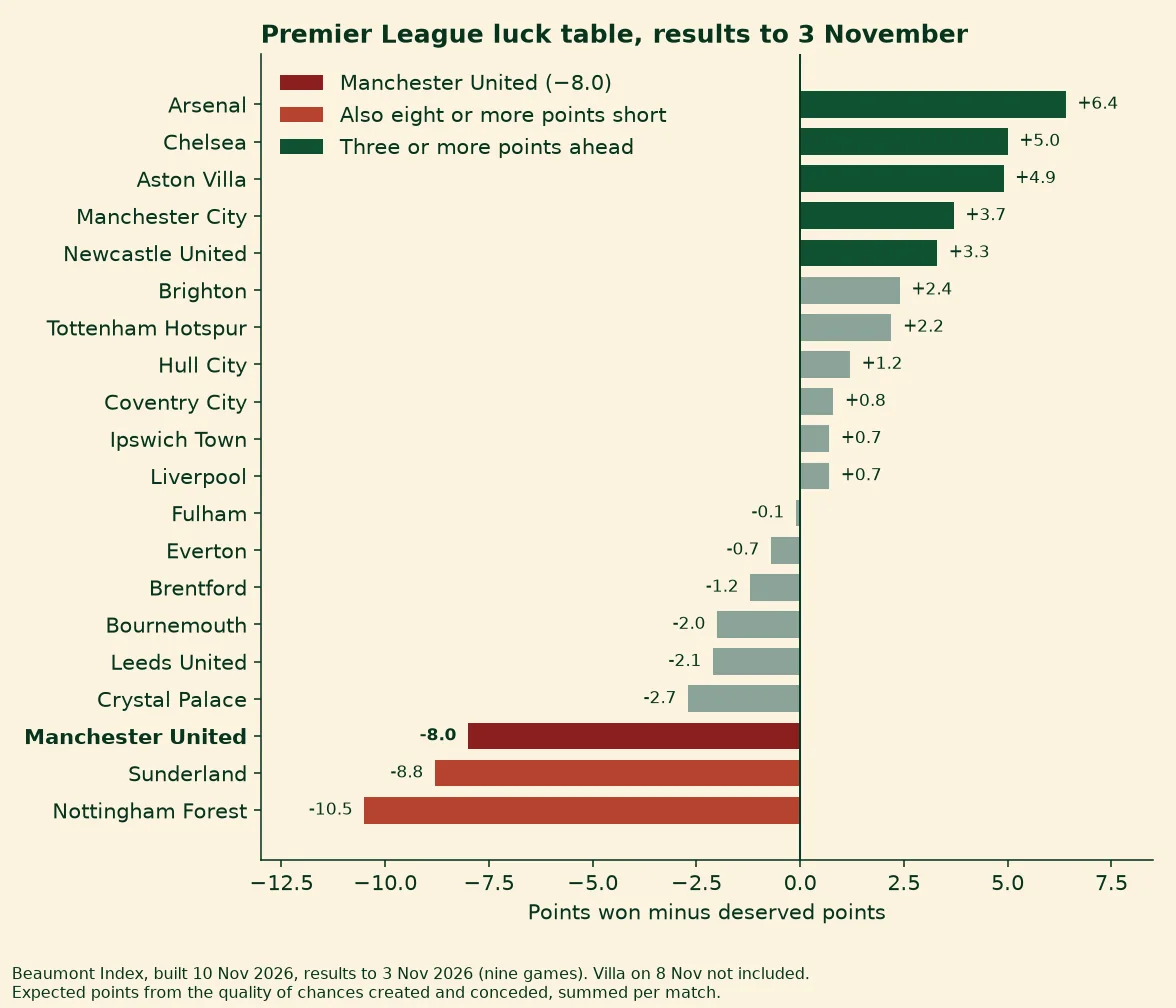
Which means their football, judged by chance quality, was running at about 1.67 points per game. That is a sixth-best rate in the division, next to Brentford, and a long way from a relegation side's output. Last season the same club finished 6.6 points ahead of their chances. The swing is violent. The underlying number this autumn is not.
Sunday added one point to the total, and four goals against. It is now eight points from ten games. We will not guess how that 4–4 moves the luck mark; the model has not absorbed the match yet, and a chaotic eight-goal draw is exactly the sort of afternoon that can fool a premature update. The pre-Villa picture still stands as the baseline: United were already about eight points light. Villa did not create that gap, and one point does not close it.
Their fixtures have not been a soft excuse either. The opponents they had faced, through 3 November, rated slightly tougher than the Premier League average. A hard run can help explain a thin points haul. It does not explain a side creating and conceding chances at a sixth-best rate and still sitting with seven points from nine.
The rating tells the same story in a different key. United are 1.17 goals per 90 better than an average club from Europe's top five leagues. That puts them eighth in the Premier League on rating and 17th in the world. The 80% range on the rating runs from 0.78 to 1.56, and the world-rank band that goes with it is 8 to 33. Those are ranges, not chances. They describe uncertainty in the estimate. They are not a probability of anything in the table.
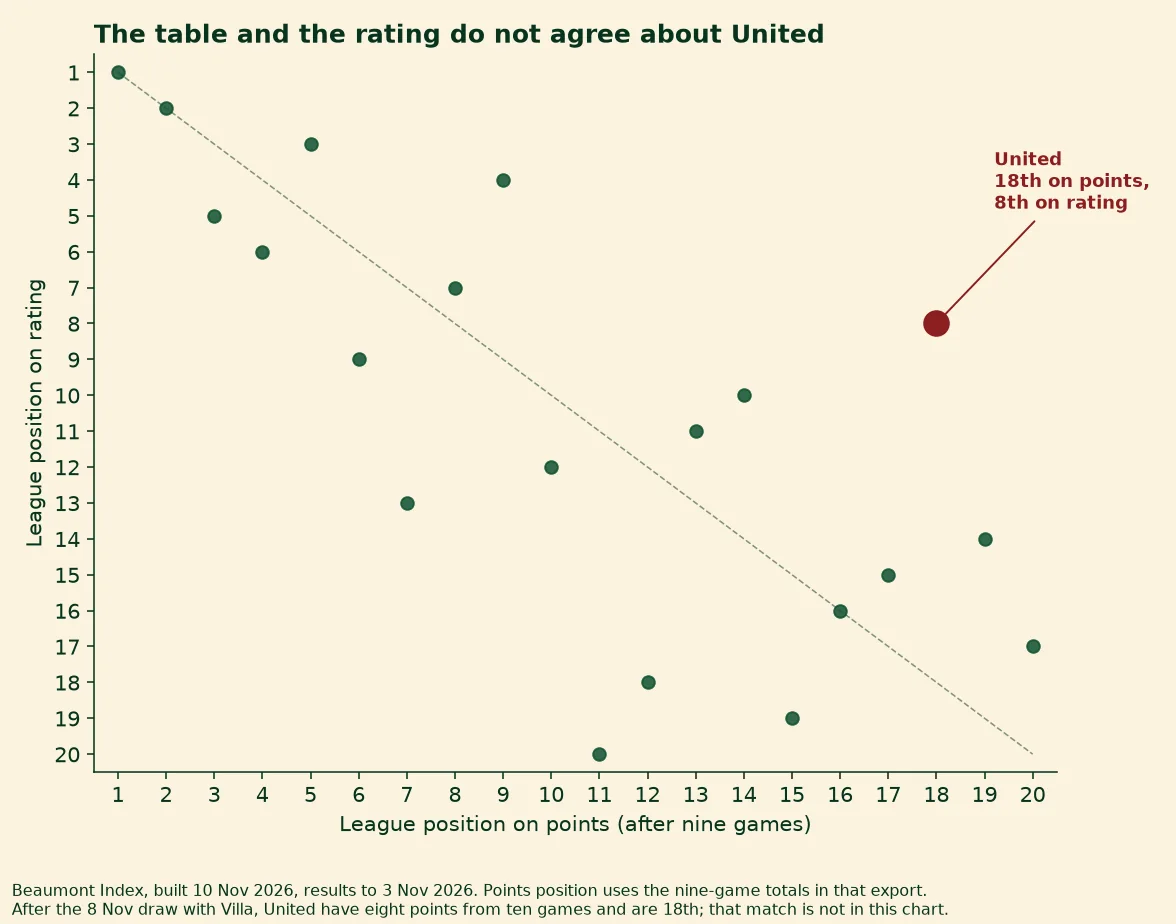
Put the two ranks next to each other and the whole argument for patience is in the gap. After nine games, United were 18th on points and eighth on rating. Forest and Sunderland, the only sides with a worse luck mark, also sit much higher on rating than in the table, though not as high as United. A club that changes coach because of 18th place is reacting to a table the model does not think this team belongs in. The football, on these figures, still looks like a top-half side.
There is a third number, and it is about timing. Our coach-tenure study covers 6,876 head-coach spells and about 346,000 matches since December 2022. The median completed spell lasted four months. Results against expectation peaked at a median of 16.3 months. Departures are front-loaded. Peaks are back-loaded. We have made that argument before, including when Carrick, then a little over nine months in, was already in the most dangerous stretch a coach who has survived the first half-year can occupy.
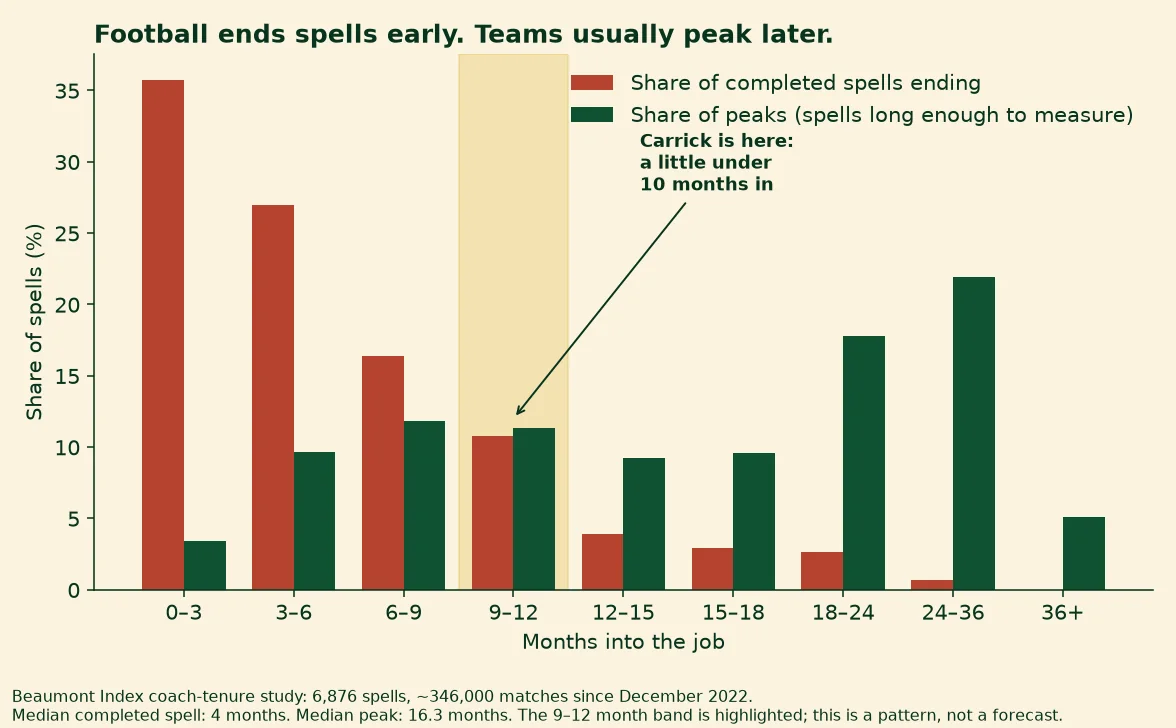
He took interim charge on 13 January 2026 and was made permanent in May, on a contract running to 2028. As of today he is a little under ten months into the job, still in that nine-to-twelve-month window. Of the completed spells in our data that lasted past nine months, 51% then ended before the one-year mark. That is a pattern in the spells that have already finished.
It is not a forecast that he has a 51% chance of being sacked, and it is not a claim that every coach improves if left alone. It describes a sport that is very good at removing people just before the bit where improvement usually starts.
A club which changes coach at ten months is, on average, giving up on the stretch where the work often starts to take. The luck table and the rating give that hesitation its evidence. If the decision this week is to wait, this is the case for waiting.
The case against waiting: the starts, the dip, the table as it stands
Patience is not the same as a clean bill of health. The same export that puts United eighth on rating also records a modest downward drift: about a quarter of a goal per 90, which our latest build still labels as steady rather than a collapse. Between late October and the 3 November cutoff the world rank slipped and the number eased. That is a warning. A team can drift and still be a top-eight side. United, on these figures, are doing both. A serious review should look at the drift, not only at the gap between points and chances.
Then there is the table as it actually stands, not as the model thinks it should. Eight points from ten games is a crisis in the standings, whatever the underlying numbers say. Anfield on 22 November is a brutal place to take that tally and ask it to start catching up. If the luck is real, it has not yet been kind enough to be relied on. A board is entitled to decide that a club of this size cannot sit in the relegation zone into December and call it a variance problem.
Sunday is the sharpest version of the case against waiting, and it is not only bad luck.
The 8 November game is in the match record, not yet in the model, and our morning-after piece on it is the right place for the tape. The short version, because it bears on the decision, is this. Villa led 2–0 inside four minutes: Alysson finished low past Senne Lammens in the first minute, then Nicolas Jackson tapped in after Lammens spilled a shot that followed Leny Yoro's headed clearance. United got back to 2–2, through a Bruno Fernandes penalty and a Youri Tielemans strike from a Noussair Mazraoui cutback. Then they fell away again. Diogo Dalot fouled Alysson, John McGinn scored from the spot, and Leon Goretzka bundled in after Yoro headed a cross back towards his own goal and Lammens pushed it onto the bar. 2–4. Joshua Zirkzee slid in at 90+2. Patrick Dorgu headed the 90+6 equaliser from a crowded free-kick.
Those late goals were a chase: bodies in the box, balls into it. They were not evidence that the problems which put United 2–0 and 2–4 down had been solved. A side can be unlucky over nine games and still give a 2–0 start away in four minutes at home. Both things were true on the same afternoon. We made a similar distinction after the 3–0 home defeat to Bournemouth on 25 October: the season-to-date numbers were well ahead of the table, and that particular performance was poor, not an unlucky blip.
If a review treats Sunday as proof that the football has gone, it will be reading the score and not the season. If it treats the luck table as a reason to change nothing about how United start matches, it will be reading the season and not the tape. The case against waiting is not that the rating has collapsed. It is that a team whose football still looks like eighth keeps giving itself too much to do, and that eight points from ten games is what that habit has already cost.
What whoever is in the dugout inherits
Should the club make a change, the names being linked in public reporting are not a mystery, and they are not the point of this piece. Mauricio Pochettino, the United States head coach, has been described as open to the job by the BBC and the Guardian. Eddie Howe, out of work since leaving Newcastle, was sounded out earlier in the autumn, the BBC reported, and the Guardian said he remains on the radar and would consider the post if it were offered. Those are reported names, not a shortlist we have seen, and not an argument about who would fit. If the club keeps Carrick, the same job description still applies.
The job is the gap. Whoever takes this team into Anfield inherits a squad whose chance quality, through 3 November, belonged with the top six or seven in the league, a rating that still says eighth, a slightly harder-than-average run of fixtures already in the legs, and a points tally that has only just reached eight from ten. He inherits a side that can chase a lost cause, as it did against Villa and, five days earlier, in the 3–2 comeback against Roma. He also inherits a side that has made a habit, on the afternoons we have already described, of falling two goals behind before it has properly started. He does not inherit a probability. He inherits eighth on the football, 18th in the table, and a ten-month coaching spell sitting on the part of the curve where clubs usually get impatient.
Anfield will be a brutal first examination of whoever is in the technical area. It will not, by itself, tell us whether the luck closes, the starts improve, or the rating's little downward drift becomes something worse. Tuesday's data refresh, when it comes, will fold Villa into the model. Until then the honest baseline is the one we have: results to 3 November, plus a 4–4 already on the record.
An uncomfortable answer, before anyone decides
So: is it a coaching problem or bad luck? It is bad luck, persistently, and it is also a team that keeps giving itself too much to do. Sacking the coach would not be a solution to the first of those. Keeping him would not, by itself, be a solution to the second. Whoever is in the dugout after this week will be judged against a table that currently lies about this team, and against starts that have not.
United are 18th. That is real, and it is why a decision is being weighed at all. It is also not what the football says. The club can change the name in the dugout, or it can leave the name where it is. Neither statement can close, on its own, the eight-point gap that was already there before Villa kicked off, or the fact that this side still looks, on our numbers, like an eighth-placed team having an 18th-placed season. The work, for whoever does it, is to make the table catch up with the football — and to stop the afternoons in which the football never gets the chance.
FAQ
Has Manchester United sacked Michael Carrick?
Yes. The club confirmed his departure on 12 November 2026, with United 18th in the Premier League on eight points. The Guardian reports that Mauricio Pochettino has a framework agreement; he has not been appointed.
Are United a relegation side on the football?
Not on our numbers. After nine league games, with results to 3 November, they were about eight points light of their chances and eighth in the Premier League on rating. After ten games they have eight points and sit 18th. The 4–4 with Villa is in the match record, not yet in the model.
What would whoever is in the dugout inherit?
A squad whose chance quality through 3 November belonged with the top six or seven in the league, a rating that still says eighth, eight points from ten games, and a habit, on the afternoons already described, of falling two goals behind early.