
The short answerManchester United drew 4–4 with Aston Villa at Old Trafford on 8 November after trailing 2–0 inside four minutes and 4–2 after 53. Zirkzee and Dorgu equalised in stoppage time. Before the game our numbers had United short of their deserved points and Villa ahead of theirs. One point does not rewrite how those goals were conceded.
An afternoon that would not settle
Old Trafford has seen stranger scores than 4–4. It has rarely seen a Premier League afternoon that kept rewriting itself quite like this one. Alysson scored inside the first minute. Nicolas Jackson made it two after four. Bruno Fernandes pulled one back from the spot. Youri Tielemans levelled before half-time. John McGinn restored Villa's lead from another penalty early in the second half. Leon Goretzka made it 4–2. Then, with the ground half-empty of hope and full of noise of a different kind, Joshua Zirkzee slid in at 90+2 and Patrick Dorgu headed the 90+6 equaliser from a crowded free-kick.
Michael Carrick's side stayed in the relegation zone. Unai Emery's side left with a point that felt like two dropped. Both managers will watch the same tape and see different stories. Villa will see a game they should have finished. United will see a point rescued by bodies in the box and balls into it. Neither story is wrong. The useful one is narrower: United can still summon a chase when the afternoon has already gone wrong. They still cannot stop the afternoon going wrong in the first place.
How Villa opened the door, twice
The first goal was clean and early. Alysson received the ball and finished low past a diving Senne Lammens. One minute on the clock, and Old Trafford was already doing the arithmetic of a bad start.
The second goal was messier, and it was partly United's own. Leny Yoro headed a clearance that dropped invitingly for Alysson. Lammens got something on the shot — a parry that became a spill — and Jackson was there to tap in. Four minutes gone, 2–0. The earliest United had trailed by two in a Premier League match, according to the weekend's reports, and the sort of opening that turns a fixture into a referendum on the manager before the first drinks break.
Villa were clinical in those moments and professional in the spaces around them. United were neither. The two early goals were not the product of sustained Villa pressure so much as of United failing basic tasks: dealing with the first shot, then dealing with the second phase after their own headed clearance.
The first recovery
United's response began with a penalty. Matheus Cunha drove into the area and was tackled by Boubacar Kamara. The referee pointed to the spot. Fernandes converted. Reports time the goal in the 16th minute; the highlights clock the start of the move a little earlier. Five days earlier, on Tuesday 3 November, United had come from 2–0 down to beat Roma 3–2 in the Champions League (Sky Sports; BBC). The comparison is available; the Villa afternoon has to stand on its own tape.
The equaliser, when it came in the 44th minute, was a proper football goal rather than a scramble. Noussair Mazraoui cut the ball back and Tielemans — against his former club — struck it past Zion Suzuki. 2–2 at the break, after a half that had contained two United collapses and one equaliser built from a cutback.
There was still a warning in stoppage time before the interval. Alysson found space again and chipped wide. Villa had not gone away.
The second collapse
Two minutes into the second half, Diogo Dalot fouled Alysson from behind. It was the kind of challenge that does not need a long VAR conversation. McGinn sent Lammens the wrong way from the spot. 2–3, and the ground's mood turned again.
The fourth Villa goal, in the 53rd minute, was another United wound. A cross came in. Yoro headed it back towards his own goal. Lammens pushed the ball onto the bar. Goretzka bundled in the rebound. 2–4. Two of Villa's four goals had Yoro's involvement at the wrong end of the sequence — first the clearance that became Jackson's tap-in, then the header that became Goretzka's finish. That is not a full diagnosis of United's defending. It is what the tape shows about two of the goals that put them two behind for a second time.
Carrick eventually emptied the bench. Dorgu, Mason Mount and Shea Lacey came on. Dalot went off to a reaction from sections of the home support that said as much about the season as about one challenge. Villa looked, for a stretch, like a side that had done the hard part.
The late chase, not a new structure
Then United did what chaotic teams sometimes do when they have already lost the game on points of principle: they threw bodies forward and put the ball into the six-yard box.
At 90+2 Dorgu crossed from the left and Zirkzee slid in. Consolation, it seemed. At 90+6 Fernandes swung a deep free-kick into a packed six-yard area. Seven or more United players were in there. Suzuki went up into the crowd, missed the ball, and got caught in the pack. No foul was given. Dorgu headed in. 4–4. Emery was furious. The referee blew for full time soon after, into a noise that was equal parts relief and disbelief.
Those two late goals are worth describing carefully, because they will be misread. They came from direct deliveries and bodies in the box. That is a late chase. It is not evidence that United suddenly reorganised their defensive structure, fixed their rest-defence, or solved the problems that put them 2–0 and 2–4 down. A side can chase a game bravely and still be the same side that conceded four at home. Sunday was both of those things at once.
What the numbers said before kick-off
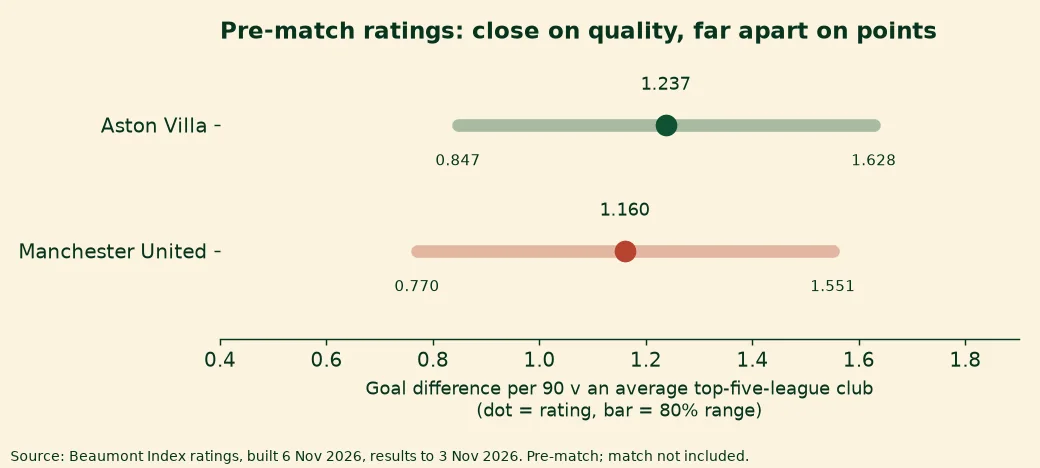
Before this match, our ratings put United and Villa closer than the table did. United were on 1.160 goals per 90 better than an average club from Europe's top five leagues, eighth in the Premier League on rating and 17th in the world. Villa were on 1.237, seventh in the league on rating and 14th in the world. The 80% ranges overlap. On quality, this was a peer fixture.
On points, it was not. United had seven points from nine games. The quality of the chances they had created and conceded was worth about 15.0. That eight-point shortfall was the third-worst under-collection in the Premier League, behind only Nottingham Forest and Sunderland. Villa had 12 points from chances worth about 7.1 — a 4.9-point surplus, among the league's largest.
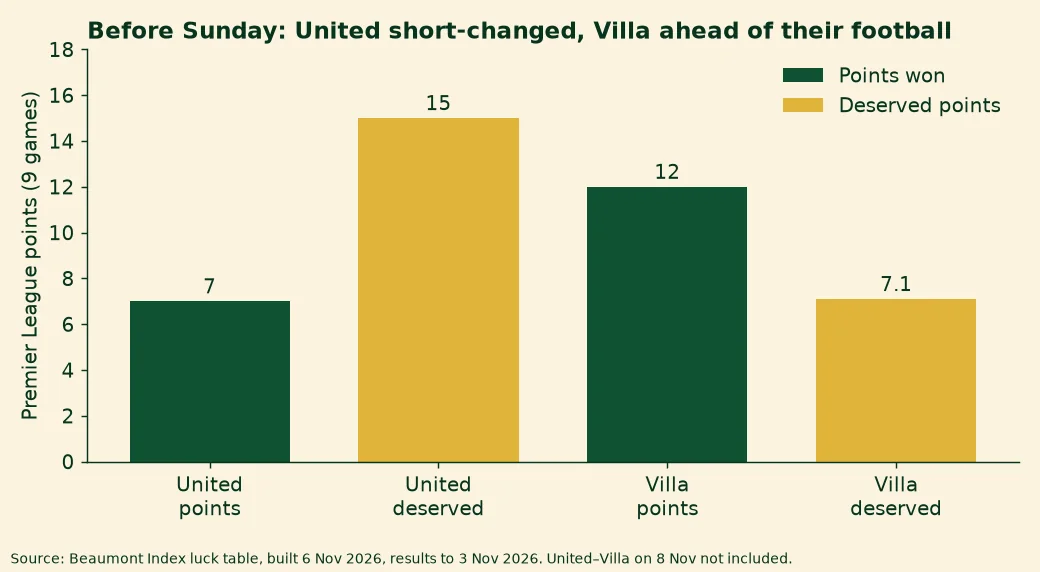
A 4–4 draw does not settle either of those stories. The pre-match model (results to 3 November) had United's chances worth about eight points more than they had banked, and Villa's points about five ahead of theirs. Sunday added one point to United's total and four goals against. For Villa it was a reminder that a two-goal lead at Old Trafford is not a banked result. Tuesday's ratings refresh will fold this match in. Until then these figures are the pre-match baseline, not a post-match verdict.
Carrick, Emery, and what a point buys
Carrick's post-match tone, across the public interviews, was defiant about his own future and clear about the problem: United make games too difficult for themselves. Emery's was anger at the manner of the equaliser and frustration at two points lost. Both reactions fit the tape. United did keep going. Villa did let a winning position go. Neither reaction changes the league table. United enter the international break in the relegation places. Villa sit in the top half with a sense of unfinished business.
The ownership banners and the jeers for Dalot are part of the atmosphere around this United team, and they belong in any honest account of the afternoon. They are not, by themselves, an explanation of Yoro's headed clearance or of a free-kick that Suzuki did not claim. On this tape the football problems are simple enough: goals conceded from moments that start with United in possession of the danger, and a point rescued by late volume when the scoreline has already escaped.
What happens next
United go to Anfield on 22 November. That is a hard place to take a chaotic 4–4 and turn it into momentum. Villa will return to a run of fixtures that ask whether their underlying numbers catch up with their points, or the other way round.
For United the useful reading of Sunday is uncomfortable and precise. In this match they scored in bunches when the game became a scramble, and they conceded in bunches while it was still a football match. The point keeps Carrick's side from another defeat in the drop zone. It does not pretend that two stoppage-time goals from crosses and free-kicks are a plan for Anfield.
The Index's pre-match picture still stands until Tuesday: with results to 3 November, United's performances were worth about 15.0 points against seven collected, and their defending on Sunday showed how a side in that position can still leak four at home. Villa were good enough to lead 2–0 and 4–2 and not good enough, on the day, to leave with three. That is an eight-goal draw: loud, unfinished, and decided by early mistakes and late deliveries.
FAQ
What was the score in Manchester United v Aston Villa?
United drew 4–4 at Old Trafford on 8 November 2026. Alysson and Jackson put Villa 2–0 up inside four minutes; United equalised twice, including in stoppage time through Zirkzee and Dorgu.
Did the Beaumont Index expect United to take points?
No match probability was published. Before the weekend United were among the Premier League clubs most short of the points their chances usually earn, and Villa were ahead of theirs.
Are these ratings after the match?
No. Every rating and luck figure in this piece is from the 6 November build, results to 3 November. Sunday is not included yet.