The short answerLiverpool beat Manchester United 4-0 on Sunday, but the match is a poor test of Pochettino's style: Yoro was sent off in the eighth minute and United played 82 of the 90 minutes with ten men. In our sample of early red cards the typical cost is two goals, and United conceded four. Our pre-match model had the two clubs closer in style than most Premier League pairs, so the result neither confirms nor refutes our 13 November piece.
The result is real. The evidence is not.
The facts first. Yoro was shown a straight red card in the eighth minute for fouling Alexander Isak as he ran through. Dominik Szoboszlai scored from the free kick in the tenth minute and Florian Wirtz made it 2-0 in the thirteenth. Rio Ngumoha added a third in the 66th minute and Víctor Muñoz a fourth in the 82nd. Liverpool had 28 shots to United's ten, 11 on target to three, and about 64% of the ball. United are 19th with eight points from eleven games.
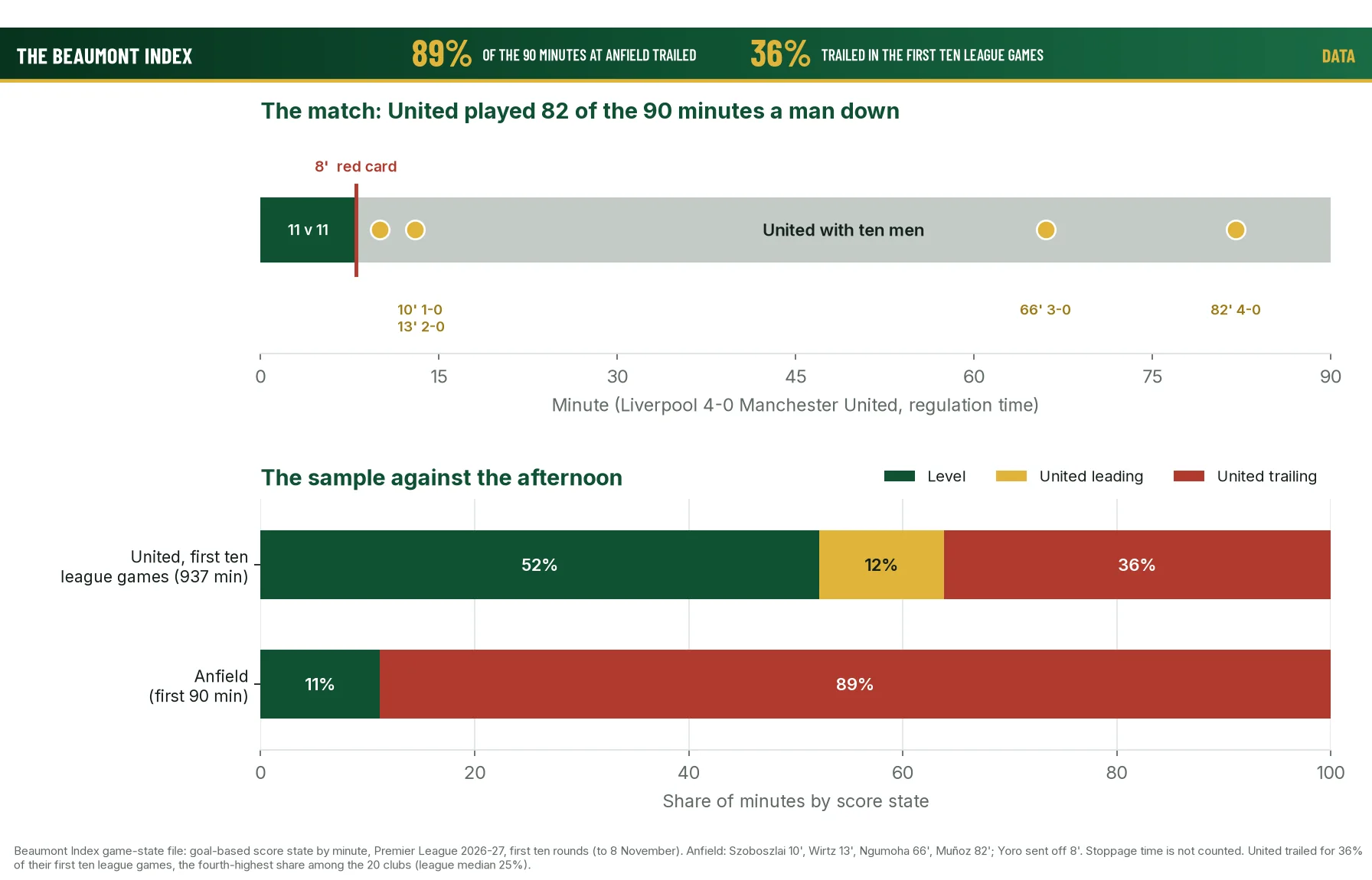
Those are the numbers a recap would end on. They are also the least useful numbers for the question we set ourselves on 13 November, which was whether Pochettino's United would look like his earlier teams on the ball and without it. To answer that you need minutes in which the game is open. Anfield supplied eight.
The chart below is the whole argument in one picture. Over United's first ten league games, 52% of the minutes were played with the score level, 12% with United in front and 36% with United behind. That is not a comfortable record. It is the fourth-highest share of trailing minutes among the 20 clubs, against a league median of 25%. But it is a mixed sample, with every kind of afternoon in it, and a style profile built on it describes how a team plays across those afternoons.
Anfield was a different object. United trailed from the tenth minute, which is 89% of the first 90, and they played 82 of those 90 minutes with ten men. Nothing that happened after the eighth minute was a measurement of the style we described. It was a measurement of a team defending a lost game.
What ten men usually costs, and what was unusual about this
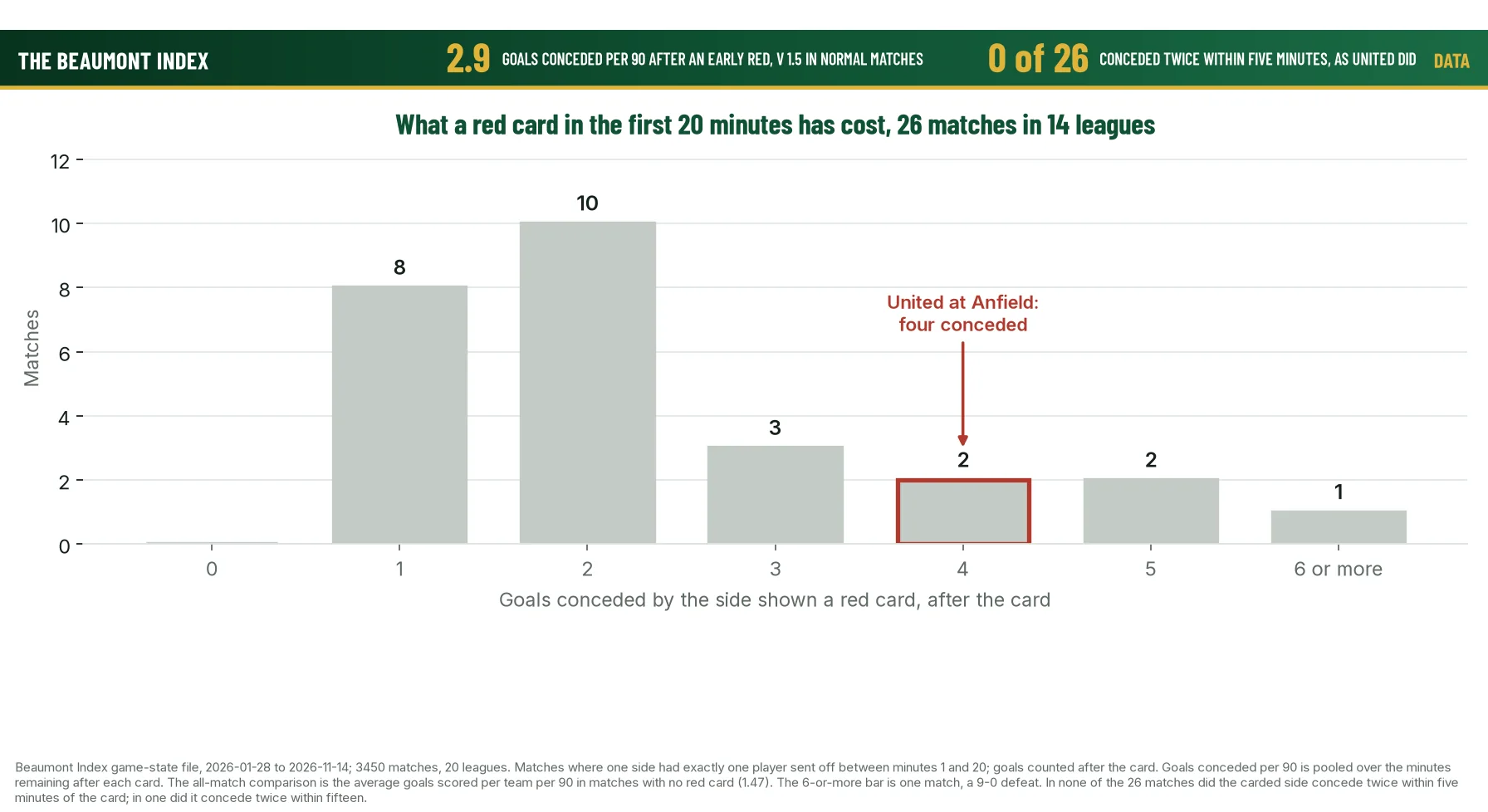
A red card is not rare enough to be treated as a freak event, so we can say something about what it normally does. In our game-state file, which covers 3,450 matches across 20 leagues from late January to 14 November, there are 26 matches in which exactly one player was sent off in the first 20 minutes. We counted the goals the carded side conceded after the card.
The typical cost is two goals. In 10 of the 26 matches the carded side conceded two, in eight it conceded one, in three it conceded three. Five conceded four or more, so United's four puts them in the heavy fifth, not in uncharted territory. Pooled over the minutes remaining after each card, the carded sides conceded 2.9 goals per 90, against 1.5 for the average team in a match with no red card. Ten of the 26 still scored at least once.
The unusual part was the speed. In none of the 26 matches did the carded side concede twice within five minutes of the card. In one did it concede twice within fifteen. United conceded twice in the five minutes between the card and the 13th minute. A red card makes a side more likely to concede. It does not normally make it concede in a heap.
That distinction matters, and one match cannot say why. What the match reports do agree on is how the move that ended in the red card began: with a ball over the top that a United defender misjudged. They name Matthijs de Ligt, who was handed his first league start in about a year in Pochettino's biggest selection call, with Harry Maguire left on the bench. In our files De Ligt had no league minutes for United in the first ten games. That is a reported detail about one action. It is not our measurement, and we do not offer it as proof of anything about method.
What our model said before kick-off
Our ratings, built to 10 November, had Liverpool seventh in the world and United 14th. Liverpool's rating was 1.51 goals per 90 better than an average club from Europe's top five leagues, United's 1.20: a gap of 0.31. The world-rank bands around those ratings overlap, five to 18 for Liverpool and seven to 33 for United. That is a gap between two clubs in the same band. It is not a prediction of anything, and nothing in it says four goals.
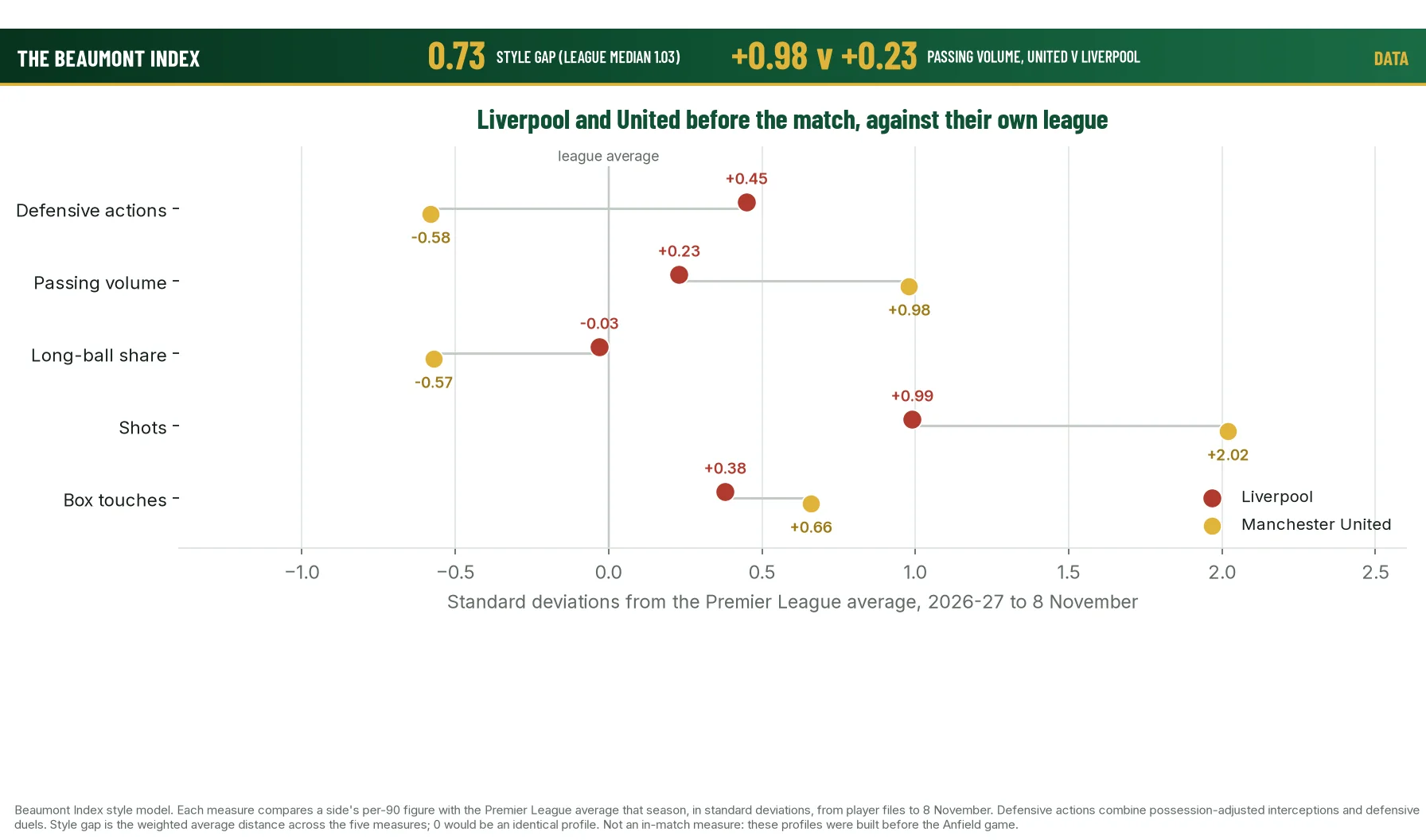
The style model said something more interesting. We measure five things as standard deviations from each side's own league: defensive actions, passing volume, long-ball share, shots and box touches. The weighted distance between two profiles is the style gap. Liverpool and United came out at 0.73. The median pair in the Premier League is 1.03. These were two clubs closer in style than the typical pair, and on passing volume the model had United as the side with more of the ball: plus 0.98 against plus 0.23 for Liverpool. On shots, United were at plus 2.02 and Liverpool at plus 0.99.
On the day Liverpool had 64% of the ball and 28 shots. That is the reverse of the profile. It tells us what the score state did on the day. It cannot tell us the profile is wrong, because the profile describes how the teams play across a spread of match situations, and Anfield was one situation, and an extreme one.
One detail is worth keeping. Liverpool's long-ball share sits at minus 0.03, the league average, so a ball over the top is not a signature of their style. We do not read the eighth-minute pass as a method. We read it as a single action that found a back line out of shape, and we leave it there.
What the footage shows, and what we cut
We watched the official highlights from the league's broadcaster and from the club, about three minutes of a 90-minute match each.
Highlights are enough to check specific claims and not enough to make general ones, so we held ourselves to three.
First, the eighth minute. A ball over the top of United's defence puts Isak through, and Yoro brings him down on the edge of the area. That is what the match reports say, and the footage and the commentary on it agree. Second, the minutes between the first and second goals. In the clip that covers that spell, most of United's outfield players are set deep around their own penalty area while Liverpool move the ball around the edge of it. Third, the highlights contain no passage in which United press high up the pitch.
The third point needs care. United had ten men and were two goals down. Not pressing is what any sensible side does in that position, so it is not evidence about Pochettino's intentions. It is simply true of the footage.
We cut several lines we had been about to write. We cut any claim about United's formation, because the highlights do not give a clean enough view to count the back line. We cut any claim about how the second and fourth goals were conceded, because the clips we reviewed do not show them clearly enough. And we cut any use of a match expected-goals number, because it is not one of our own outputs.
The 13 November piece, marked
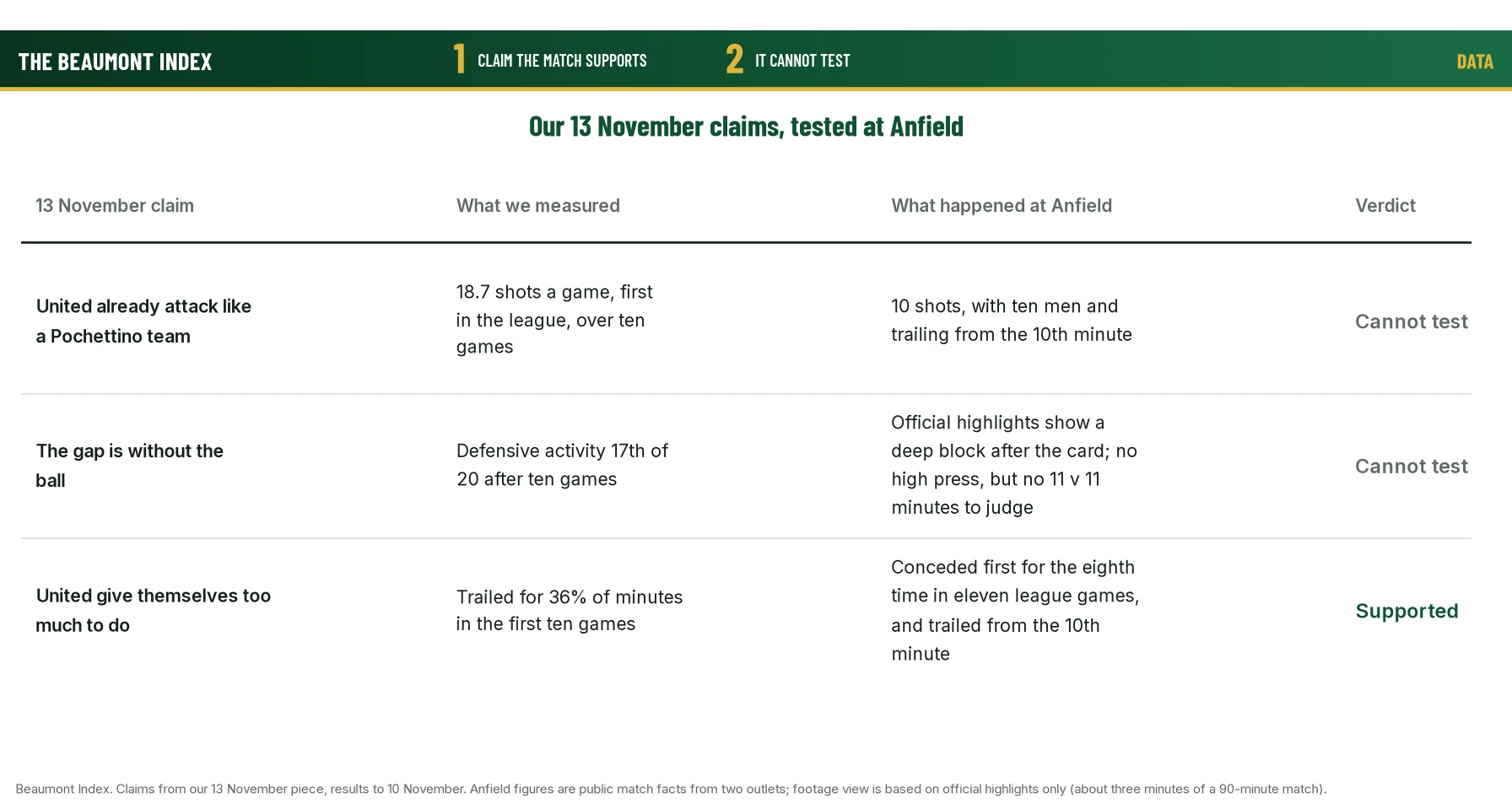
On 13 November we argued three things. United already shoot, progress and cross like Pochettino's measured teams. The gap is without the ball. And United have a habit of giving themselves too much to do. This is how each one fared.
The first claim cannot be tested. United had ten shots with ten men and trailed from the tenth minute. Our season figure was 18.7 shots a game, the highest in the league. A drop to ten tells us about the game state. It says nothing about the style.
The second cannot be tested either. The claim concerned how United defend when the match is level, with 11 players, and there were eight minutes of that on Sunday. The ball over the top at 8' is consistent with a defensive problem. It is one action.
The third is supported, and it did not need a red card. United have now conceded first in eight of their eleven league games, and in three of the eleven inside 20 minutes: Aston Villa after one minute, Liverpool after ten, Hull City after 17. They had trailed for 36% of their minutes before Sunday. Conceding first is an outcome, not a cause. We do not claim it proves a lack of pressing. We do claim that the pattern we described on 13 November, a side that regularly has to chase, is the pattern that the first ten games and Anfield both show.
What would count as a test
The next two games are the first with a chance to be fair. United are at Sporting in the Champions League on Wednesday at 20:00 UK time and host Brentford in the league on Saturday at 15:00.
Defensive actions are the measure to watch. United sit at minus 0.58 on it, below the league average, and a press, if it arrives, should show as that figure moving toward zero and beyond. One game will move it. One game will not settle it. We would want several league games played mostly at level or leading scores before saying anything about a change in style.
If it does move, the 13 November argument gets its test. If it does not, the argument was right about the problem and wrong about how quickly a coach can fix it. Either way, the thing to measure is the minutes when the game is level. The 4-0 will be remembered as Pochettino's debut. For our purposes, the debut is still to come.
FAQ
Did Liverpool's 4-0 win prove anything about Pochettino's style?
Very little. Yoro was sent off in the eighth minute and United trailed from the tenth, so 82 of the 90 minutes were played with ten men and 89% of them behind on the score. A style profile describes how a team plays across a spread of match situations, and this was an extreme one.
How often does a side sent off early concede four?
In our game-state file there are 26 matches in which exactly one player was sent off in the first 20 minutes. The carded side conceded two goals in 10 of them, one in eight, three in three and four or more in five, so United's four is in the heavy fifth and not uncharted territory.
What should we watch in United's next two games?
United are at Sporting in the Champions League on Wednesday 25 November at 20:00 UK time and host Brentford on Saturday 28 November at 15:00. The measure to watch is defensive actions, where United sit at minus 0.58 on our style model, below the league average. We would want several league games played mostly at level or leading scores before reading a change in style.