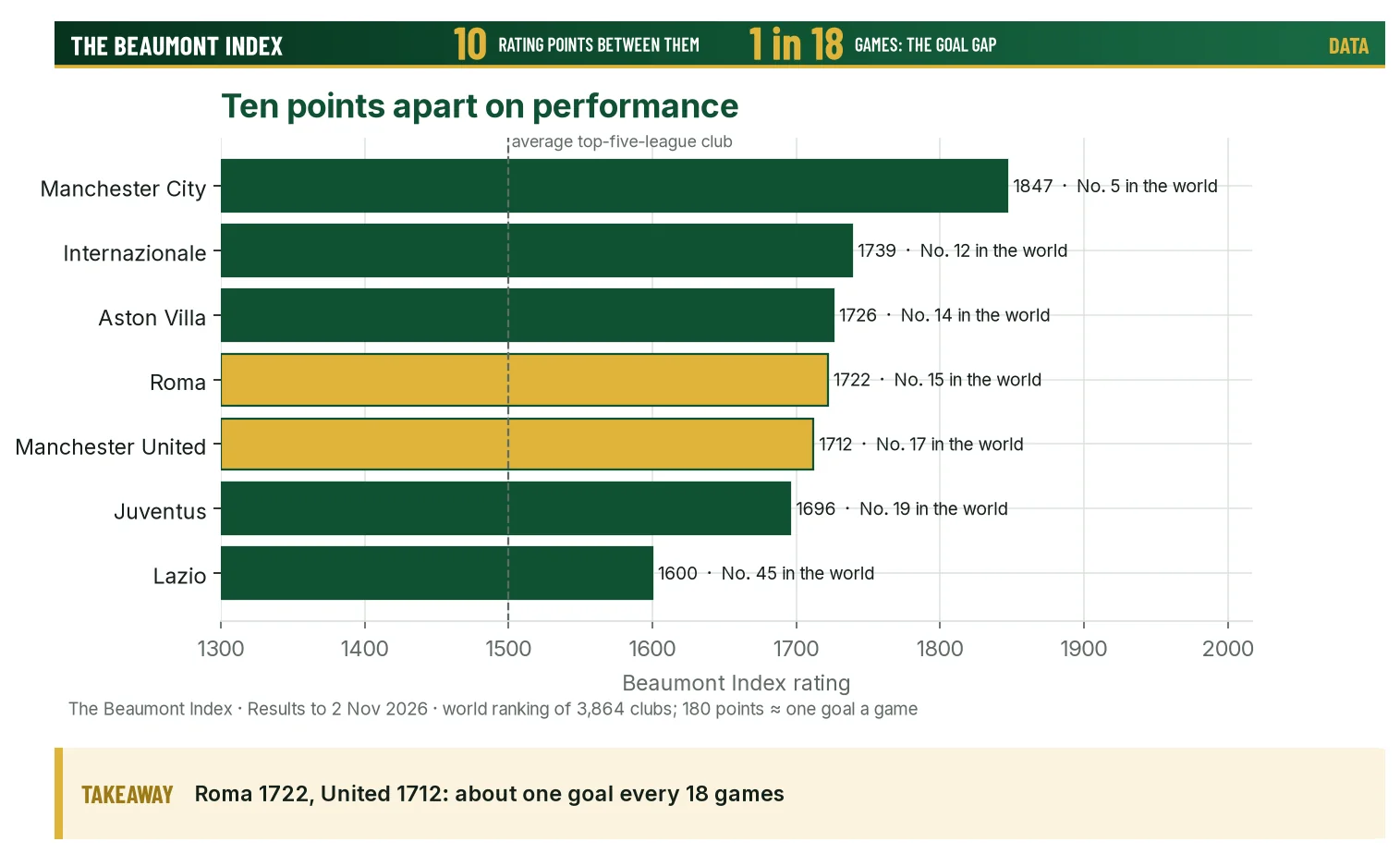
The short answerThe comeback barely changes our view of United. Before kick-off we had Roma on 1722 and United on 1712, ten points apart, and United 8.0 points short of what their league football deserved. A home win over an equal side is roughly what a 1712 team should get some of the time. What changed on Tuesday was the luck, not the level: a retaken penalty, a shot that hit both posts and stayed out, and a defensive error broke United's way for once.
Here is the uncomfortable thing about Manchester United's 3-2 win over Roma. If you believed what our numbers said before the game, nothing that happened at Old Trafford on Tuesday night should have surprised you, and nothing that happened should change your mind. Two sides rated 1722 and 1712 met. On our scale that is a gap of about one goal every 18 games. Roma were better for 45 minutes, United were better for most of the second half, and the result went to the side that got the bounces in the last ten minutes. That is what a coin-flip fixture looks like when it is played out in full.
The reason it feels like a turning point is that United's season so far has been a long run of the coin landing the wrong way. Before kick-off they had 7 Premier League points from nine games where the chances they created and conceded deserved about 15. That shortfall of 8.0 points was the third-biggest in England. On Tuesday, for about half an hour, every marginal moment went the other way. A penalty that was saved was retaken. A Roma centre-back misjudged a bounce. A shot that hit both posts did not go in, but the next two chances did. If you want one sentence for the night, it is this: United did not suddenly become a better team, they became a luckier one for 35 minutes.
That is not a criticism of the comeback, which was real and was earned by a genuinely better second half. It is a warning about what the comeback proves. The question we asked going in was whether this is a top-20 club playing badly or a top-20 club being punished by small margins. Tuesday is evidence for the second reading. It is not evidence that the problems we identified, the conversion at both ends and the defending of key moments, have gone away. Both of Roma's goals came from exactly those problems.
The first half was United's season in miniature
Roma scored twice in the opening 17 minutes, and both goals came from the same pattern. In the 11th minute United lost the ball in midfield, Roma moved it from right to centre and then played it through to the left, and Matías Soulé, set up by Rodrigo Mora, cut inside onto his right foot and finished low into the far corner. The footage shows United's defenders backing off rather than stepping in. Diogo Dalot, playing on the left rather than his natural right, was caught out of position as the ball was lost.
Six minutes later it was 2-0. A cross from the left flank was headed down, Soulé got a second chance after a poor clearance, and Ayden Heaven, sliding in to block, was penalised for handball after a VAR check. Donyell Malen scored the penalty. Soulé was the outstanding player of the first half, and Roma's shape, compact without the ball and quick to find the free man with it, was exactly what our numbers had suggested: a side whose average chance is among the best in Italy because it works the ball until the chance is a good one.
This is where our pre-match picture earns its keep. We said United's issue was not that they could not create or were being carved open every week, but that the key moments at both ends kept going against them. Roma did not need to dominate the first half to lead by two. They needed two moments, and United's defending gave them both. Senne Lammens then made a good save from Malen late in the half, the one first-half moment that went United's way, and it mattered more than it looked at the time. At 3-0 there is no comeback. United went in 2-0 down and were booed off. It was, according to reports, the first time they had ever trailed by two goals at half-time in a home European match.
The penalty retake was luck, but correct luck
The game turned in the 55th minute. Matheus Cunha was fouled in the box by Gianluca Mancini, and a VAR check confirmed the penalty. Bruno Fernandes's kick was too close to Devis Vásquez, Roma's third-choice goalkeeper, playing his first Champions League game for the club after Mile Svilar's injury and a late back problem for Pierluigi Gollini, who saved it. Bryan Cristante raced in and cleared the rebound before Fernandes could reach it.
Then the VAR, Carlos del Cerro Grande, intervened. Cristante had been on the edge of the penalty area as the kick was taken, and because he then challenged for the rebound and cleared it, the encroachment counted. Referee Jesús Gil Manzano ordered a retake. Fernandes drove the second one in, harder and higher, and Vásquez had no chance. United were 2-1 down in the 58th minute.
We want to be precise about the word luck here, because it matters for how we read the result. The retake was the correct decision under the laws. But it is the definition of a small-margin event. A Roma midfielder's foot on a line, at a moment when a goalkeeper had already done his job, turned a saved penalty into a goal. In the language of our model, the chance was the same chance both times. The outcome flipped on a detail that has nothing to do with how well either side played. Over nine winless games United had been on the wrong side of a long list of details like that. This was the first big one to go their way.
A minute later came the moment that tells you most about the night. Cunha slipped Bryan Mbeumo through one-on-one with Vásquez, and Mbeumo's shot hit one post, ran along the line, hit the other and stayed out. Had that gone in, United would have been level within four minutes of the penalty, and the story would be about a dominant second half. Instead it stayed 2-1 for another 24 minutes, which is the more honest version: United were clearly the better side, kept creating, and kept not scoring. That is precisely the pattern that produced their 8.0-point shortfall in the league.
Why the second half really was better
It would be wrong to put the whole comeback down to fortune. The second half was a different performance, and some of the reasons are structural rather than random. Carlos Baleba went off with a hamstring injury in the 51st minute, and Youri Tielemans came on. United's midfield improved from that point, with Kobbie Mainoo, who had lost the ball before the opener, settling into the game and helping United keep the ball in Roma's half. The pressure on Roma's back line became constant.
Gian Piero Gasperini was candid about it afterwards. He said the penalty gave United a huge boost and that his side lost the pressing battle and the individual duels, and admitted Roma could no longer track United's runners. That matches what the footage shows. In the last half-hour Roma's centre-backs were dropping deeper, their wing-backs were pinned, and the distance between their midfield and their defence kept growing. A side that had controlled the first half by being compact had become a side that was simply holding on.
Shot volume is United's defining style trait on our profile, well above the Premier League average, and this is what it looks like when it is turned on against a tiring opponent. Volume alone is not a virtue. But our deserved-points measure already weighs each chance by its quality, and it said before the game that United's chances were worth something close to a top-six side's. The second half was that side. The first half was the other one.
Cunha's eight minutes: a goal from an error, a goal from nothing, a red card
United's equaliser came in the 83rd minute. Fernandes clipped a ball into the box from the left, Leonardo Balerdi misjudged the bounce, and Cunha took a touch and finished from close range, beating Vásquez at his near post. Roma's centre-backs did not step to him. It was a goal built from pressure, but it was also a goal gifted by a defensive mistake, and Gasperini named it as the moment his side collapsed.
Three minutes later United were ahead. Shea Lacey, on for Amad Diallo in the 75th minute, played the ball inside to Cunha, who took a touch and drilled it in off the inside of the near post from a tight angle. Cunha took his shirt off and celebrated with the crowd, and was booked for it. In stoppage time he lunged into a challenge on Balerdi near the touchline and was shown a second yellow card. United played out the last minutes with ten men and held on.
Cunha was the best player on the pitch in the second half. He won the penalty, created the chance Mbeumo hit the posts with, and scored twice. He also, in the space of four minutes, picked up two cautions for things that had nothing to do with winning a football match. The red card should rule him out of United's next Champions League game, and for a side whose margin in this competition is now very thin, that is not a footnote.
What the result does and does not change
Start with the table, because the Champions League's league phase is where this result has the clearest consequence. United now have six points from four games and sit 17th. Roma have four and are 19th. In a 36-team table where the top eight go straight through and ninth to 24th go to the play-offs, United have moved from a position of genuine anxiety into the middle of the pack. That is worth a lot. It is also worth noting that 17th is precisely where United sat on our world ranking before kick-off, and very close to where their performance says they belong.
Now the rating. Our ratings judge clubs on the football they play rather than the points they collect, and a home win over a side rated ten points higher is close to the expected outcome for a team of United's level. It moves the number a little, not a lot. A comeback from 2-0 does not count for more than any other 3-2 win, and the first half, in which Roma were clearly better, counts too. If you were hoping the night would be read by our model as proof of a new United, it will not be. If you feared it would be dismissed entirely, it will not be either. It is one more data point, and it points the same way as most of the others: a top-20 club, playing like one.
The luck is the interesting part. Before kick-off United's league season was 8.0 points worse than their football, and last season it was 6.6 points better: a swing of 14.6 points. Roma, by contrast, had come back to almost exactly level with their football, at -0.7, after running 6.4 points ahead last season. We said then that one club's luck had reverted to normal and the other's had overshot. Tuesday is what reversion looks like, one match at a time. Not a dramatic correction, but a night on which a retake, a misjudged bounce and a shot off the inside of the post all went United's way.
That has a practical meaning for anyone reading the table. United's next few results are more likely to look like their football than their last nine did. That is not a prediction of a run. It is a statement about what usually happens to sides whose results have fallen this far below their chances. The shortfall does not have to be paid back, but it rarely keeps growing at the same rate.
Carrick: the night bought time, which is what the numbers wanted
On Monday we wrote that Michael Carrick, 9.6 months into the job, was standing in the most dangerous stretch of a coaching spell. In our coach-tenure study, of the completed spells that passed nine months, 51% ended before the one-year mark. The same study says teams peak at a median of 16.3 months, and 64% of peaks come after the first year. Our conclusion was that the sack risk was high and the case for the sack was weak.
Tuesday does not settle that argument, and it would be a mistake to pretend it does. A different referee's view of Cristante's foot and the story this morning is about a fourth straight defeat, a team booed off at half-time, and a coach in serious trouble. That is the point. When a manager's fate depends on a retake, the decision about him is being made on noise. Our case for patience did not rest on United winning this game. It rested on the gap between what United's football deserved and what it had produced, and that gap is still there after a win.
What the night did do is buy time, and time is the thing our tenure data says clubs most often fail to give. United's first win in ten games, with a second half that showed what the squad looks like when the midfield functions and the pressure is sustained, gives the club a reason to wait for the underlying numbers to come through. Whether it waits is a different question. But on the evidence of our model, the right call before Tuesday was patience, and the right call after Tuesday is the same.
The honest verdict
So: does the comeback change United's underlying picture, or was it a penalty retake plus late chaos? The answer is closer to the second, but with an important qualification. The late chaos was not random. It came after 35 minutes of sustained pressure from a side whose underlying numbers have been much better than its results all season. The retake gave United the first goal they had been creating towards. Balerdi's error came under pressure that had been building for half an hour. Cunha's winner was a finish from a player who had been United's best attacker all night.
Our pre-match view was that this was one of the most even ties of the Champions League week, between a Roma side whose points match their football and a United side whose points had fallen well short of theirs. The match played out almost exactly like that. Roma were the better team for a half and scored from United's mistakes. United were the better team for most of the second half and, for once, got paid for it. Neither side should take very much from the scoreline. Both should take a lot from the performance.
For United, the thing to watch is not whether they can produce another night like this. It is whether the first half, the losses in midfield, the defenders backing off, the cheap goals conceded, stop happening. Tuesday's second half was what United's numbers have said they are capable of. Tuesday's first half was why they have 7 league points. Only one of those can be fixed by luck.
Every club's rating, schedule and luck figure is on its club page, and the full table is in the world club ranking. Our preview of this game and our piece on Carrick's sack risk set out the numbers this piece relies on.
FAQ
Who won Manchester United v Roma?
Manchester United won 3-2 at Old Trafford on 3 November 2026 after trailing 2-0 at half-time. Matías Soulé and Donyell Malen (penalty) scored for Roma. Bruno Fernandes scored a retaken penalty and Matheus Cunha scored twice for United.
Why was Bruno Fernandes's penalty retaken?
Roma's Bryan Cristante encroached on the penalty area and then cleared the rebound after Devis Vásquez saved the first kick. The VAR advised a retake, and Fernandes scored the second attempt.
Why was Matheus Cunha sent off?
Cunha was shown a second yellow card in stoppage time for a lunging challenge on Leonardo Balerdi. His first booking came for removing his shirt while celebrating the winner.
Does the win change how good Manchester United are?
Not much, on our numbers. United were rated 1712 and Roma 1722 before kick-off, about one goal every 18 games apart. United's league results had been 8.0 points short of what their football deserved, and Tuesday's win looked like that luck turning rather than a new level.