The short answerMichael Carrick is 9.6 months into the Manchester United job, and our coach-tenure study says that is the most dangerous stretch a coach who has survived the first half-year can be in: of the completed spells in our data that passed nine months, 51% ended before the one-year mark. But the same study says teams peak at a median of 16.3 months, and that 64% of peaks come after the first year. United are 17th, but their chances in our latest model run were worth about 12 points against the seven they took. On our numbers, the sack risk is high and the case for the sack is weak.
That is the non-obvious part of the Carrick story, and it is why we are writing it today rather than after Tuesday's game against Roma. Most of the conversation about whether he survives is about results: nine games without a win in all competitions, a 2-0 defeat at Chelsea on Saturday, and a place in the table above the relegation zone on goal difference only. Our numbers are about timing. Football is very good at removing coaches in the window just before their teams usually improve, and Carrick is standing in that window.
Where the 51% comes from
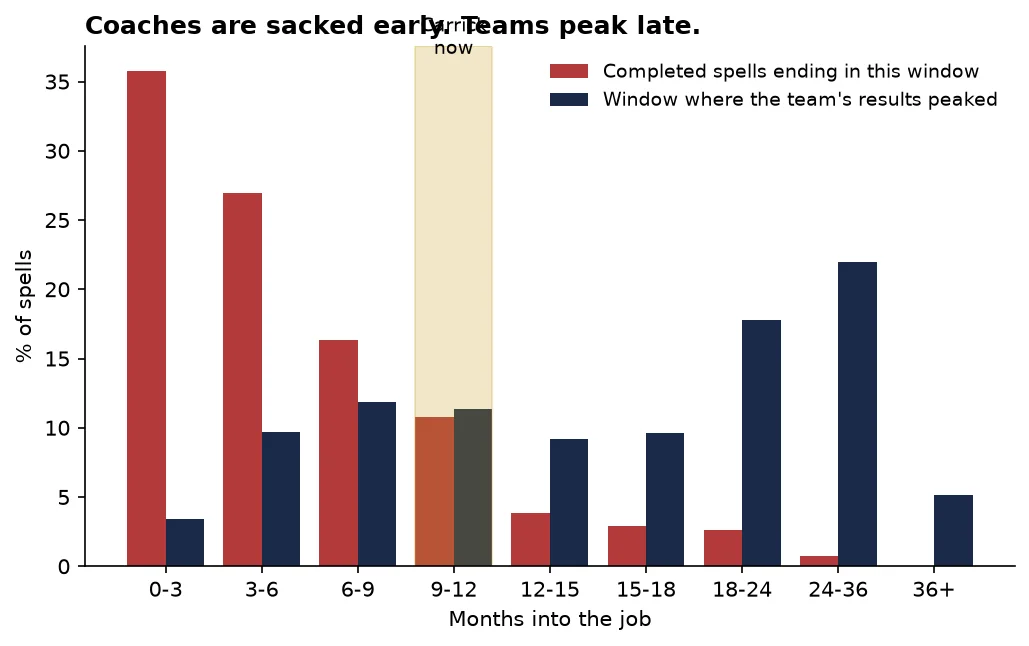
Our coach-tenure study covers 6,876 head-coach spells and about 346,000 matches since December 2022. Of the spells that have already ended, 2,115 in total, the median lasted four months. About 36% were over inside three months and 79% inside nine.
The 51% is what happens to the rest. Only 443 completed spells made it past nine months. Of those, 228 ended in the next three months, between month nine and month twelve. Put another way, once a coach is past the first-season cull, the three months before his first anniversary are when most of the remaining departures happen.
We need to be careful about what that number is. It is drawn from spells that have finished, so it leaves out coaches who are still in their jobs, and long-serving coaches are more likely to still be in theirs. It is not a forecast that Carrick has a 51% chance of being sacked by January. It describes a pattern in the sport: the nine-to-twelve-month stretch is the point at which clubs that kept their coach through a first rough patch most often decide not to keep him through the next one.
The other half of the curve
The study's second number is the one clubs seem to ignore. When we measure each team's results against what its squad and opponents would normally produce, the median peak came 16.3 months into a coach's spell. Of the 1,909 spells long enough to measure a peak fairly, only about a quarter peaked inside the first nine months. Nearly two-thirds, 64%, peaked after month twelve, and the single most common window for a peak was between two and three years in.
Put those two curves next to each other and the shape is strange. Departures are front-loaded. Peaks are back-loaded. The point where the two curves pass each other is close to where Carrick is now. A club that sacks a coach at ten months is, on average, giving up on the bit of the spell where the improvement usually starts.
None of this means every coach improves if left alone. Some spells never peak. Some peak early and fade. But the base rate is clear, and it runs against the instinct of every boardroom that has just watched a nine-game winless run.
The study's second number is the one clubs seem to ignore.
Is United's football as bad as the table?
The second question is whether United's position is a fair reflection of how they have played. Our ratings say no.
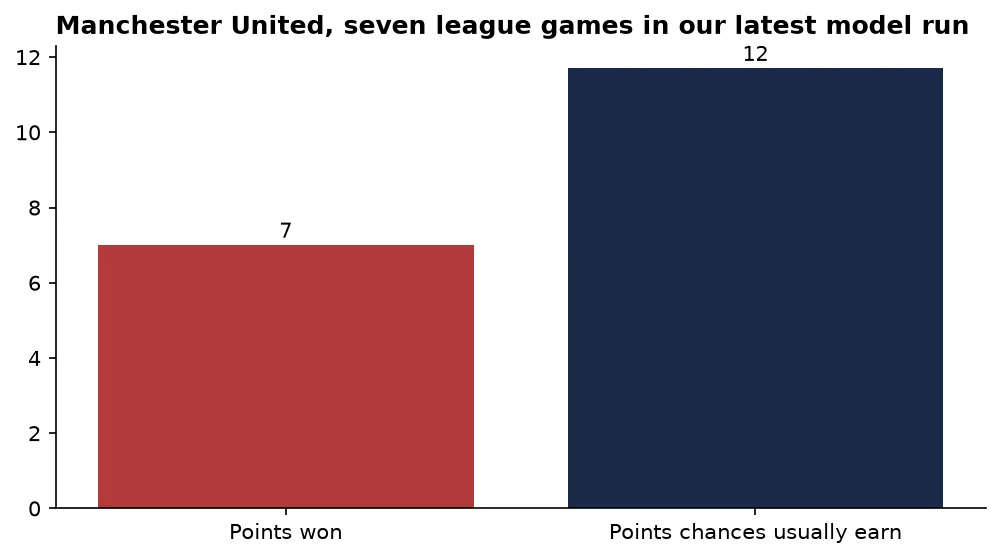
In the seven Premier League games in our latest full model run, United took seven points. The chances they created and conceded in those games would usually have earned about 12. That shortfall of almost five points was one of the biggest in the league. Per game, United's chances were worth 1.67 points, the sixth-best rate in the Premier League. They had the shot volume of a top-six side, almost two standard deviations above the league average, and the results of a side near the bottom.
Saturday's game at Stamford Bridge was a compact version of the season. United had the better first half. Bruno Fernandes shot over when unmarked and Amad Diallo was twice denied by Mike Penders. Morgan Rogers then scored five minutes after half-time, Lisandro Martínez was sent off for a second yellow card, and Cole Palmer scored the penalty. A promising first half had turned into another defeat.
On our world ranking United were 14th before the weekend and seventh in the Premier League on performance. A results-only update for the Chelsea defeat takes them down 12 rating points, to about 1716. That is still a top-20 club in the world on our numbers. The table has them 17th in England.
What the pillars say about Carrick
Our ratings split each club into six pillars, each ranked as a percentile against the rest of its league. United's profile is uneven, and it is worth reading carefully because it points at where the problem is and isn't.
Club decision-making is in the 100th percentile in the Premier League. The first XI is in the 75th. Those are the parts of a club that take years to build, and United have them. Squad depth is in the 53rd. The weak pillars are star spread, in the 20th, which means quality is concentrated in a few players, and squad lifecycle, in the 10th, which reflects the age and contract shape of the group.
The manager pillar, which measures how a team performs under its current coach compared with what the squad suggests, is in the 44th percentile. That is below average, but it is not the bottom of the league. Read with the chance numbers, the honest summary is this: Carrick's United create enough to be a top-six side, finish and defend key moments like a bottom-six side, and get roughly what an average Premier League coach would get from this squad's pillars. That is a disappointing coach. It is not, on these numbers, a coach whose team has collapsed.
The record before this season
Carrick was appointed on 13 January 2026 on an interim basis after Ruben Amorim left, with United sixth. He was made permanent on 22 May after taking United into the Champions League and securing a third-place finish. That spell is part of the reason his position is being treated as a judgement call rather than a formality.
It also matters for the tenure numbers. A coach who arrives mid-season and has a strong first four months often looks better than he is, because a new voice and a reset squad can lift results quickly. The test is what comes after the honeymoon. Carrick's second phase, this season, has been worse on results. On chances, it has been far better than his results.
What the club has said
The Guardian reported on Sunday that Carrick will be in charge against Roma and that his position is expected to be reviewed again during the international break, after United host Aston Villa next Sunday. The same report said director of football Jason Wilcox and chief executive Omar Berrada had met the previous Monday to discuss his future and decided to give him a chance to turn things around. The Manchester Evening News also reported that he would take the Roma game.
So the decision window is roughly two weeks: Roma on Tuesday, Villa on Sunday, then a break. That fits the 51% pattern almost exactly. This is the stretch where clubs that held their nerve once decide whether to hold it again.
Tuesday against Roma
Roma arrive at Old Trafford third in Serie A, unbeaten in five, and 15th in the Champions League league phase. United are 21st. On our ratings the two sides are almost level: Roma are 18th in the world at 1711, and United about 1716 after Saturday's update. Roma's style stands out for shot quality, close to two standard deviations above the Serie A average on the value of each chance. United's stands out for shot volume.
With home advantage, our ratings make United the slightly stronger side on Tuesday. That is the opposite of how the game is being framed. It is not a prediction, and a single match can go either way. But it is a reminder that the question being asked about Carrick, can he get a result against a strong side, has a better answer on the numbers than in the headlines.
The case for the sack
It is fair to make the strongest version of the other argument. Nine games without a win is a long run for a club of United's resources. Creating chances and not taking them is a problem a coach is partly responsible for: shot selection, the players chosen to take the shots, set-piece routines. The manager pillar is below average. And a 17th-placed club cannot ignore a relegation table just because its expected points look better.
There is also the human side that numbers cannot see: the decision to drop Bruno Fernandes and then restore him, and a red card for one of the senior defenders at the moment the Chelsea game turned. If a dressing room has stopped responding, that can show up in results before it shows up in chance data.
Our view is that the evidence for those things is not yet strong enough to override the base rates. But it is a judgement, and it could be wrong.
The verdict
The headline number is 51%. Of the coaching spells in our study that passed nine months and have since ended, just over half ended before the first anniversary. Carrick is at 9.6 months. That is the risk.
The answer to whether United should sack him is the other number: 16.3 months, the median point at which teams peak. Add the chance data, which says United have played like a top-six side and been paid like a bottom-three one, and our numbers point the same way they did in October. Judge Carrick at 16 months, on performances. If United sack him in the next fortnight, they will be doing what football usually does, and on our data what football usually does is a little early.
Coach-tenure figures are from the Beaumont Index study of 6,876 head-coach spells since December 2022. Club ratings, expected points, pillars and style figures are from the Beaumont Index model with chance data to 25 October 2026; the Chelsea result is folded in with a results-only rating update. Table, quotes and club news from match reports and published reporting.
FAQ
Is Michael Carrick about to be sacked?
Manchester United have said he will be in charge against Roma on 3 November, with his position expected to be reviewed in the international break. Our coach-tenure study cannot predict a decision, but it shows that of completed spells that passed nine months, 51% ended before the one-year mark.
When do football managers' teams peak?
In our study of 6,876 head-coach spells since December 2022, results relative to expectation peaked at a median of 16.3 months, and 64% of peaks came after the first year.
Are Manchester United as bad as the table says?
No. In the seven league games in our latest full model run, United's chances were usually worth about 12 points; they took seven. Their chances per game ranked sixth in the Premier League.