Ratings and world ranks in this piece come from before our 25 October 2026 ranking update. Current figures are on each club's page.
The short answerBarcelona beat Real Betis 5-2 at La Cartuja on 17 October 2026 because they controlled almost everything that can be measured: 69% of the ball, 18 shots to six, and chances worth roughly three goals to Betis's one. Lamine Yamal won eight of his ten duels from the right wing, and Facundo Bernal's red card at 2-3 ended the contest.
The ball was still rolling towards the far corner when the first Betis fans began to sit down. Ten minutes in at La Cartuja, Lamine Yamal had rolled his foot over the ball to beat Facundo Bernal and hit a fierce strike from outside the box, and the stadium that had come to find out whether third could live with first got its answer early. It would get it four more times.
The final score was 5-2. There was a sensational Giovani Lo Celso volley ruled out, a straight red card for Facundo Bernal, and, by the end, Barcelona had nine league wins from nine. All of that will be remembered. This piece is about the bits that won't be: the shapes, the switches, the duels and the moment the game stopped being a game.
The shapes: a mirror, with one crack
On paper this was a mirror match. Manuel Pellegrini and Hansi Flick both named a 4-2-3-1. For Betis that was routine: it was their main shape in seven of their previous eight league games. For Barcelona it was a choice. In their previous eight league games, Flick's main shape had been a 4-3-3 five times. Here he went with two holding midfielders, Rodri and Pedri, behind Fermín López, with Yamal right, Karim Adeyemi left and Gabriel Jesus up front.
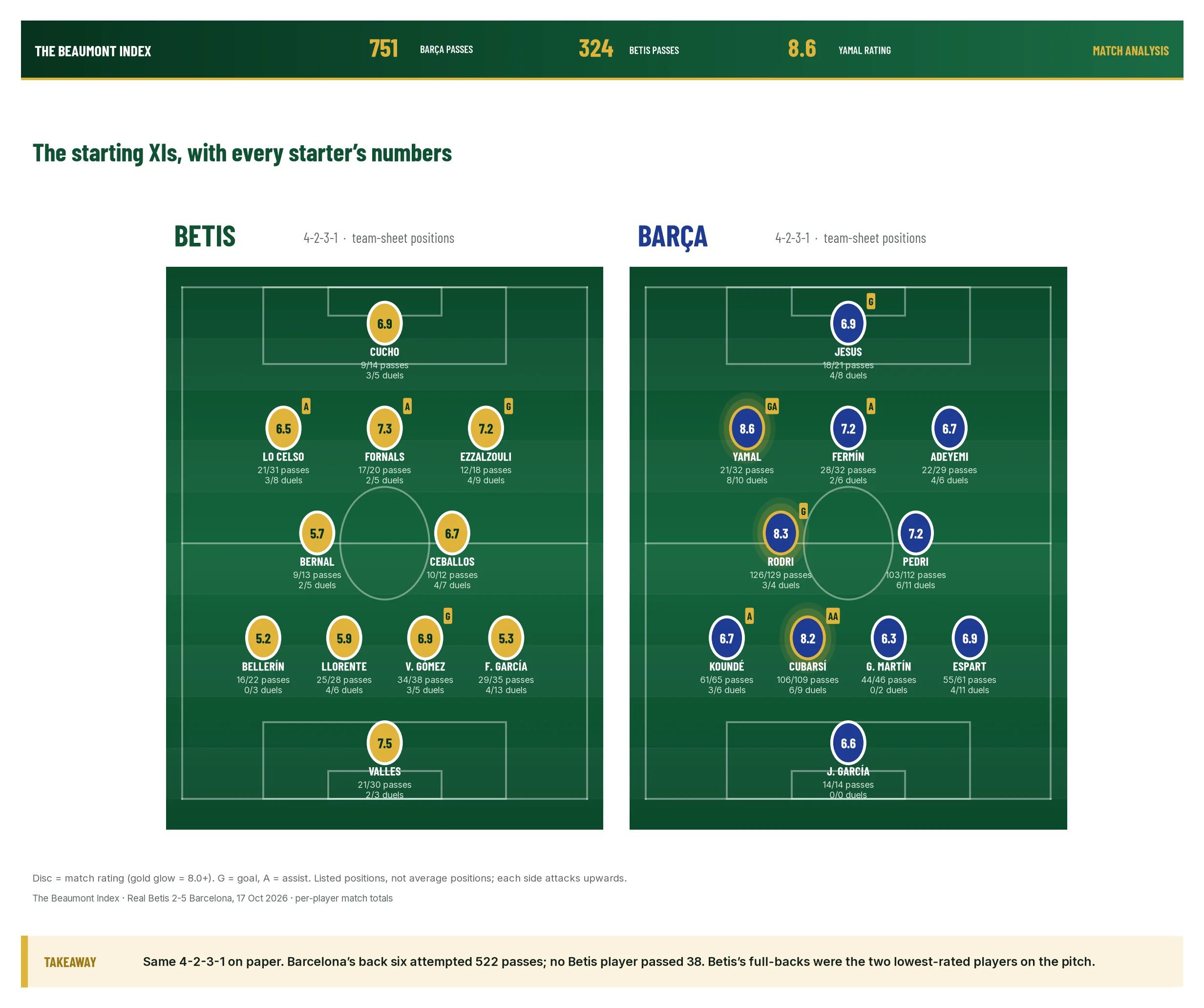
Put each starter's numbers where the team sheet put them (listed positions, not where they actually stood) and the match draws itself. Barcelona's back four and double pivot attempted 522 passes between them, 70% of the team's 751. Five Barcelona players attempted 60 or more. No Betis player got past 38, and that was Valentín Gómez, a centre-back. The best-rated Betis player was their goalkeeper, Álvaro Valles, on 7.5, which is what happens when you face this many shots and only let in five. The two lowest-rated players on the pitch were Betis's full-backs: Héctor Bellerín on 5.2 and Fran García on 5.3. Barcelona's three best starters were Yamal (8.6), Rodri (8.3) and Cubarsí (8.2), one from each line of the team.
The double pivot matters because of what it allowed the full-backs to do. With Rodri and Pedri both sitting, Jules Koundé and Xavi Espart were free, we'd infer, to push on without leaving the centre-backs exposed. Koundé set up the first goal; Espart attempted more dribbles than any Barcelona defender. Barcelona held their 4-2-3-1 for the whole match. Betis held theirs for about 61% of it; most of the rest, we'd infer, was the reshuffle after the red card.
The crack in the mirror was on the Betis left. Fran García, listed at left-back, had Yamal in front of him, and Abdessamad Ezzalzouli, ahead of him, is a winger whose job is to run at people: he tried five dribbles. That's a reasonable trade most weeks. Against Yamal, it was an invitation.
How Barcelona attacked: patience, not speed
Barcelona weren't trying to beat Betis on the break. They had one counter-attack all match, about their season norm. What they had instead was volume: 47 positional attacks, against an average of about 35 in their previous eight league games, with 14 of them ending in a shot. They passed the ball 751 times and completed 92%. Rodri alone completed 126 of 129. Pedri completed 103, and Pau Cubarsí 106 from centre-back.
The double pivot matters because of what it allowed the full-backs to do.
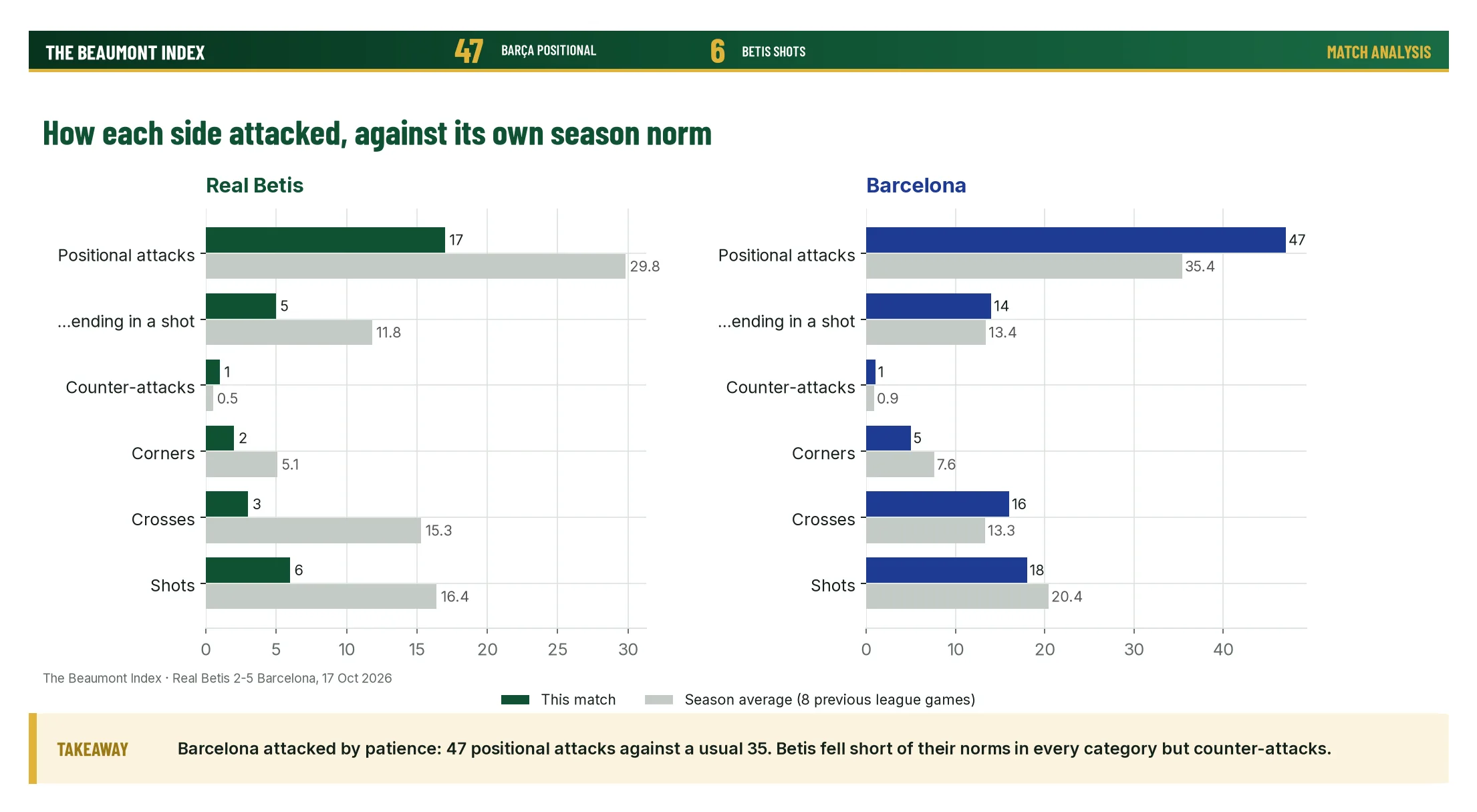
Here's the interesting bit, though. For all that control, Barcelona's chances weren't unusually good by their own standards. Depending on which model you trust, their chances were worth somewhere around three goals, which is a big number, but below their season average on either of the models we use. Their 18 shots were slightly fewer than usual, and of their 16 crosses only two found a teammate. What Barcelona did unusually well was finish: five goals from chances worth about three. Rodri headed in Fermín's corner. Eric García tapped in after Cubarsí got to the ball first following a blocked Yamal free-kick and squared it. Yamal's strike and Dani Olmo's late strike were the kind of finishes no chance model expects.
How Betis attacked: almost not at all
Betis's numbers are the starker ones. In their previous eight league games they averaged about 30 positional attacks, 15 crosses, five corners and 16 shots. Here they managed 17 positional attacks, three crosses, two corners and six shots. They had 31% of the ball and completed 256 passes, about a third of Barcelona's total.
And yet the six shots were good ones. Five were on target, and the chances were worth a little over a goal. Betis's two goals both came from moments when they briefly got numbers forward: Valentín Gómez heading in Pablo Fornals' cross after a corner wasn't cleared, and Ezzalzouli racing clear to finish across Joan García straight after Barcelona's third. Lo Celso's ruled-out volley, cancelled after a review found a handball by Cucho Hernández earlier in the move, would have been a third moment. That's the honest summary of Betis's attack: not much of it, but not nothing. Joan García had five shots on target to deal with, and two went in.
Pressing and defending: Barcelona squeezed, Betis retreated
The clearest single number in this match is how far apart the two pressing styles were. We measure pressing as the number of passes a team allows its opponents before making a defensive action: lower means more aggressive. The LaLiga median this season is about 11.6.
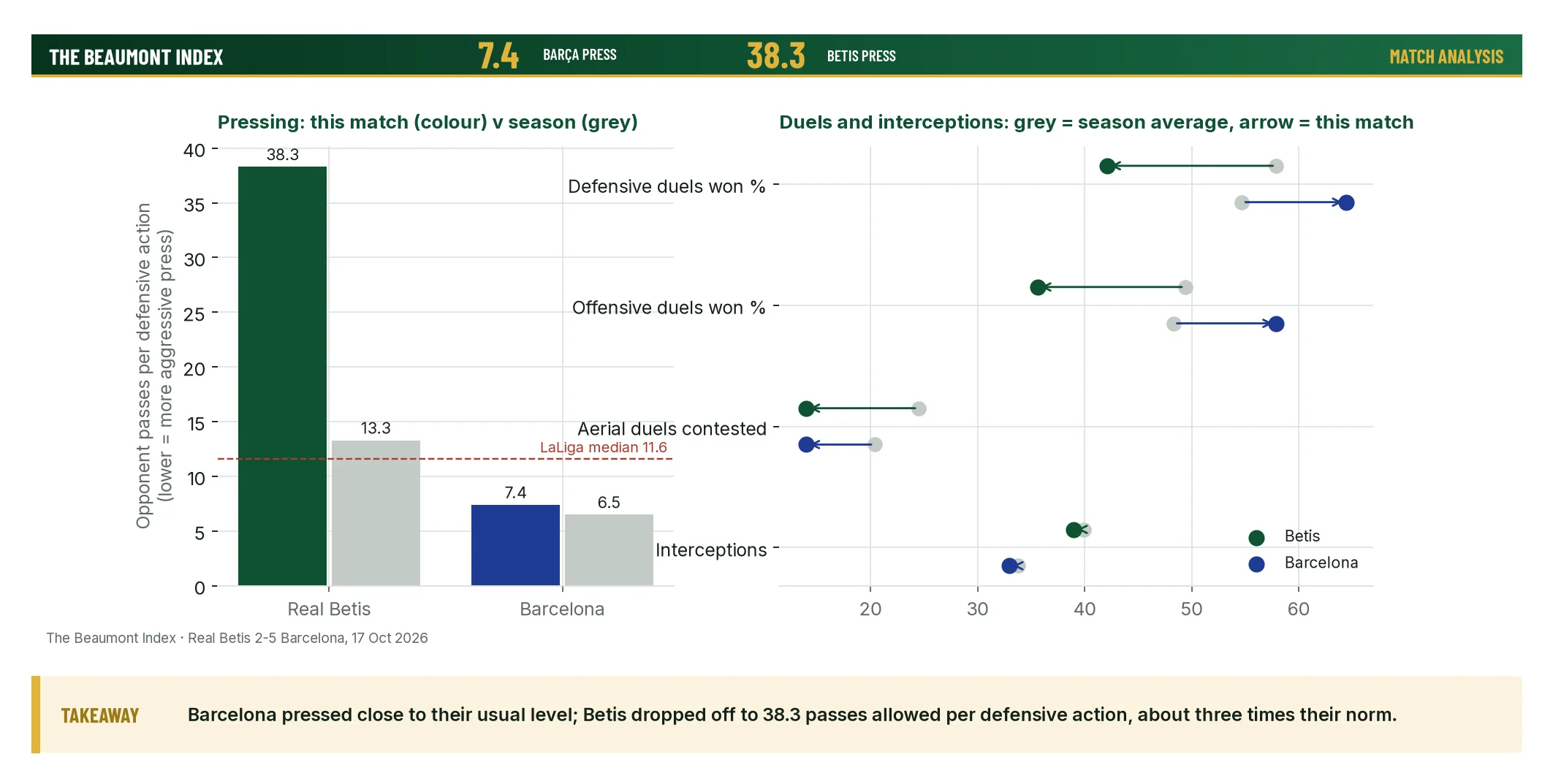
Barcelona allowed Betis 7.4 passes per defensive action, close to their own season average of 6.5 and far more aggressive than the league typical. Betis allowed Barcelona 38.3. Their season average is about 13. Some of that is the red card, and some is simply what happens when the other side has 69% of the ball. We can't split these numbers by half, so we can't say how much of the retreat was choice. The duels suggest it wasn't only the red card.
Betis won 42% of their defensive duels, against a season average of 58%. Barcelona won 64%, against their own norm of 55%, and they won 58% of their attacking duels, against a usual 48%. That's the match in two numbers: when a Barcelona player ran at a Betis player, he usually got past. Interceptions were bang on both teams' averages, 39 for Betis and 33 for Barcelona, which tells you the Betis block was in roughly the right places. The problem was what happened when it had to engage.
The individual numbers count more strictly, so their totals are smaller, but they tell the same story and show who did the work. Betis players made 17 tackles and 14 interceptions, 31 defensive actions in all, against Barcelona's 21. More than half of Betis's came from the back four: seven tackles and ten interceptions, against four and four for Barcelona's defenders. Fran García (two tackles, three interceptions) and Diego Llorente (three and two) made five each, the most on the pitch. Bellerín made three interceptions and won none of his three duels. We'd read that as a back line that spent the afternoon reacting rather than stepping out, though without locations that is an inference.
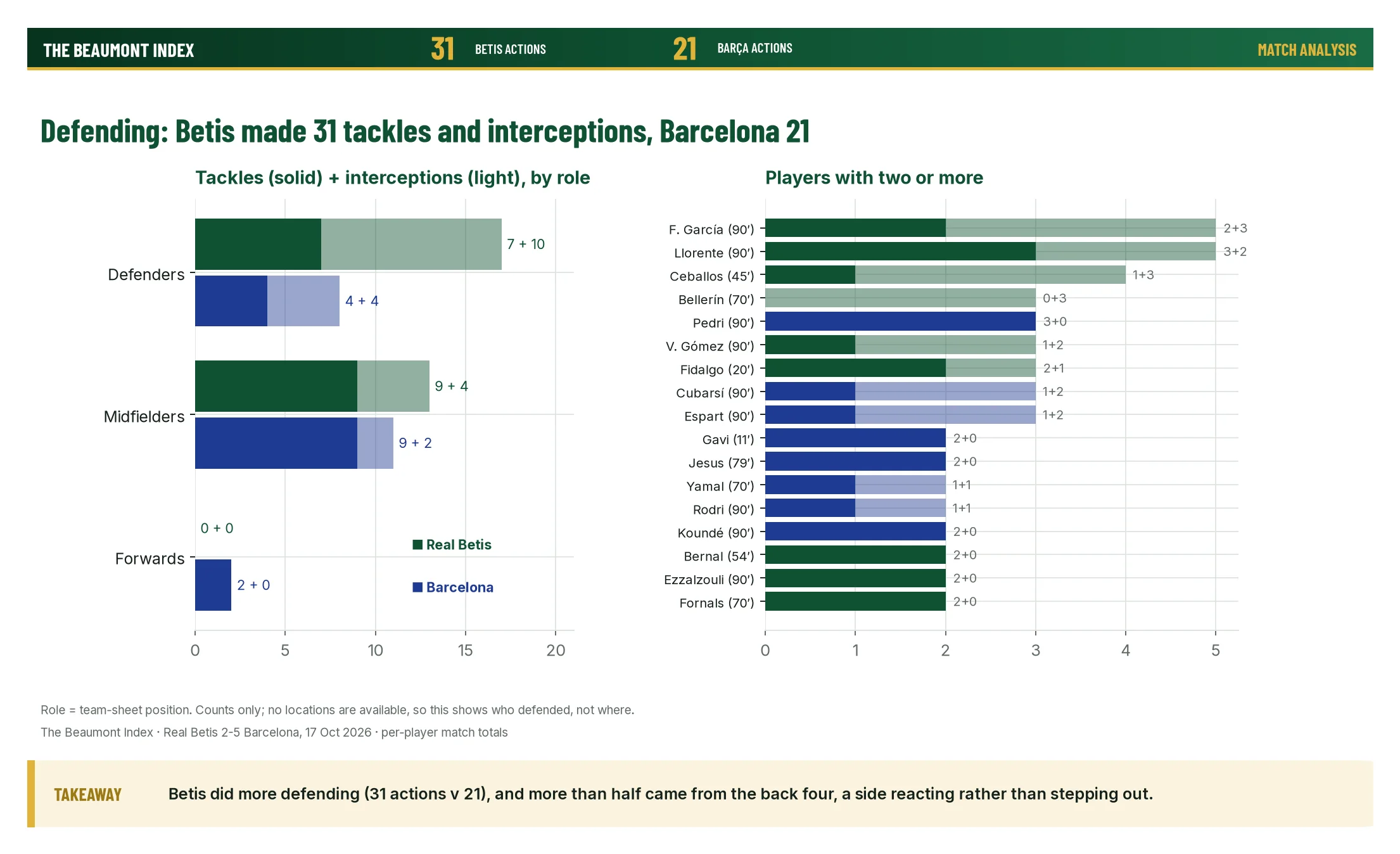
Barcelona's defending was spread more evenly up the pitch. Their midfielders made nine tackles, the same as Betis's, and Pedri's three were the most by any Barcelona player. Their forwards chipped in two, both from Jesus, while Betis's forward line made none. Even Gavi, on for the last 11 minutes, made two. That fits the pressing numbers above, though we should be clear about the limits: these counts tell you who made a tackle, not where on the pitch it happened.
The key battle: Yamal against the Betis left
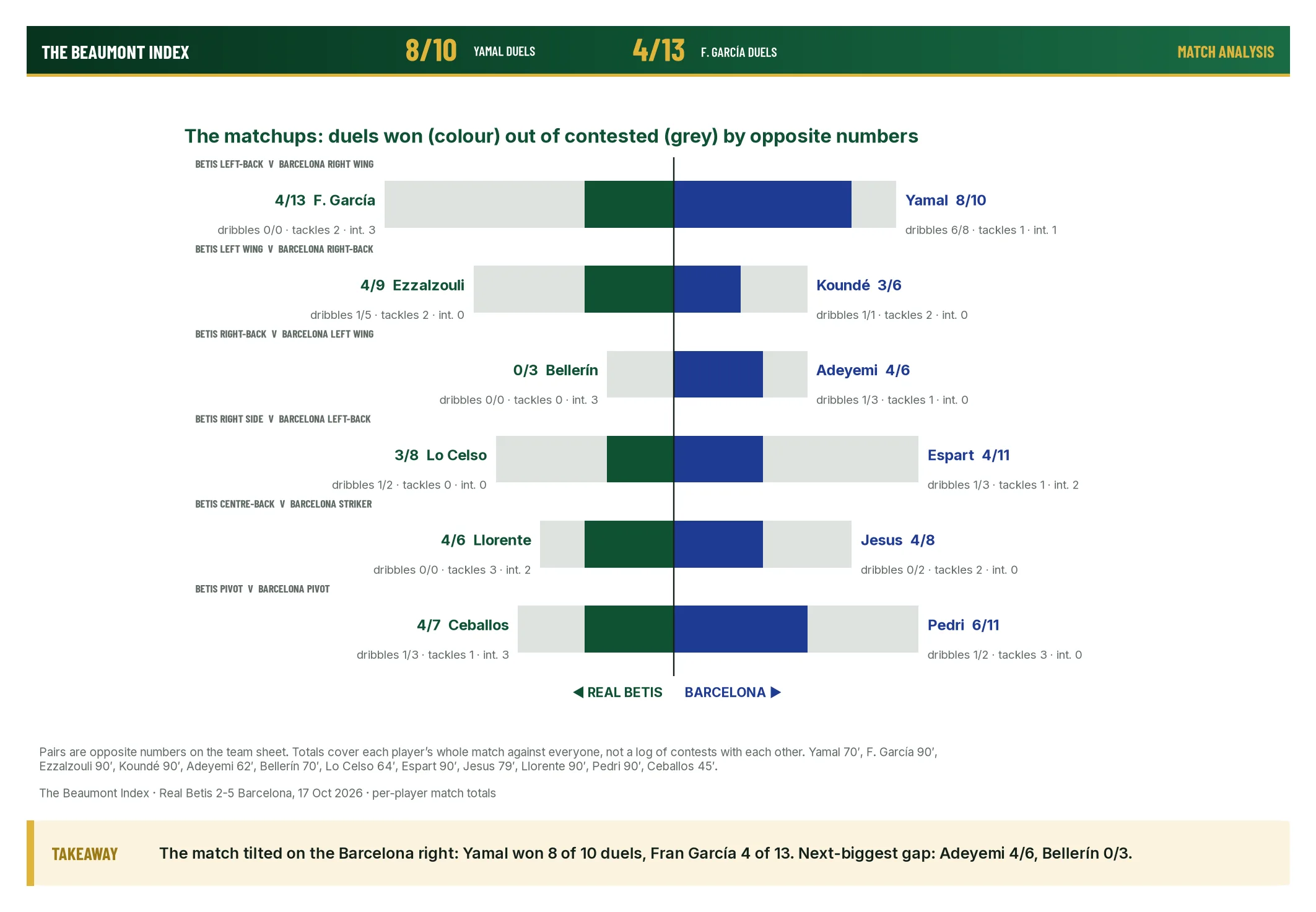
If you want one matchup to explain the afternoon, it's this one. Yamal played 70 minutes, contested ten duels and won eight. He tried eight dribbles and completed six, had three shots with two on target, scored the first goal and set up the third. Fran García, on the other side of that flank, contested 13 duels and won four, and was dribbled past seven times, more than anyone else on the pitch.
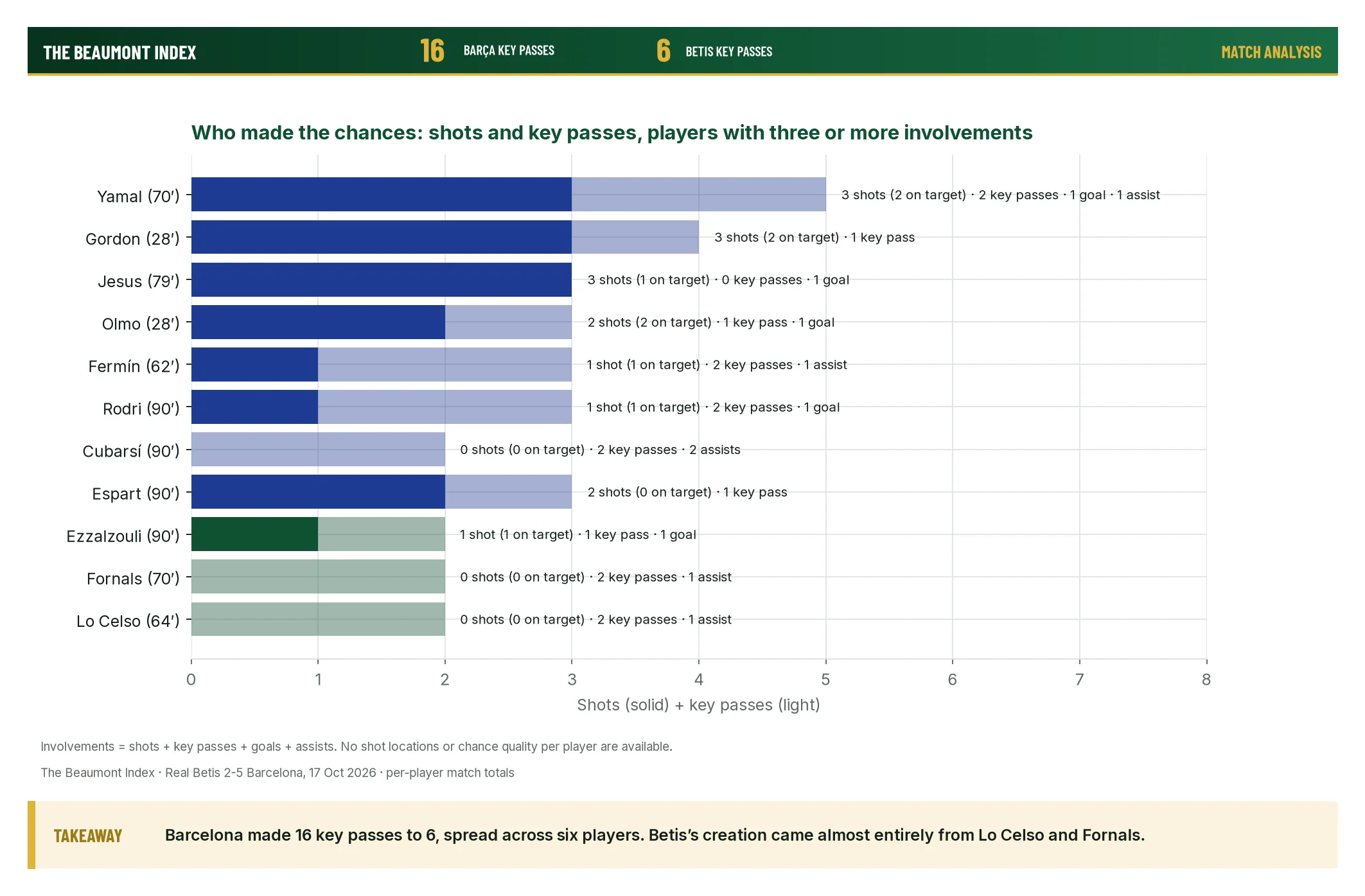
Yamal also led the match for attacking involvements: three shots, two key passes, a goal and an assist. Across the team, Barcelona players made 16 key passes to Betis's six. Six Barcelona players made two each, including both holding midfielders and Cubarsí from centre-back. Only Lo Celso and Fornals did that for Betis, and between them they set up both Betis goals.
We should be careful here. These are match totals, not a log of one-on-one contests, and Fran García was often left two against one by a winger ahead of him who was looking the other way. But the shape of the numbers is clear enough. Barcelona's best player spent the afternoon running at Betis's most exposed defender, and the Betis plan didn't change to protect him until it no longer mattered.
The other flanks were closer, and more interesting. Ezzalzouli, the winger in front of Fran García, won four of his nine duels against Koundé's side of the pitch but completed only one of his five dribbles. He still scored, because one clean run was enough. On the other side, Adeyemi won four of his six duels and Bellerín won none of his three, though Bellerín did make three interceptions. Lo Celso, on the Betis right, won three of eight duels against Xavi Espart's flank, but his two key passes made him one of Betis's two main creators. Espart was busy at both ends: 11 duels, four won, three dribbles tried and two shots, neither on target.
The other battle was in the middle. Betis's double pivot of Bernal and Dani Ceballos was meant to stop Rodri and Pedri dictating. Between them, in the minutes they played, they made 25 passes. Rodri and Pedri made 241. Pellegrini took Ceballos off at half-time for Nelson Deossa, the first sign that he knew the midfield had gone. That wasn't for lack of effort: Ceballos won four of his seven duels and made three interceptions in 45 minutes. Pedri, opposite him, won six of 11.
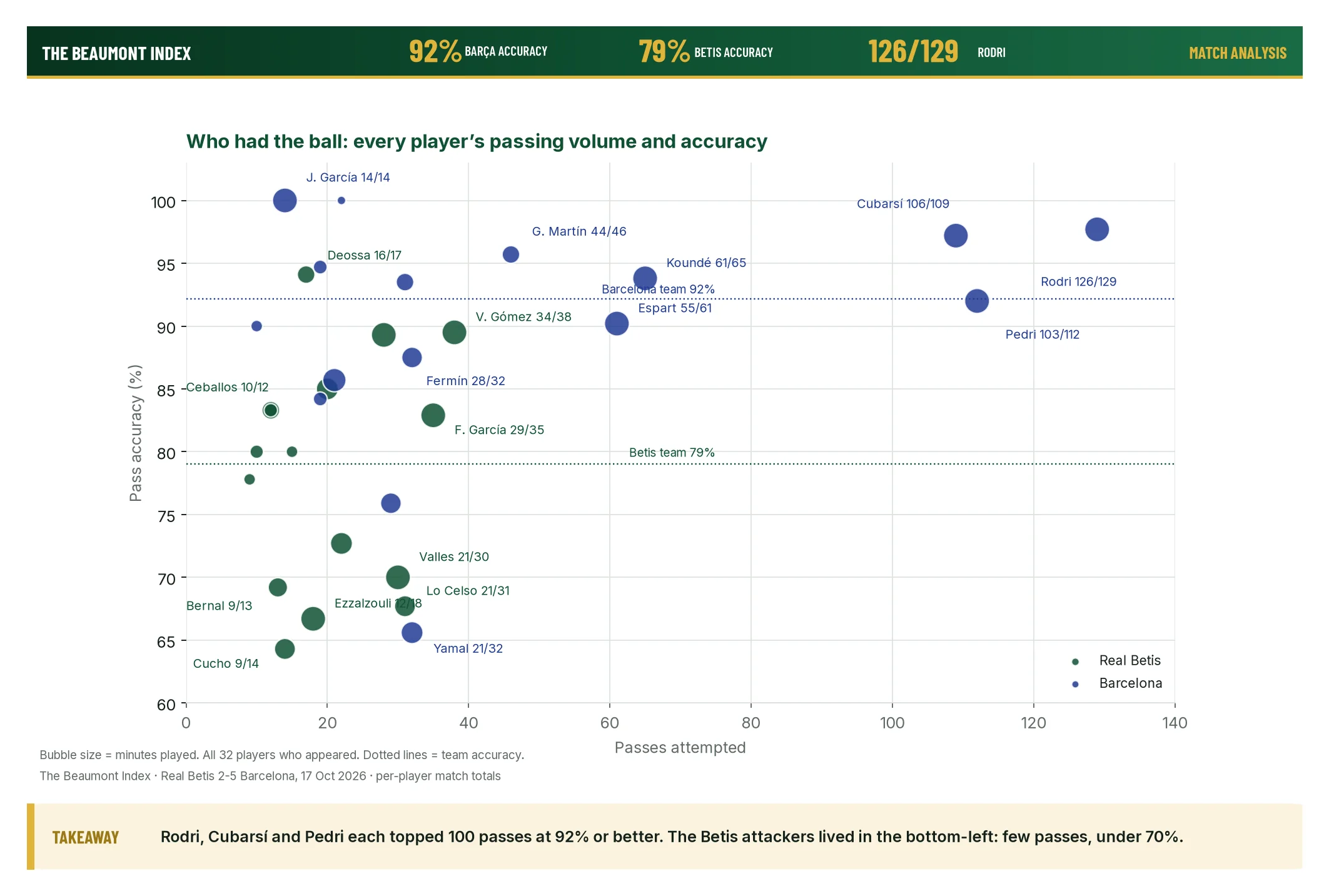
The scatter shows the two kinds of player on the pitch. In the top-right corner are Barcelona's circulators: Rodri at 98%, Cubarsí at 97%, Pedri at 92%, all with more than 100 passes. Bottom-left are the forwards who were asked to do difficult things with the ball. The four lowest pass-accuracy figures among the starters belonged to Cucho Hernández (64%), Yamal (66%), Ezzalzouli (67%) and Lo Celso (68%). For Yamal that is the cost of trying things; for the Betis attackers it is the cost of receiving the ball with three Barcelona shirts around them. Betis as a team completed 79% of their passes, Barcelona 92%.
The changes, and the turning point
Both coaches made half-time changes. Pellegrini's was about control: Deossa for Ceballos. Flick's was like for like at centre-back: Eric García for Gerard Martín. García would score. Jesus had a goal ruled out for offside moments before, then, six minutes after the restart, Yamal squared for him to make it 3-1.
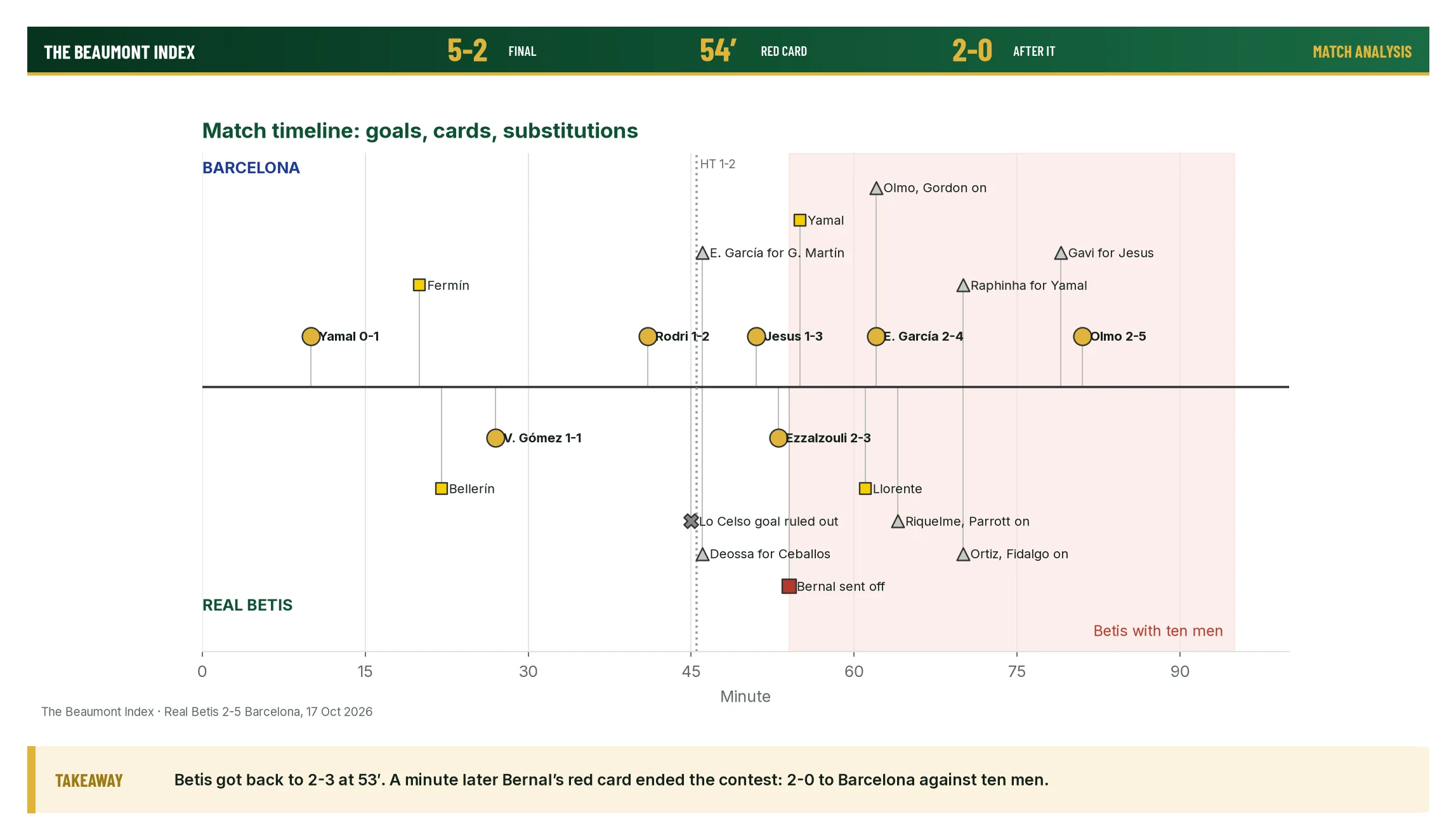
Then came the two minutes that decided it. At 53 minutes Ezzalzouli made it 3-2, and for the first time since the 27th minute Betis had a game. Within seconds, Bernal and Yamal came together in the scramble that followed; Bernal was shown a straight red card for violent conduct. Until that moment Barcelona had been the better team without being out of sight. From that moment they were playing against ten men who had to chase a goal.
Flick's response was immediate and aggressive. At 62 minutes he sent on Olmo and Anthony Gordon for Fermín and Adeyemi, and in the same minute García finished from close range after Yamal's free-kick was blocked and Cubarsí got to the ball first and squared it. Pellegrini went for broke at 64 minutes, bringing on Rodrigo Riquelme and Troy Parrott, then Ángel Ortiz and Álvaro Fidalgo at 70. It changed nothing. Olmo's strike in the 81st minute was the fifth, and Cubarsí's second assist. After the red card the score was 2-0 to Barcelona, and Betis didn't manage a goal with ten men.
A fair judge has to weigh the red card properly. At 2-3, with 37 minutes left, Betis were in the game. But the numbers before it already favoured Barcelona heavily, and the gap on our ratings, 224 points or roughly 1.2 goals a game, said a Barcelona win by about a goal was the fair expectation anyway. The red card turned a likely win into a rout. It didn't turn a Betis win into a defeat.
What it means next
For Betis, this was the reckoning the Index had been warning about. Going into the weekend they were collecting 2.29 points per game from performances worth 1.40, the biggest overperformance in LaLiga, about six points over seven games. On the Index they are rated 1532, a good team; Barcelona are rated 1763. Bernal now faces a ban, and without him Pellegrini has to rebuild the double pivot that lost the midfield here. The tactical question for Betis isn't really about Barcelona. It's whether the left side can be protected against good wingers, because Yamal won't be the last.
For Barcelona, the more interesting test comes next, against a Real Madrid side the Index rates second in Spain. The 4-2-3-1 with Rodri and Pedri together looked like an away-game shape: control first, attack through the right. Whether Flick keeps it, or goes back to the 4-3-3 he has used more often this season, will tell us how he sees that game.
At La Cartuja, the fans who sat down early were right. They had seen enough to know. The numbers had known for a while.
FAQ
What was the score in Real Betis v Barcelona?
Barcelona won 5-2 at La Cartuja on Saturday 17 October 2026, their ninth league win from nine.
What formation did Barcelona play against Betis?
A 4-2-3-1, with Rodri and Pedri as a double pivot. In their previous eight league games Barcelona had started in a 4-3-3 five times.
What was the turning point in Betis v Barcelona?
Facundo Bernal's straight red card in the 54th minute, seconds after Betis had pulled the score back to 2-3. Barcelona scored twice more against ten men.
Who was the best player in Betis v Barcelona?
Lamine Yamal: a goal, an assist, eight of ten duels won and six of eight dribbles completed in 70 minutes.