
The short answerIlia Ivanschitz, Liefering’s 19-year-old vice-captain, made nine key passes in his first seven league games this season, against four in all of last season, while playing deeper in midfield. Then his league minutes all but stopped: 11 since 17 October, though he started a Youth League tie. Nobody has said why.
On 17 October, Ilia Ivanschitz played all 90 minutes of a 4-1 defeat at Blau-Weiß Linz. It was his ninth league start in nine games. A week later he wasn't in the matchday squad at all. Since then he has played four minutes against Rapid's second team and seven against Austria Salzburg, long enough to score a penalty. In between, he started for Salzburg's under-19s in the UEFA Youth League, scored against Genk and stayed on until the 83rd minute.
So this is not a report about a player who can't get a game. He started nine league games in a row, and then, in late October, the league side stopped starting him. Liefering haven't explained it, and nothing published so far does. What we can do is look carefully at the numbers from before it happened, because they are the most interesting thing about him, and then be honest about how far they go.
The No. 10 who rarely made the clear chance
Ivanschitz was born on 7 April 2007. He wears 16 for Liefering, Red Bull Salzburg's cooperation club in Austria's second tier, and he has played for Austria at under-17 level. Austrian press coverage this season describes him as Liefering's vice-captain.
Last season he arrived slowly. He sat on the bench for the opening game in August 2025 and spent the autumn coming on for short spells. Before 1 November 2025 he never played more than 45 minutes in a league match. After it he became a regular, usually playing between an hour and the full 90. By the end he had 22 league appearances, 1,203 official minutes and four goals. Our event data tagged him mostly as an attacking midfielder, a No. 10 or close to it.
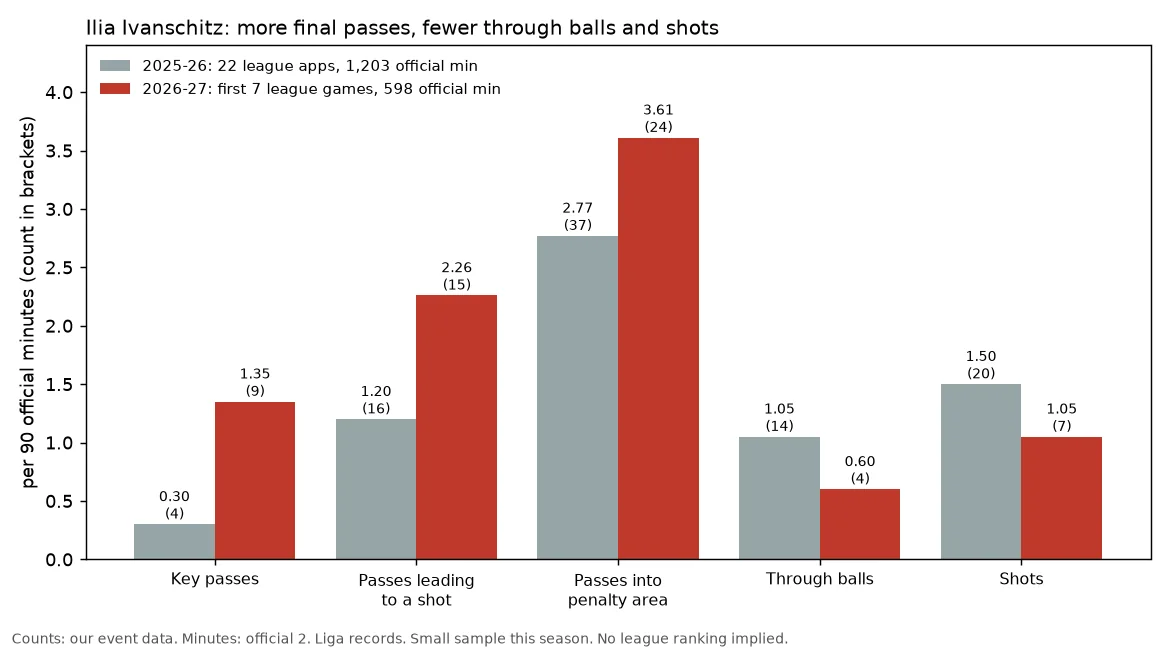
Two of the event-data categories need separating here, because they measure different things. A pass leading to a shot is simply the last action before a team-mate shoots, whatever the shot. A key pass is narrower: a pass that immediately creates a clear goalscoring opportunity. Last season Ivanschitz had 16 passes leading to a shot but only four passes classified as key passes, roughly one every 300 minutes. So he was setting up shots, but few of them were the clear chances that the key-pass category is meant to capture.
This season the same event data describes a different position. It tags him mainly as a left-sided central midfielder, and sometimes as the deeper of two. On the face of it, that should make the clear chance harder to come by. A player who starts further from goal usually has more ground and more defenders between him and the final pass.
Further from goal, more clear chances
In his first seven league games, to 18 September, he made nine passes classified as key passes. That's more than double the previous season's total in roughly half the minutes. On official league minutes it works out at 1.35 per 90, up from 0.30.
Passes leading to a shot went from 1.20 per 90 to 2.26, and passes into the penalty area from 2.77 to 3.61. His expected assists for those seven games came to 1.6, against 1.3 across all of last season. Those numbers all rose together, but they aren't independent confirmation of each other. They come from the same passes, the same source and the same seven games, and one good run of games would lift all of them at once. What they do show is that the rise in key passes wasn't a quirk of one category. Across every way the event data counts his chance creation, there was more of it.
Some of his other passing fits the new tags. His average pass got shorter, under 16 metres against about 18 last season. It also got more accurate, 75% against 69%, and more of it went sideways. That is the pattern you'd expect from a player handling the ball more often in midfield.
So for seven games he was doing more of the tidier work and still making more clear chances than he had as a No. 10. Whether the move deeper produced that, or simply coincided with a 19-year-old getting better, the numbers can't say. Players improve between seasons whatever position they're in, and the opposition in seven games is not a controlled experiment.
What went down
Two numbers went the other way.
The first is through balls. He played 14 last season, 1.05 per 90, and four in the first seven games of this one, 0.60. So the extra creation hasn't come with more passes that split a back line. Our numbers don't tell us where his other chance-creating passes started, so we can't say what replaced them. That needs location data or video.
The second is his own shooting. He took 20 shots last season, 1.50 per 90, and seven in those seven games, 1.05. He has still scored three league goals this season: one in the 4-0 opening win at KSV 1919, one in a 3-2 win at Voitsberg and a penalty against Austria Salzburg on 6 November. Over this sample there is limited evidence of a consistent scoring threat from midfield. Seven games can't tell you what he will become, only that goals are not yet the strong part of the case.
Without the ball, the numbers are thinner and harder to read. He's involved in fewer duels than last season, about 15 per 90 against 21, and he's making fewer interceptions, 1.8 against 2.4. He is listed at 177cm and rarely contests in the air. Those are counts, not a judgement. Whether he reads danger, covers ground or presses well is a question for video, and we haven't watched it, so it's left open.
Then the minutes stopped
Here is his league season in full, from the 2. Liga's official match pages.
| Round | Date | Opponent | Result | Minutes |
|---|---|---|---|---|
| 1 | 31 Jul | KSV 1919 (a) | Won 4-0 | 90, scored |
| 2 | 7 Aug | Hertha Wels (h) | Lost 3-2 | 90 |
| 3 | 16 Aug | First Vienna (a) | Drew 2-2 | 82 |
| 4 | 21 Aug | Young Violets (h) | Won 2-1 | 80 |
| 5 | 28 Aug | Voitsberg (a) | Won 3-2 | 90, scored |
| 6 | 13 Sep | St. Pölten (h) | Lost 3-1 | 76 |
| 7 | 18 Sep | FAC (a) | Lost 4-0 | 90 |
| 8 | 10 Oct | Sturm Graz II (h) | Won 3-1 | 63 |
| 9 | 17 Oct | Blau-Weiß Linz (a) | Lost 4-1 | 90 |
| 10 | 24 Oct | Schwarz-Weiss Bregenz (h) | Drew 2-2 | Not in squad |
| 11 | 31 Oct | Rapid II (a) | Won 2-1 | 4 |
| 12 | 6 Nov | Austria Salzburg (h) | Won 4-1 | 7, scored (pen) |
That's 762 minutes, nine starts and three goals in 11 appearances. Read down the right-hand column and you can see where it changes. Nine starts, then nothing, then two cameos.
The easy story is that a heavy defeat cost him his place. The table doesn't settle that either way. Liefering were beaten heavily at Blau-Weiß Linz, but they had also been beaten heavily at FAC a month earlier, and he started the next league game after that one.
And whatever has kept him out of the league side hasn't kept him out of football. On 3 November he started the Youth League second-round second leg against Genk, scored the third goal early in the second half of a 4-3 win and went off in the 83rd minute, according to match reports in LAOLA1, Sky Sport Austria and the Salzburger Nachrichten. The published line-up that night had him in the front two, not in midfield.
Why his league minutes dropped is unknown. Liefering haven't said, and we won't guess.
Where he goes next
He has said where he wants to go. In an interview with the Kronen Zeitung published on 12 September, he said his concrete aim was to make the jump from Liefering to Red Bull Salzburg, and the paper added that Spanish football appeals to him longer term. He named Barcelona's Fermín López as the player he most enjoys watching at the moment. And he said what he needed to work on in the 2. Liga: winning his duels and imposing himself, and making more of an impact in attack. That is a fair self-assessment, and it lines up closely with the numbers above.
The Fermín line is the interesting one. The thing people notice about Fermín is the arrival, the midfielder who turns up in the box and scores. That is the part of Ivanschitz's game this season's numbers support least. His chance creation went up while his shooting went down. If he is going to become that sort of player, the evidence for it hasn't arrived yet.
Start with the route he is already on, because it is not an open market. Liefering is legally its own club, but it plays in the 2. Liga as Red Bull Salzburg's cooperation club, under Austria's rule that lets young players move between a top-flight club and a second-tier partner within a season. Ivanschitz is part of that system now: on 3 November he scored for Salzburg's under-19 side in a 4-3 Youth League win over Genk. So the natural next destination is Salzburg's first team, and the path there has been walked many times. Konrad Laimer, Xaver Schlager and Nicolas Seiwald all went from Liefering into Salzburg's first team. That describes the route, though; it doesn't forecast anything. Nothing public says Salzburg have a plan for him this season, and the route does not make him ready.
RB Leipzig sit further along the wider Red Bull network. Many players have moved from Salzburg to Leipzig, Laimer and Seiwald among them, but they are separate clubs. In 2017 UEFA ruled that no one had decisive influence over both, and described Red Bull's tie to Salzburg as a standard sponsorship. For Ivanschitz, Leipzig is at most a possible later step after Salzburg. It isn't his stated aim, and it isn't a next destination.
Our club ratings show how big each step would be, though not whether any individual is ready for it. The ratings, built on 6 November with results to 3 November, are expressed as goal difference per 90 minutes against an average club from Europe's top five leagues. They put Liefering ninth of 13 in the 2. Liga, at about 2.5 below that average, and Salzburg at about 0.3 below. Below the four clubs the ratings put clearly ahead, Salzburg, Sturm, Rapid and LASK, the rest of the Bundesliga is much more bunched. Hartberg, Altach, WSG Tirol and Austria Wien all sit between about 1.45 and 1.6 below. That makes those clubs roughly a goal a game stronger than Liefering as teams, and Salzburg more than two. It describes how much harder the football around him would be. It says nothing on its own about how a particular 19-year-old would cope with it.
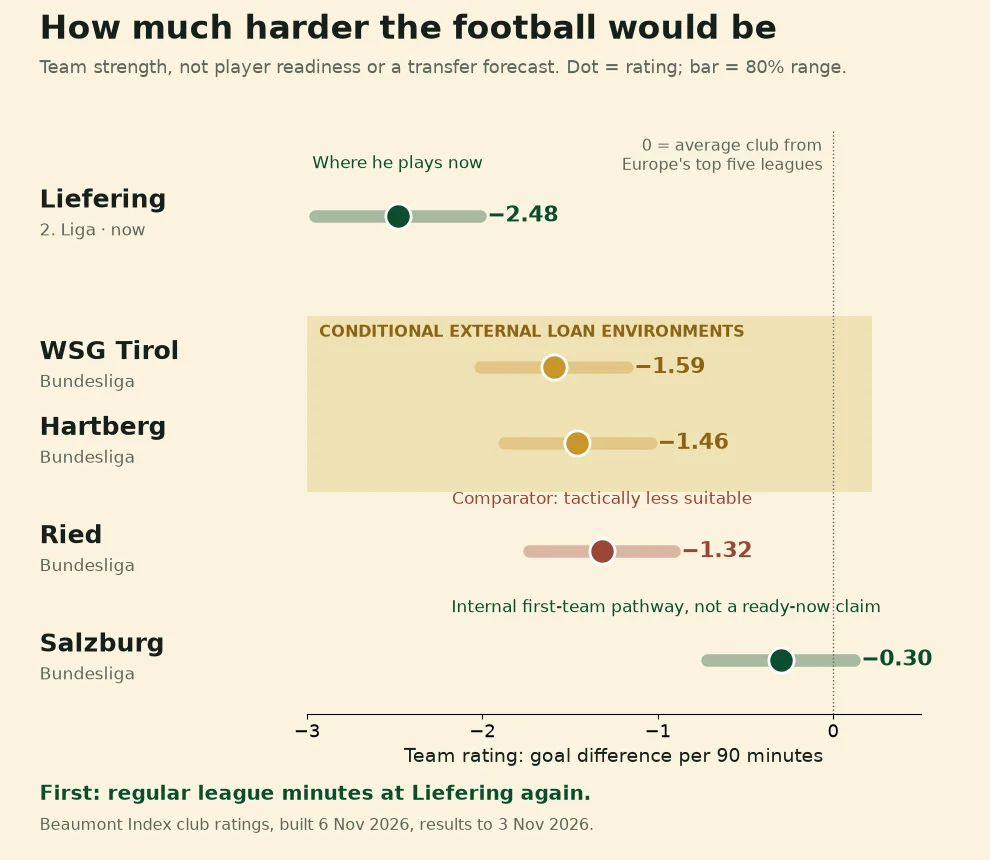
That gap is why the system often uses loans. A season at a Bundesliga club outside the leading group can be the test between Liefering and Salzburg, as Hartberg is for Oliver Lukic this season. Any such loan would serve the Salzburg pathway rather than replace it, and it is no more likely than Salzburg simply keeping him at Liefering. First, he needs his Liefering minutes back.
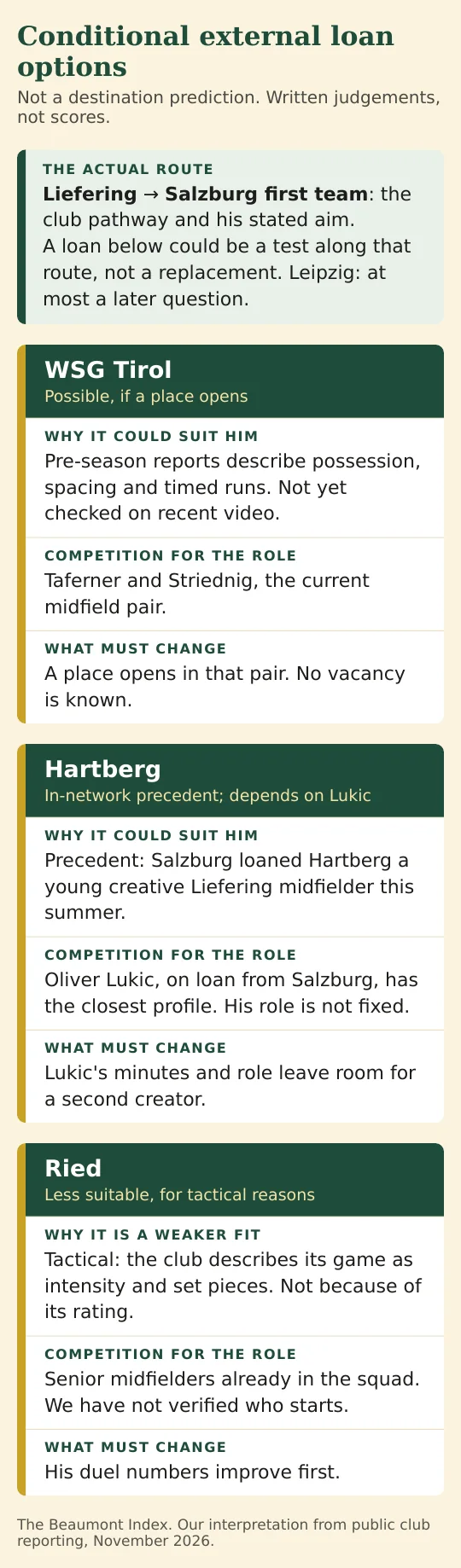
If a loan did come up, style would matter, and WSG Tirol is the clearest fit on paper. It's a hypothesis, not a report of interest. Philipp Semlic is still the coach, and he talks about his side in terms of an idea of play rather than results. After the 2-1 defeat at LASK on 31 October he said the idea was the same home or away and that the team was developing and playing good football. In pre-season, 90minuten described his WSG as disciplined and clear in possession, built on timed runs and spacing, with as many players as possible arriving in finishing positions. They have started recent league games in a 4-2-3-1 with a midfield pair of Matthäus Taferner and Marc Striednig. Striednig is the detail that matters. He is 20, came through the Salzburg academy, was Liefering's vice-captain last season and joined Tirol permanently in June, and he has played almost 800 league minutes since. Tirol have shown they will trust a young midfielder from exactly Ivanschitz's pathway. But Striednig is already doing that job, so any place would depend on the squad at the time and on Semlic wanting a passer of his type. Whether Tirol still play the way they were described in July is something only their recent matches on video can confirm.
Hartberg is the in-network precedent, and it is conditional. Markus Schopp described Lukic as a creative player who could play as a No. 10, an 8 or a 6 and be dangerous in the final third from different positions, which is close to what Ivanschitz did in his first seven games. Lukic came off the bench in two of Hartberg's October league games and started at the GAK on 30 October. His role isn't fixed, but he has the closest profile, so Hartberg only makes sense if there is room for a second creator.
Ried is the useful contrast. Mario Despotovic took over in the summer, and sporting director Lukas Brandl said on 3 November that the club wanted intense football and strength at set pieces. For a midfielder whose own stated weakness is duels, that is a tactical reason to see Ried as a less suitable first step. It has nothing to do with Ried's rating.
The panels below are our reading of those conditional external options, in words rather than scores. They are not a prediction of where he goes.
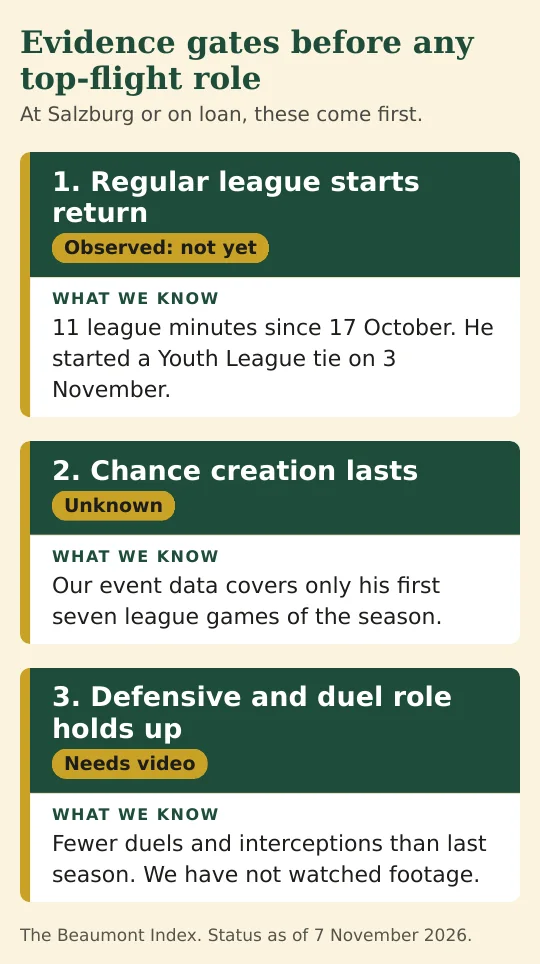
Before any top-flight role, at Salzburg or on loan, three things have to be true, and only one can be checked from the numbers alone.
The verdict
Strip it back and Ivanschitz is a player with one encouraging stretch of evidence and one unexplained gap.
The encouraging part is specific. In seven league games, a teenager tagged further from goal made more clear chances, more passes leading to shots and more passes into the box than he had as a No. 10, while passing shorter and more accurately. That is worth following, on its own terms and with its small sample.
The gap is just as real. Seven games is not much, his through balls and shots have fallen, and for three rounds Liefering have played their league games almost entirely without him. Every judgement here is provisional until that changes.
So the recommendation starts at Liefering, where he needs his league minutes back first. After that, the natural route is Salzburg's first team. It is the club's own pathway and his stated aim, though he isn't ready for it yet. A loan to a Bundesliga side outside the leading four could be a useful test along the way, with WSG Tirol the clearest style fit if a place opened and Hartberg possible if there is room beside Lukic. Neither is more likely than Salzburg keeping him where he is. Leipzig, further along the network, are at most a later question.
The things to watch are simple. Does he get his league minutes back before the winter break? Does the creation hold up over a full half-season on official minutes? And do the through balls return as he settles into the role? We'll come back to him after the break with a bigger sample.
On 17 October he started his ninth league game in a row. Since then, the league has seen him for 11 minutes. That's the next chapter, and it hasn't been written yet.
How we measured this
Method: Appearances, minutes and goals come from the Austrian Bundesliga's official 2. Liga match and player pages, checked game by game. Last season's 1,203 minutes include 12 in a match later annulled when the opponent withdrew from the league. Passing, creation and defensive counts come from our event data for the full 2025-26 league season and his first seven 2026-27 league games. A key pass, in that data, is a pass that immediately creates a clear goalscoring opportunity; a pass leading to a shot is any last action before a team-mate's shot. Every per-90 rate divides those counts by official minutes. The Youth League appearance comes from published line-ups and match reports. We haven't watched video for this report. We publish no ranking against other players. The next-level view is a scouting judgement, not a calibrated forecast. No club has been reported as interested, and nothing public describes a Salzburg plan for him. The Liefering-Salzburg relationship comes from public reporting on Austria's cooperation-player rule and UEFA's 2017 decision on Salzburg and Leipzig.
FAQ
Who is Ilia Ivanschitz?
A midfielder born on 7 April 2007 who plays for FC Liefering, Red Bull Salzburg’s cooperation club in Austria’s 2. Liga. He is the side’s vice-captain, and his stated aim is Salzburg’s first team.
What has changed this season?
Our event data tags him mainly as a central midfielder rather than a No. 10, and his key passes rose from 0.30 to 1.35 per 90 official minutes over his first seven league games. His through balls and shots fell.
Why has he played so little in the league recently?
He was not in the squad for round 10 and has played 11 league minutes since, but he started a UEFA Youth League tie on 3 November. Liefering have not explained it.