The short answerPSG are 4th in our world ranking, and the only top-six club whose squad depth (84th percentile) rates above its first eleven (72th). Since Dembélé and Kvaratskhelia were injured on 20 October, their margin of chances created over conceded has held, and the 6-0 at Villarreal fits that picture.
The headline from Villarreal is the four goals in 17 minutes. The more useful number is older. Before a ball was kicked at the Estadio de la Cerámica on Tuesday night, our club profile already rated Paris Saint-Germain's squad depth in the 84th percentile of every club we rate, and their usual starting eleven only in the 72nd. Of the six best-rated clubs in the world, PSG are the only one whose bench scores higher than its first team.
That is not how most people think about the European champions. The image is of a side built around Ousmane Dembélé's Ballon d'Or season and Khvicha Kvaratskhelia's dribbling. The 6-0 win, with both of them missing, is the cleanest public demonstration so far of what the model had been saying quietly: this PSG is a squad first and a set of stars second. It also explains something odd about their rating, which we come to below.
The facts of the night are simple and every report agrees on them. João Neves scored after nine minutes, following a corner. Désiré Doué made it two on 12 minutes, Senny Mayulu three on 13, and Fabián Ruiz four on 17. The fourth goal arrived 16 minutes and two seconds after kick-off, which the club and several outlets report as the fastest four-goal start in the competition's history. Ruiz added a fifth early in the second half and David Boly, a 17-year-old full-back on his Champions League debut, scored the sixth. It was PSG's fourth win from four in this season's league phase, 20 goals scored, and their tenth straight win in all competitions.
They did it without Dembélé, who injured his left thigh in the 4-2 win over Barcelona on 20 October, and without Kvaratskhelia, who ruptured the anterior cruciate ligament in his right knee in the same game and had surgery a week later. Captain Marquinhos and left-back Nuno Mendes were also missing.
The bench that rates above the eleven
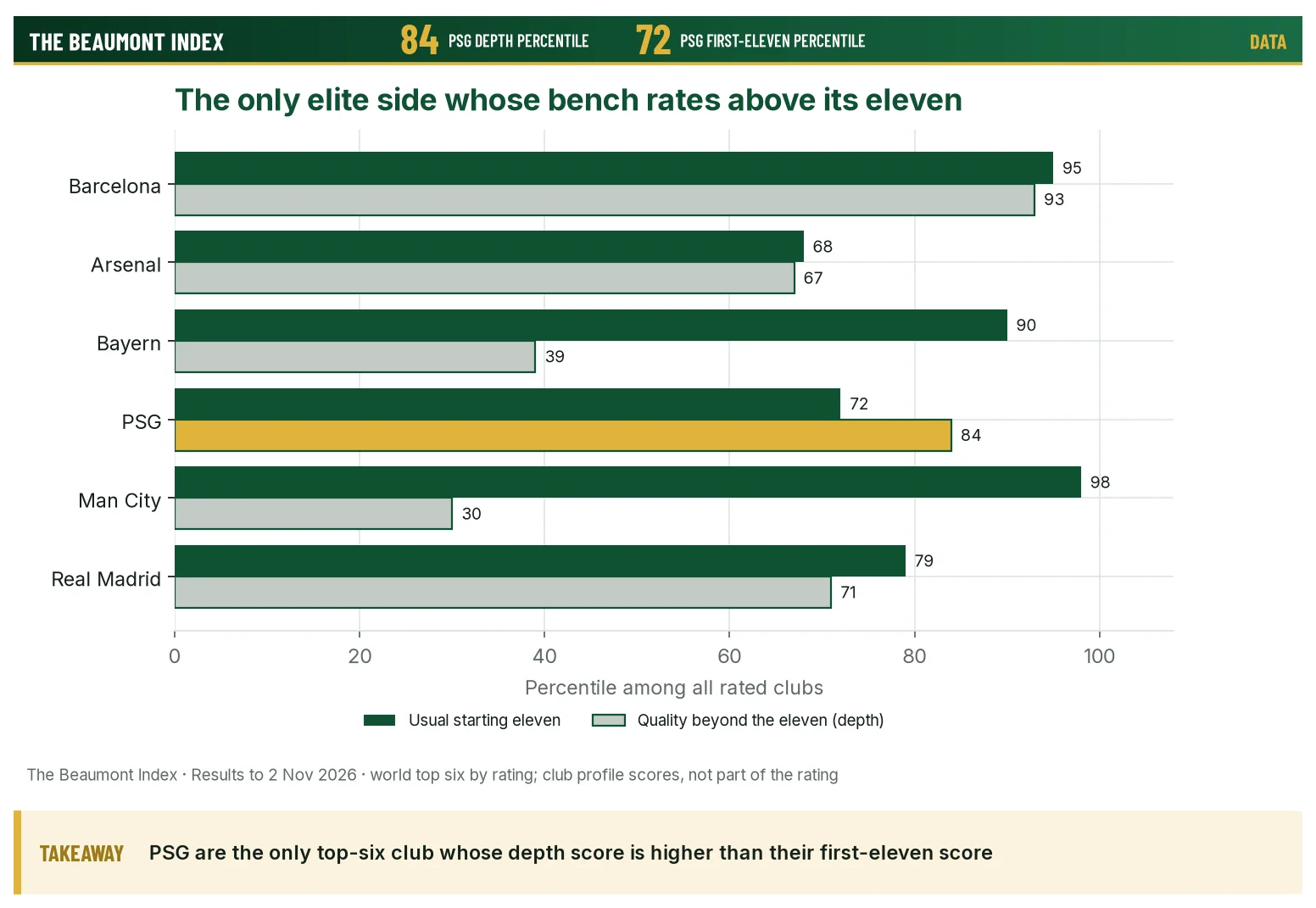
Our club profile is separate from the rating. It does not add or subtract points; it describes how a club's strength is built. Two of its parts matter here. The first-eleven score asks how good the usual starting side is, including its weakest regular and how many genuinely top players it has. The depth score asks how much quality there is beyond those eleven.
Read the chart from the top. Barcelona are elite on both, 95 and 93. Arsenal are level at 68 and 67. Then the shape changes. Bayern München's first eleven is in the 90th percentile but their depth only in the 39th. Manchester City are the extreme case: 98 for the eleven, 30 for the rest. Real Madrid are 79 and 71.
PSG are the exception: 72 for the eleven, 84 for depth. Only Barcelona's depth score is higher among the top six. Their star-spread score, which measures how evenly quality is shared rather than concentrated in one or two players, sits in the 46th percentile, the middle of the pack. In plain terms the model does not think PSG lean on one player. It thinks they have a lot of good ones.
That fits Tuesday. Of the six scorers, none was Dembélé or Kvaratskhelia, and reports credit Maghnes Akliouche with two assists. Boly, the scorer of the sixth, was making his debut in the competition. A side whose quality sat in two forwards would not usually score four in 17 minutes away from home without them. A side whose quality is spread across 18 or 20 players is the kind that can.
The first-eleven score needs a caveat. It is built on who has actually played the most minutes. When minutes are shared widely, the "usual" eleven is less settled, and the score can sit lower for that reason rather than because the players are worse. We would not read 72 as "PSG's best team is ordinary". We would read it as "PSG's best team is harder to pin down, because so many players share the minutes".
Since the injuries, the margin has held
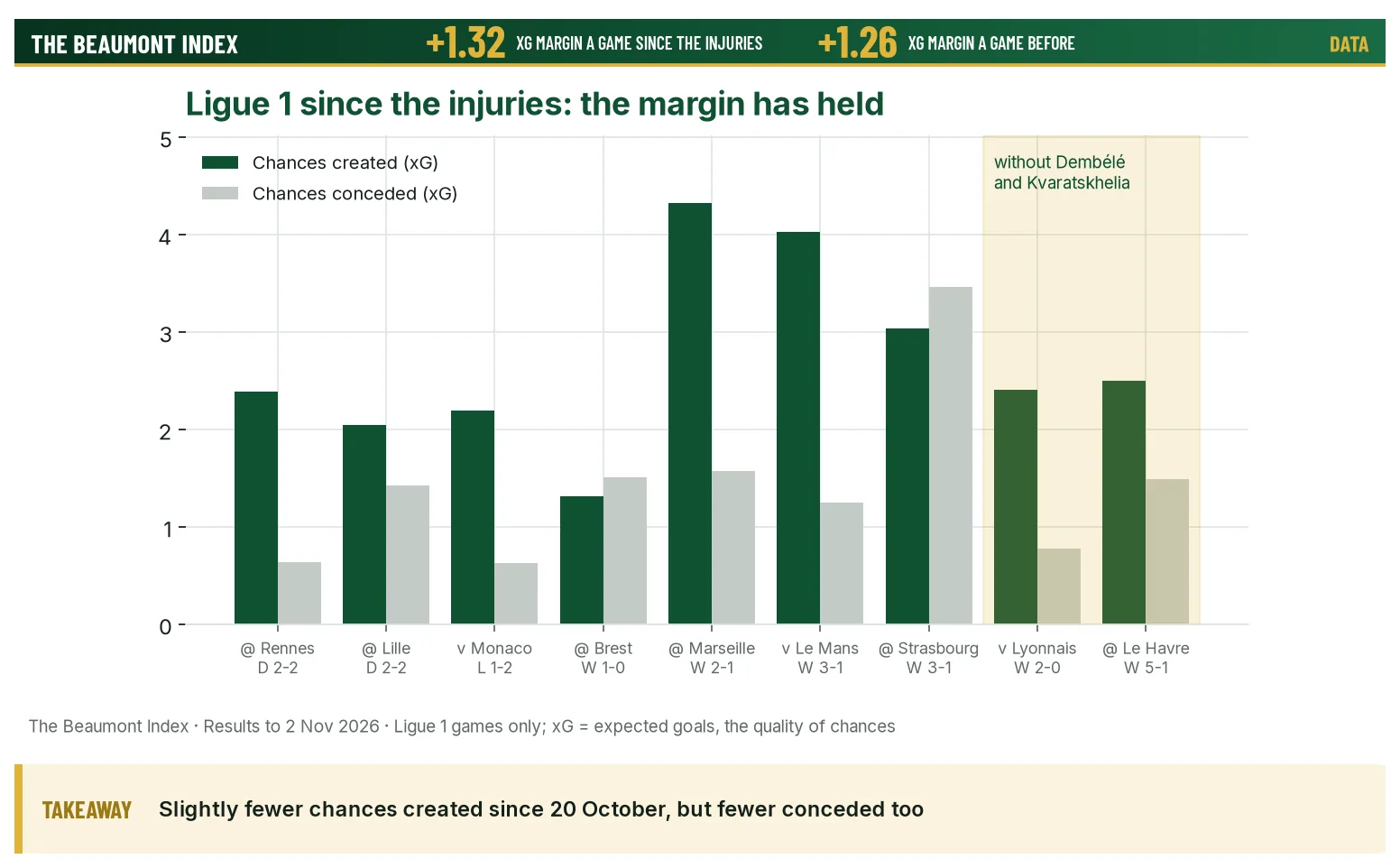
One game in Spain proves little on its own. Villarreal were poor, and reports describe goalkeeping errors behind at least two of the early goals. So we looked at what our match data says about PSG in the league since 20 October.
There are only two Ligue 1 games in that window, so treat this as a direction rather than a verdict. Against Lyon at home PSG won 2-0 and created chances worth 2.41 expected goals. At Le Havre they won 5-1 with 2.50. That is an average of 2.46 expected goals a game, a little down on the 2.76 across their first 7 league games, when Dembélé and Kvaratskhelia were at least available. But the other side of the ball moved more. PSG conceded 1.14 expected goals a game after the injuries, against 1.50 before. Put the two together and the margin between chances created and conceded has gone from +1.26 a game to +1.32. Without the two stars, PSG have created a bit less and allowed clearly less.
The before-and-after is not a clean experiment. Kvaratskhelia had barely started this season, and the BBC reported that the Barcelona game was his first start. So the "before" sample was not built around both stars either. What the data rules out is the obvious worry: that PSG would stop controlling games once the two most famous attackers were gone. The attacking output dipped slightly, the control did not, and the Villarreal scoreline suggests the dip may not last.
The league season as a whole tells the same story about consistency. PSG have 20 points from 9 Ligue 1 games, against 17.4 points deserved on the chances they have created and conceded. We call that fair. Last season the gap was similarly small, 76 points against 73.3 deserved. This is not a team running hot on finishing. It is a team whose results roughly match its football, year after year.
Why their rating leans on the squad
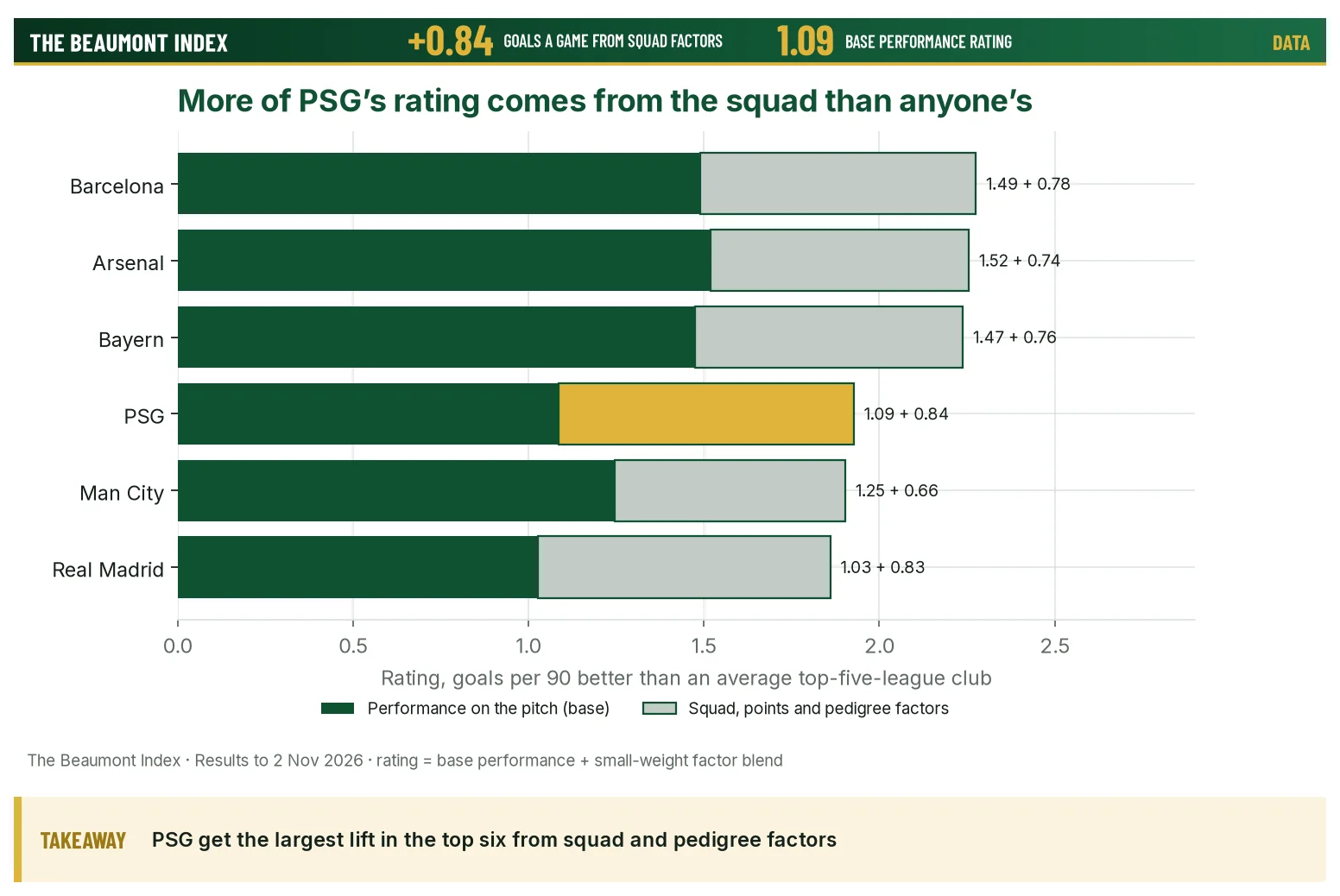
Here is the odd thing about PSG's rating. They are 4th in our world ranking on 1851, 64 points behind Barcelona and just 4 ahead of Manchester City. But if you take away the factor blend and look only at the base rating, which is built from league strength, play within the league and continental results, PSG drop to 1.09 goals a game better than an average top-five-league club. Only Real Madrid, on 1.03, are lower among the top six.
The factor blend is a small-weight layer added on top of that base. It includes points per game, the quality and value of the 18 most-used players, and recent continental pedigree. PSG get 0.84 goals a game from it, the largest lift of any top-six club. Some of that is pedigree, after two European titles in a row. Some of it is the quality of the 18 most-used players, which is a depth measure by another name. The model is, in effect, saying that the squad is worth more than PSG's base performance numbers show.
Two things hold the base down. The first is the league. Ligue 1 rates −0.18 goals a game against an average top-five-league club, the weakest of the big five on our numbers, and every PSG rating starts from that floor. Within Ligue 1 PSG are dominant, 2.11 goals a game better than an average French side, the third-best within-league figure in the top six. The second is the trend: their rating has drifted −0.27 goals a game over recent weeks, which we mark as falling over a league start that included draws at Rennes and Lille and a home defeat to Monaco.
On the other hand, PSG get the biggest boost in the top six from results against strong opposition, +0.17 goals a game. That is the Champions League showing up. Wins against Manchester City and Barcelona count towards their own rating as well as Ligue 1's strength. Our ratings in this piece use results up to 2 November, so the 6-0 at Villarreal is not yet in them. We expect it to push the continental part of the rating up again when the next build lands.
Fourth, and the gap to France
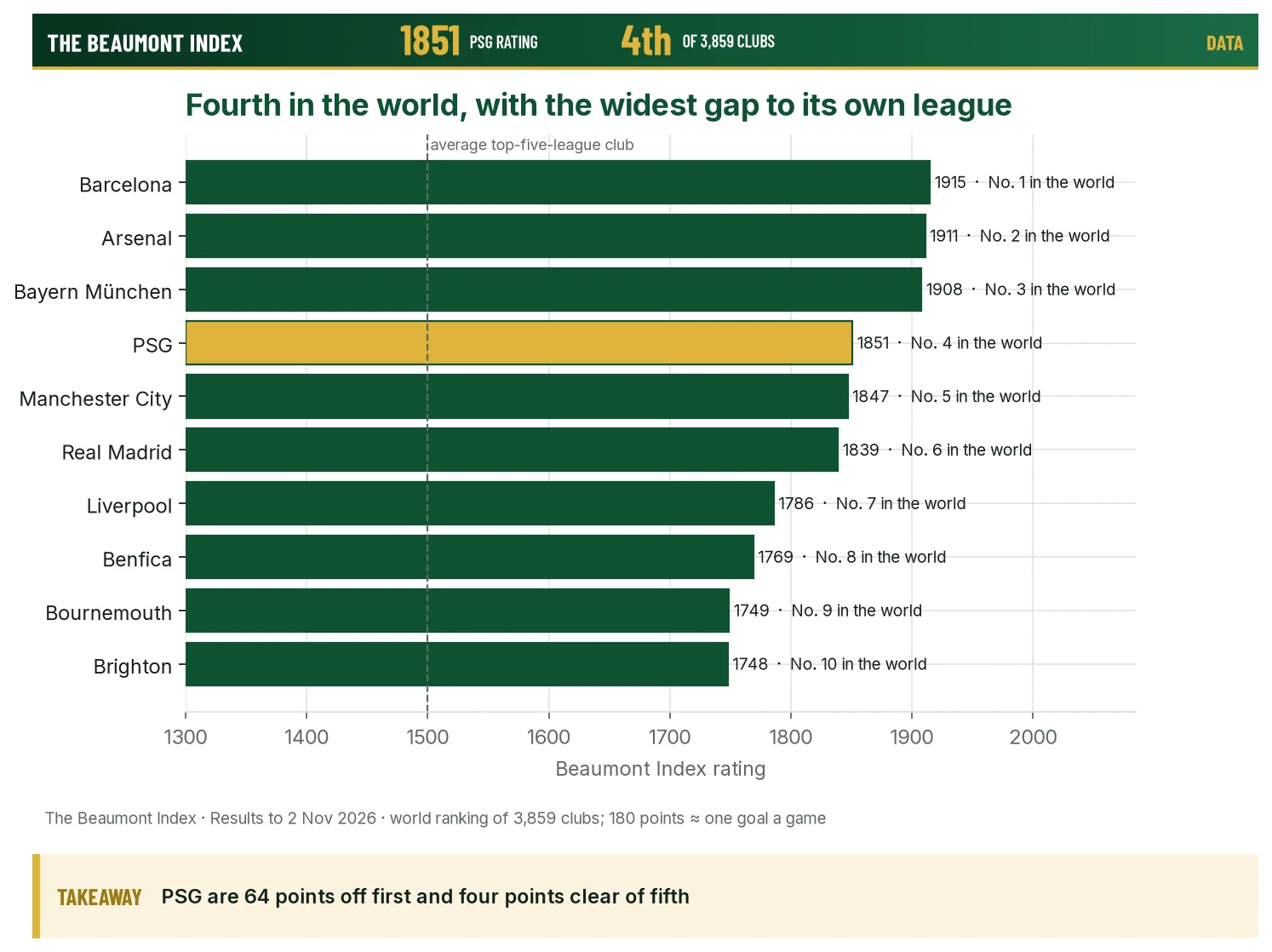
PSG's uncertainty range runs from 1st to 7th, and their 80% rating band from 1.52 to 2.33 goals a game. That is a wide band, and it overlaps every club above them. On our numbers it is a genuine argument whether PSG or Barcelona is the best team in Europe right now; it is not an argument whether they belong in the top handful.
The other gap is domestic. The next-best Ligue 1 club, Monaco, are on 1636, 215 points behind PSG. That is more than a goal a game. Few clubs in the world play a weekly league schedule against opponents so far below them. That gap gives a coach room to share league minutes around a squad, and shared minutes are how a club ends up with players who are ready when a Dembélé or a Kvaratskhelia goes down in Europe.
What to watch
Three things will tell us whether this is a structural edge or a good fortnight.
The first is the next build of the ranking. Villarreal is not in it yet. If PSG's continental adjustment climbs and the falling trend flattens, the model will be agreeing with what the scoreline said.
The second is the left side. Kvaratskhelia is likely out for months and Nuno Mendes was also missing in Spain. Doué's goal and Akliouche's assists came largely from the attacking positions those absences opened up. If that holds over the next month, the depth score is doing its job. If chance creation falls further once opponents are stronger than Lyon and Le Havre, the two-game sample was flattering.
The third is the rest of the league phase. Liverpool, Real Madrid and Real Betis all play their fourth games on Wednesday night with three wins from three. PSG are the only club on 12 points for now. Whether anyone joins them matters less to us than the shape of the wins: PSG's opponents so far include Manchester City and Barcelona, and the remaining four games will test whether the depth holds over a full autumn.
The read
The common story about PSG is that they won Europe on the back of a few superb attackers. Our numbers tell a different one. Among the world's six best-rated sides they are the only one whose depth rates higher than its starting eleven, their rating leans more on squad strength than anyone's, and their control of games has not dropped since their two most famous forwards got injured. The 6-0 in Villarreal was not a surprise to the model. It was the model's version of PSG, shown on television.
Our club profile scores are percentiles against every club we rate and do not feed the rating. Expected goals measure the quality of chances. Ratings here use match results to 2 November 2026. See the full world club ranking, how the ranking works, and this week's World Ranking and luck table. We wrote about PSG's league form in our PSG v Lyon analysis.
FAQ
How good are PSG without Dembélé and Kvaratskhelia?
On our numbers, still elite. They are 4th in the world and in Ligue 1 since both were injured on 20 October they have created 2.46 expected goals a game and conceded 1.14.
Why are PSG only 4th in the world ranking?
Their base rating starts from Ligue 1, the weakest of the big five leagues on our numbers. Squad quality and Champions League results lift them back near the top.
Is the 6-0 at Villarreal in the ranking yet?
No. Ratings in this piece use results to 2 November 2026. The Villarreal result will be included in the next build.