The short answerOn the Beaumont Index, Johor Darul Ta'zim are 89th in the world, rated exactly level with an average club from Europe's top five leagues. That is above every club in Japan, Korea, China, Thailand and Australia. Malaysia's league ranks 167th of 231. The gap between JDT and the second-best Malaysian club is the largest between first and second in any league we rate. Our 80% range for JDT is wide: 45th to 188th.
Ask a European fan to name the best club in East Asia and you will hear Japanese names: Vissel Kobe, Kawasaki Frontale, Sanfrecce Hiroshima. Perhaps a Korean one. Almost nobody says Johor Darul Ta'zim. Our ratings do.
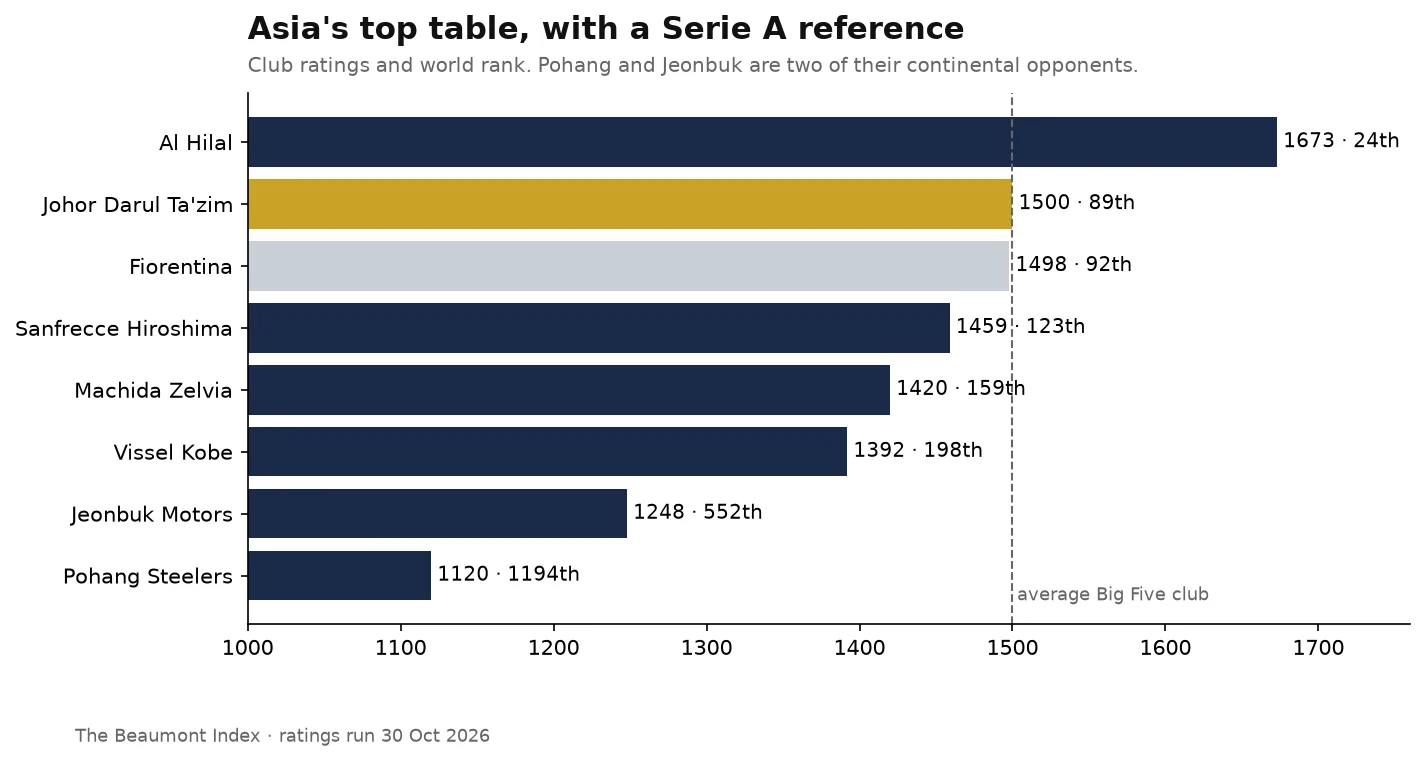
JDT, from the southern tip of the Malay peninsula, are rated 1500 on the Index. That puts them 89th in the world and level, to the decimal place, with an average club from Europe's top five leagues. No club in Japan, Korea, China, Thailand, Vietnam or Australia is rated higher. Sanfrecce Hiroshima, the best Japanese side on our numbers, are 123rd, about 41 rating points behind.
This is a strange result, and it deserves scepticism. The Malaysian Super League ranks 167th of the 231 leagues we cover. How can the best club in a weak league be rated above clubs that play in much stronger ones? This piece explains how the number is built, why we think it is broadly right, and where it could be wrong.
A league of one
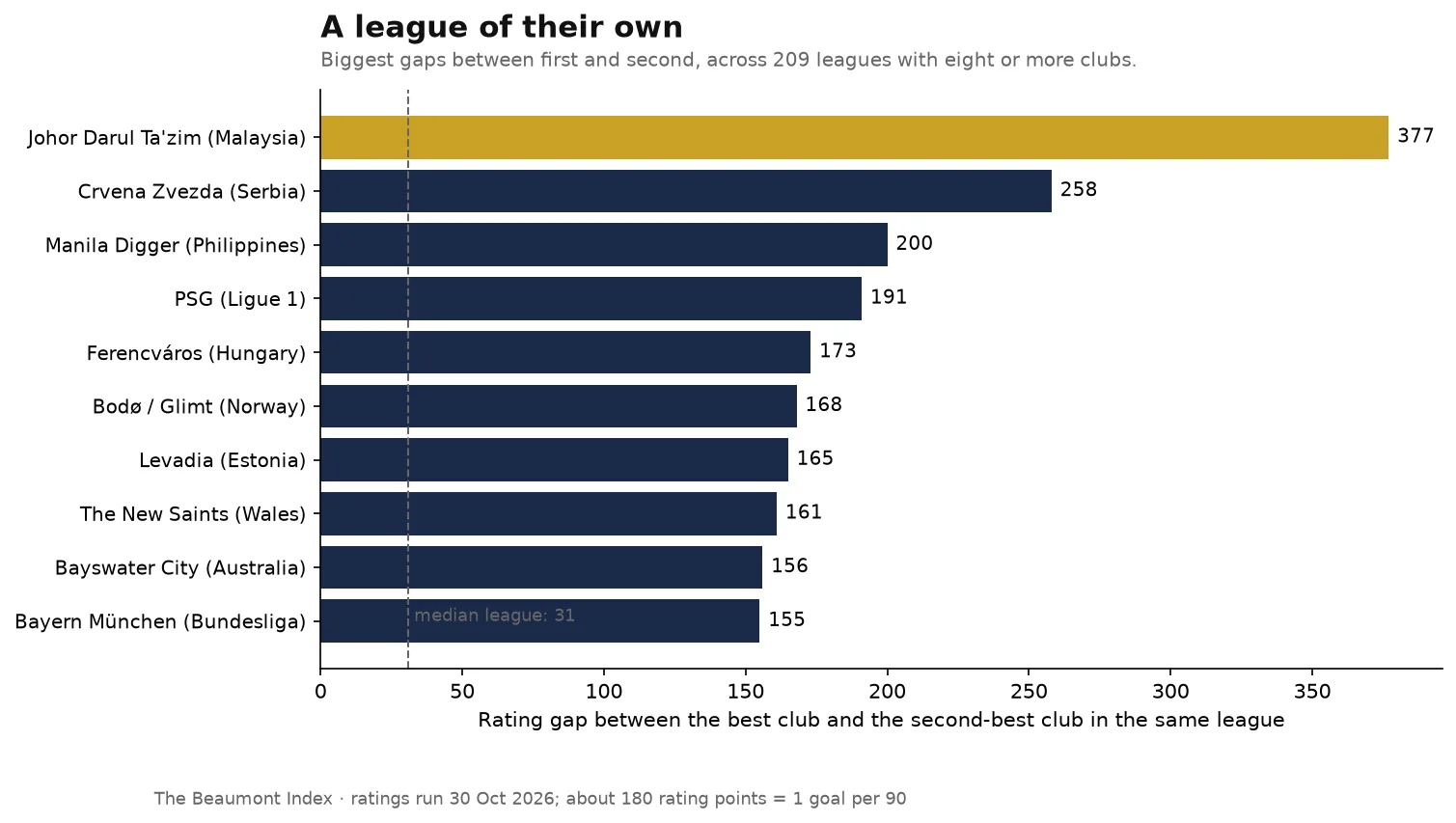
Start with the most striking fact. Across the 209 leagues in our ratings with at least eight clubs, the median gap between the best club and the second-best is about 31 rating points: a little under 0.2 goals per 90 minutes. In most leagues, the champion is only slightly better than the runner-up.
In Malaysia, JDT are rated 1500 and Selangor, the second-best side, 1123. The gap is 377 points, which on our scale is worth about two goals per 90 minutes. It is the largest first-to-second gap in any league we rate. The next largest is Crvena Zvezda over Partizan in Serbia, at 258. PSG's lead over Monaco in Ligue 1 is 191. Bayern's over Leverkusen is 155. Arsenal's over Manchester City is 63.
The results match the rating. JDT have won every Malaysian Super League title since 2014, twelve in a row. Last season they finished with 70 points from 24 games, 23 wins and a draw, scoring 117 goals and conceding ten. They clinched the title in March with five games to spare. They have won all their league games so far this season too.
Not luck
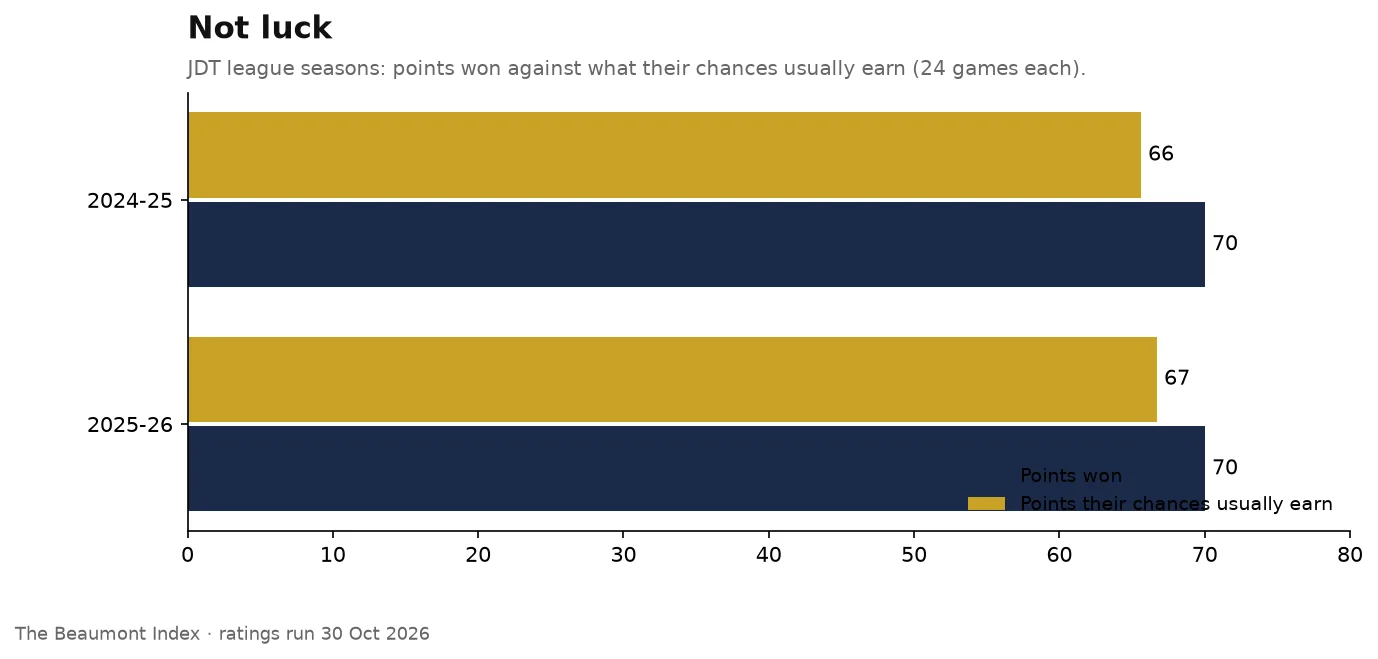
A club that wins every week can still be riding its luck. JDT are not. In each of the last two seasons they took 70 points from chances that would usually earn about 66 and 67. That is a few points ahead, which is normal for a side that wins this often, but nothing like the gaps that make us sceptical of a team elsewhere. Their performance and their results agree.
In Malaysia, JDT are rated 1500 and Selangor, the second-best side, 1123.
Their style is what you would expect from a side this far ahead of its opponents. Compared with the rest of the Malaysian league, they are extreme outliers for shot volume, for completions close to the opposition box and for touches inside it, each between 2.5 and 2.7 standard deviations above the league norm. They live in the other team's penalty area.
Within its own league, no club in the world is further above the average than JDT. Our within-league measure puts them about 3.07 goals per 90 above an average Malaysian club. That is the highest figure of the 3,844 clubs we rate, ahead of Bayern, Barcelona and Benfica.
How the number is built
This is where the scepticism belongs. Our club ratings combine three things: how strong the league is, how far a club is above or below its own league's average, and how the club does against teams from other leagues. A small blend of other factors, such as squad quality and recent form, is added on top.
For JDT, the first two pull in opposite directions. The league is weak, about three goals per 90 worse than the average top-five European league. JDT are about three goals per 90 better than their league. The two almost cancel out, which is why their rating lands so close to the European top-five average.
That arithmetic has an obvious weakness. When a club is this far ahead of every opponent it meets at home, the within-league number becomes harder to measure. Beating a side 9-0 does not tell you as much as beating a strong side 1-0. Our model limits how much any one result can count, but the honest summary is that JDT's domestic evidence tells us they are very good, not exactly how good.
The blend also matters. Before the extra factors are added, JDT's base rating is about 1400, which would put them outside the world's top 200. The blend lifts them by about 0.55 goals per 90. That is not unusual: the same step lifts Al Hilal and Benfica by more. But it means part of the rating comes from squad quality and form rather than from match results alone.
The width of our range reflects all of this. Our 80% range for JDT runs from 45th in the world to 188th. Confidence is medium. If you want a single honest sentence, it is this: JDT are somewhere between a good top-five European club and a decent second-tier European club, and our best guess sits in the middle.
The continental test
The best way to check a rating built this way is to watch the club play teams from stronger leagues. JDT are doing that now in the AFC Champions League Elite. They drew 1-1 at home to Buriram United in September, won 2-0 away at Pohang Steelers on 13 October and beat Port FC 3-0 on Tuesday. Seven points from three games puts them second in the East section of the league stage.
The Pohang win is the useful one. Pohang play in Korea's K League 1, which ranks 57th of our leagues, 110 places above Malaysia's. On our ratings Pohang are 1120, 380 points below JDT. A comfortable away win there is the kind of result our rating would expect. JDT's next game is away at Jeonbuk on 3 November. Jeonbuk are rated 1248, stronger than Pohang but still well below JDT. That game is the next real test of the number.
Where they sit in the world
JDT's rating of 1500 would put them in the middle of most top-five European leagues. Of the 96 clubs in the Premier League, LaLiga, the Bundesliga, Serie A and Ligue 1, 41 are rated below them: eleven in the Bundesliga, eleven in Serie A, ten in LaLiga, six in Ligue 1 and three in the Premier League. Fiorentina, the subject of another of our pieces today, are rated 1498, two points below.
That is not a claim that JDT would finish mid-table in Serie A. A club that plays a full season against stronger opponents faces a different test, with injuries, travel and a squad stretched every week. Our ratings measure the level of a team's football, not how it would cope with a different calendar.
Outside Europe, only six clubs are rated higher: three Saudi clubs (Al Hilal, Al Nassr and Al Ahli), Flamengo and Palmeiras from Brazil, and Toluca from Mexico. Every one of them plays in a league ranked at least 140 places above Malaysia's. Only three clubs in our world top 100 come from leagues outside the top 30: Shakhtar Donetsk (Ukraine's league is 44th), Crvena Zvezda (Serbia's is 82nd) and JDT, from the 167th. No other club comes close to that distance between its own rating and its league's.
What the squad looks like
Our squad profile shows why. JDT's usual starting eleven is the best in Malaysia by a distance and in the 98th percentile of every club we rate. That is the core of the story: a club with a top-level first eleven playing in a league whose other clubs have nothing close to it.
Two other parts of the profile stand out. Their coach scores in the top percentile on our measure of how well a team has performed against what its squad suggested. And their quality is concentrated: on star spread, they are in the 13th percentile globally, meaning a small group of players carries a large share of the side's quality. We do not have enough data to rate their squad depth.
That concentration is the main risk in continental games. Against Malaysian opposition, losing one or two key players barely matters. Against Jeonbuk or a Japanese side, it might.
Why this matters
There are two lessons in JDT's rating, and neither is really about Malaysia.
The first is that league strength and club strength are different questions. Most rankings assume a club is only as good as its league. That is a reasonable starting point and usually right. But a few clubs break away from their leagues so completely that the league tells you very little about them. Crvena Zvezda in Serbia and Bodø/Glimt in Norway are other examples in our current list. JDT are the most extreme.
The second is that the real test always comes from outside. JDT's domestic record tells us they are far better than every team in Malaysia. Only games like Pohang and Jeonbuk tell us how much better. Watch those games. If JDT keep winning them, our rating is right. If they start losing them, the rating will fall, and we will report that too.
What would change our mind
Three things would make us lower the rating. The first is continental results. Two or three heavy defeats against Korean, Japanese or Thai sides would move JDT down quickly, because those games carry far more information than another 7-0 at home. The second is the squad. If the handful of players who carry most of the team's quality leave or get injured, the domestic numbers might hold up while the true level drops. The third is a stronger Malaysian challenger. A second club rising towards JDT would give us better evidence about both.
One thing would make us raise it: wins away from home against the strongest East Asian clubs in the knockout rounds. JDT have not yet had that chance this season. If they get it and take it, the case that a Malaysian club is the best in the region would stop being a curiosity and become the consensus.
See the full world club ranking.
FAQ
Where are Johor Darul Ta'zim in the world ranking?
89th on the Beaumont Index, rated level with an average club from Europe's top five leagues, with an 80% range of 45th to 188th.
Are JDT really better than every Japanese club?
On our ratings, yes: Sanfrecce Hiroshima, the highest-rated Japanese side, are 123rd. The uncertainty is wide, and the Champions League Elite games are the best test.
How strong is the Malaysian Super League?
167th of the 231 leagues we rate. JDT's gap over the second-best Malaysian club is the largest between first and second in any league.