The short answerYes, mostly. Middlesbrough's opponent-adjusted xG difference is +1.59 a game, the best in the Championship by 0.64, against the 4th-toughest schedule. They have scored fewer goals than their chances deserve. The risk is defensive: chances against are up from 0.92 to 1.36 a game.
Middlesbrough are top of the Championship, and the underlying numbers say they deserve to be. Once every game is judged against the quality of the opponent, Kim Hellberg's side have created +1.59 more non-penalty expected goals than they have conceded per game. That is the best figure in the division by 0.64, and nobody else is within two-thirds of it. West Ham are second on +0.95, Wolves third on +0.74.
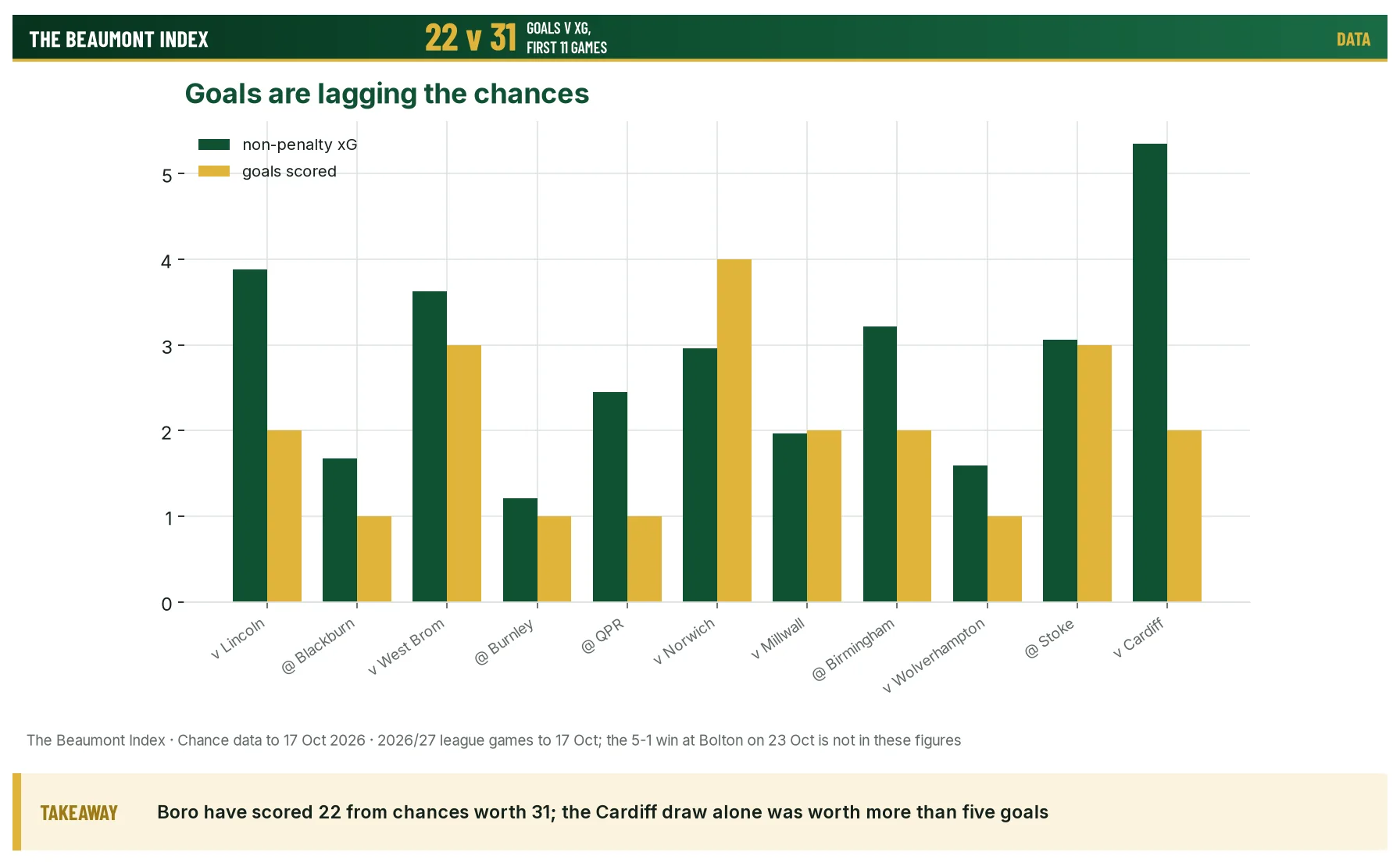
That's the case in one paragraph. Boro have 25 points from 12 games and lead Swansea by 2. More striking is how they have got there. In each of the 11 league games in our chance data, they created more than their opponents. Their results have actually lagged behind their football: they have scored 22 goals from chances worth 31.0. A team that is top while underperforming its own chances is a different proposition from a team that is top on a hot streak.
So is it built to last? Mostly, yes. The attack is the best in the league, and it is stronger now than at any point in Hellberg's 11 months. The question is the other end of the pitch, where he has knowingly traded some control for more chances.
Better than the table, not just top of it
Raw expected goals can flatter a side that has played weak opponents. So we compared each Championship game with what that opponent creates and concedes in its other matches. Beat a side that normally gives away very little, and the chances you created count for more. Concede a lot to a team that rarely creates anything, and the adjustment counts against you.
For Middlesbrough, the adjustment helps. Their raw margin is +1.46 per game (2.82 for, 1.36 against). Their opponents so far have been the 4th-toughest set in the league, and allowing for that adds 0.13 a game. They have not been fattening up on the bottom half.
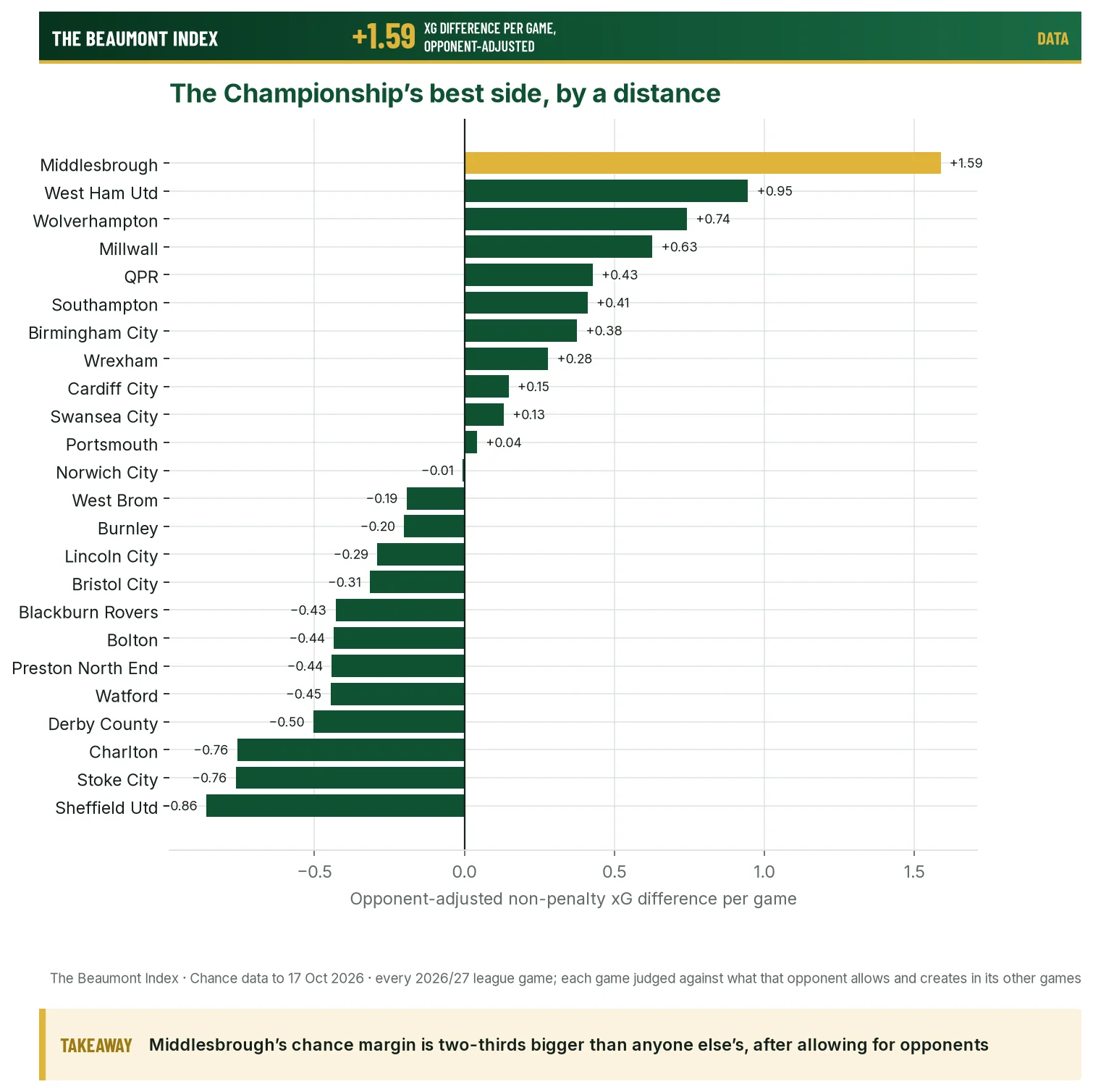
One game skews the average. Against Cardiff on 17 October, Boro had 36 shots and chances worth 5.35 expected goals, and drew 2-2 after coming from two goals down. Take that game out and their adjusted margin falls to +1.22. That's still the best in the division.
The Index agrees, more cautiously. On our ratings, Middlesbrough are 1506, 89th in the world and 3rd in the Championship, level on rating with Wolves and behind West Ham (1608). The gap to West Ham is mostly history. At this point in a season, the current campaign carries only about 26% of a club's within-league score, so West Ham's recent Premier League seasons still count for a lot. On this season's football alone, Boro's expected points rate of 2.29 a game is the best in the division. Their 25 points are about 2.5 fewer than that football would normally earn. The Index rates them as rising.
Their raw margin is +1.46 per game (2.82 for, 1.36 against).
Eleven months of Hellberg
Hellberg was appointed on 24 November 2025, from Hammarby, after Rob Edwards left for Wolves. The seven league games in our data from just before the change were ordinary: a margin of +0.34 a game in raw terms, and +0.12 once opponents were counted.
Under Hellberg, the margin jumped. Across his 29 league games last season, Boro created 1.85 non-penalty expected goals a game and allowed 0.92, an opponent-adjusted margin of +0.89. They finished fifth on 80 points. They lost the play-off semi-final to Southampton, were reinstated when Southampton were expelled over the spying case, and then lost the final 1-0 to Hull City at Wembley.
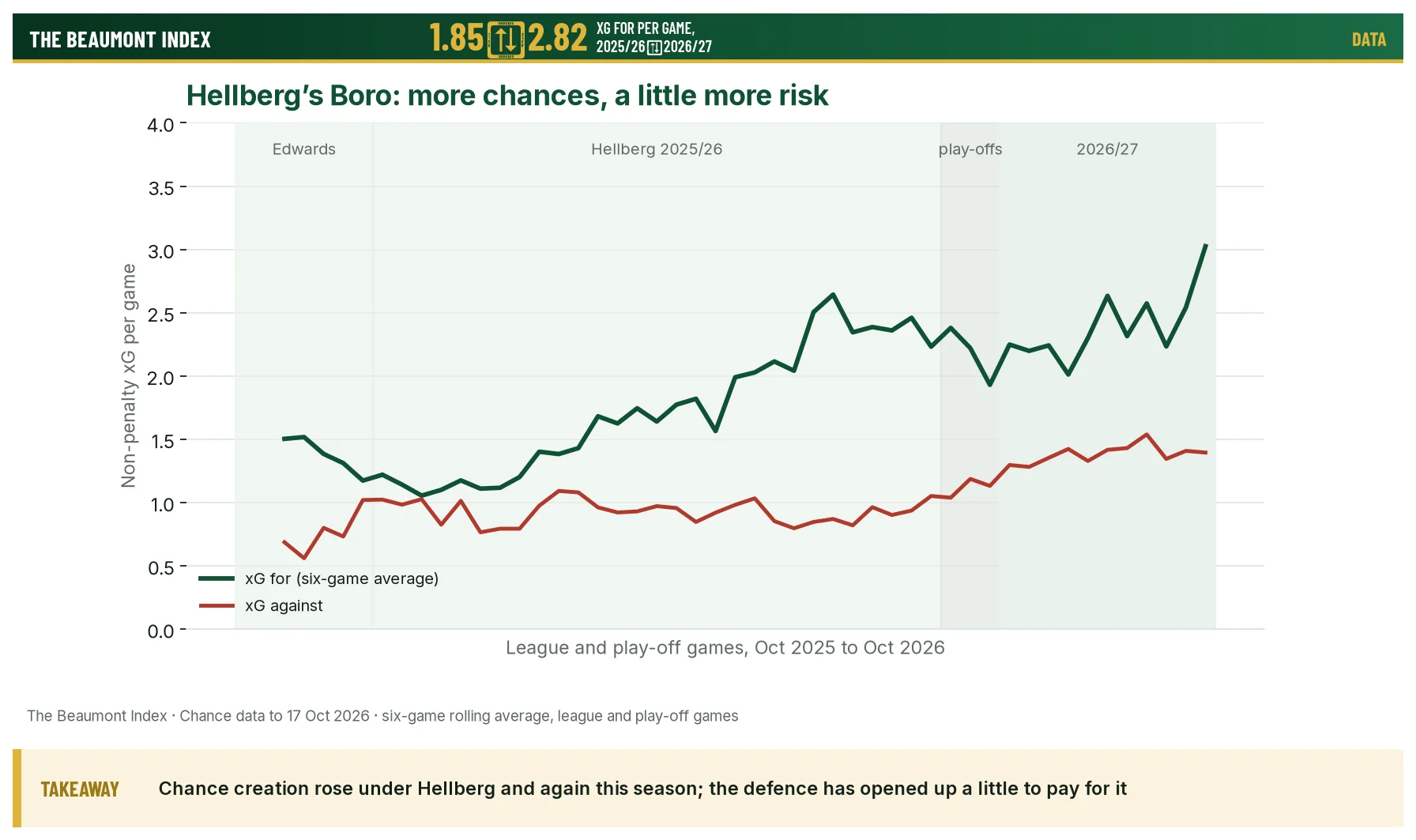
This season, the attack has taken another step. Boro's 2.82 expected goals a game is up from 1.85 last season, and it's the most in the league. The defence has moved the other way: 1.36 a game against, up from 0.92. That is still the 4th-lowest figure in the Championship. Boro have kept only two clean sheets, though, and the 25 goals scored and conceded in their six games before the Bolton trip showed how open some of their matches have become. Hellberg has been clear that this is a choice. "You have to pick in football what you want to be and we want to be an offensive team," he told BBC Radio Tees last week.
How they play
The shape on the team sheet changes. This season Boro have started most often in a 3-4-2-1 or a 4-2-3-1, three times each, and have also used a 4-3-3, a 4-4-2 and a 4-1-4-1. The principles don't change. On our style measures, Boro have the most box presence, the most deep completions and close to the most possession in the division, each more than two standard deviations above the league norm.
In practice, that means a patient possession side that pins teams back and then floods the box. They lead the league in positional attacks (33.9 a game against an average of 26.9), shots (18.8) and crosses (20.7). They are near the bottom for counter-attacks, 18th of 24, because opponents rarely leave them space to break into. Their chances are good ones, too: 0.15 expected goals per shot, against a league average of 0.13. Volume and quality together are rare.
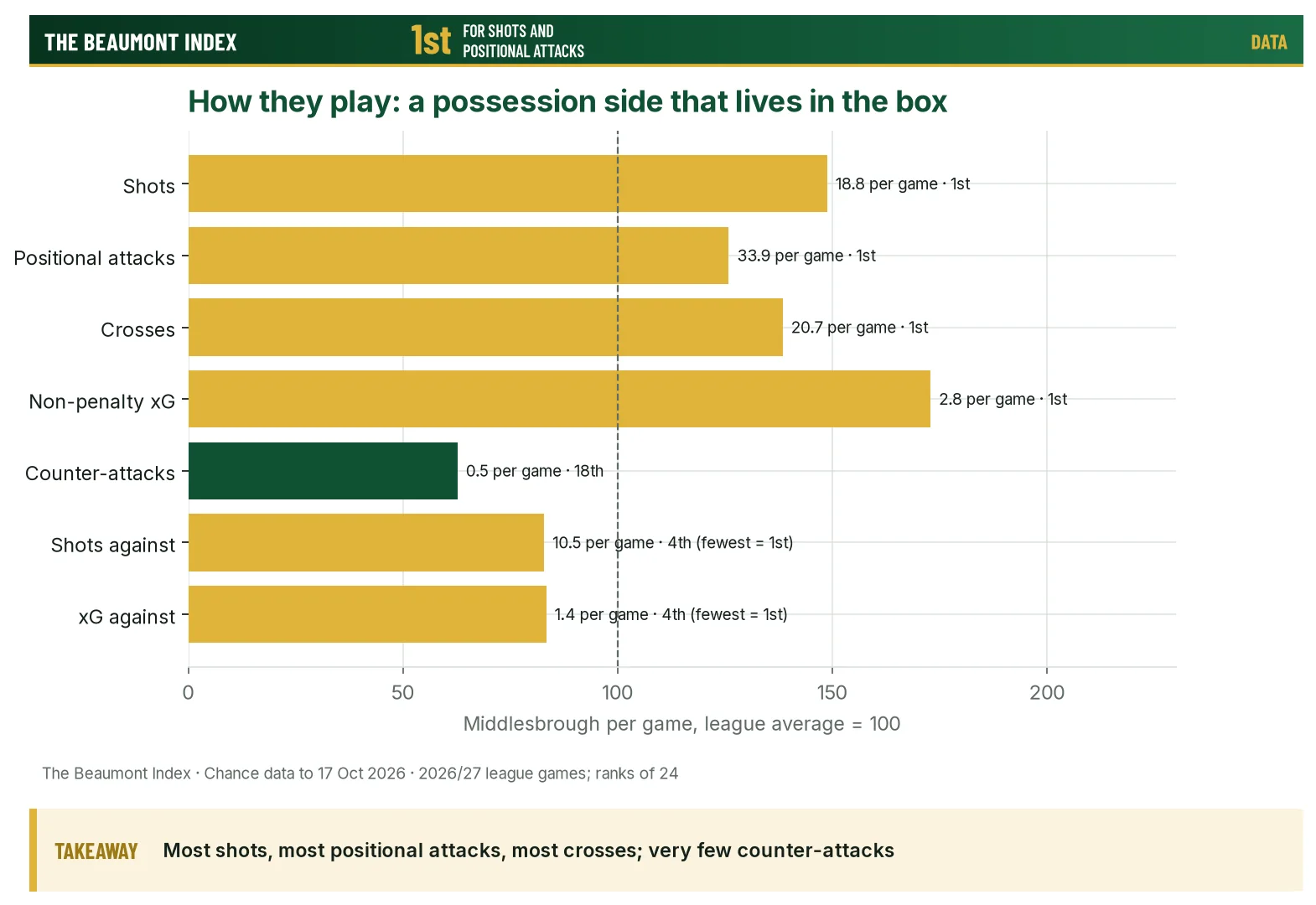
The defensive side of the model is control rather than a deep block. They face 10.5 shots a game, the 4th-fewest, because they have the ball so much. The cost is what happens when they lose it. As the volume of attacks has gone up this season, so have the chances against, which is what you would expect from a side committing more players forward. Hellberg's own description after the 5-1 win at Bolton was "We used the space behind the last line… then we played fluid football". That's a side willing to play through and behind a block, not just around it.
Is it sustainable?
Three things say yes. First, the margin is large enough to absorb a lot of regression. Even if Boro's chance creation fell back to last season's level, they would still be among the best sides in the division. Second, it isn't built on finishing. Boro have scored about nine fewer goals than their chances were worth, so the results have more room to improve than to fall. Will Lankshear has 11 league goals in 12 games and is the division's top scorer, but the team was creating chances before he was taking them. Third, it has lasted. Hellberg's Boro have been the better side on chances for most of a calendar year, against good opponents as well as bad ones.
Two things say watch carefully. The goals against are up, and a team that concedes 1.36 expected goals a game will keep drawing matches it dominates, as it did against Millwall and Cardiff. And the squad is being tested. David Strelec and Alfie Jones have both been out, Rokas Pukstas has a longer-term hamstring injury, and Hellberg drew criticism for resting Lankshear and Sebastian Berhalter against Cardiff. With "game, game, game", as he put it, the attack has to keep its level through rotation.
The rivals' numbers
The two sides closest to Boro on chances are worth a look, because they show what kind of lead this is. West Ham have scored the most goals in the division, but their adjusted margin of +0.95 has come against the 12th-toughest schedule, close to the middle. Wolves are third on +0.74. Both are good teams. Neither has matched Boro for volume. Middlesbrough have taken 18.8 shots a game, West Ham 15.8 and Wolves 15.0. Further down, Swansea are second in the table but only 10th on adjusted chances. That gap is the subject of our Championship real table.
The next test is Charlton at the Riverside on Saturday. Charlton have the 22nd-worst adjusted margin in the league, so it's a game Boro's numbers say they should control. The more useful evidence will come from the run after it, against the sides around them.
Our verdict
Top on merit, and built to last. Middlesbrough have the best football in the Championship this season, by a margin no other side comes close to, and against a tougher schedule than most. The attack is more than one striker's hot streak, and it is still improving under Hellberg rather than levelling off. The one thing to watch is how much they give away to get it. Two numbers matter over the next ten games. Does their expected goals against stay near 1.3 a game, or creep towards the league average of 1.63? And do the goals start to match the chances? If the first holds, the second should follow.
FAQ
Are Middlesbrough top of the Championship on merit?
Yes. Judged against the opponents they have faced, they have the best non-penalty xG difference in the league, +1.59 a game, and they have created more than their opponent in all 11 league games in our data.
How do Kim Hellberg's Middlesbrough play?
As a possession side that pins teams back and fills the box. They lead the Championship for shots, positional attacks and crosses, switch between back-three and back-four shapes, and rarely counter-attack.
Can Middlesbrough keep it up?
The attack looks sustainable: it is stronger than at any point in Hellberg's spell, and Boro have scored fewer goals than their chances deserve. The risk is defensive. They concede 1.36 expected goals a game, up from 0.92 last season.