The short answerArsenal are first in the world on the Index, but their level is below last season's and they have 21 points from chances usually worth about 16. They also beat their chances by about five points last season. Liverpool are seventh in the world and close to their underlying numbers. Arsenal are rated about 0.76 goals per 90 better. We publish no win probability.
Arsenal go to Anfield on Sunday level on 21 points with Manchester City at the top of the Premier League, with seven wins from eight. They also arrive after one of the worst nights of their recent history: a League Cup exit on penalties at fourth-tier Fleetwood after a 1-1 draw. Liverpool are fourth on 15 points and unbeaten in five in all competitions under Andoni Iraola. A home win would cut the gap to three.
The easy reading is that Fleetwood was a blip and the league table is the truth. Our numbers suggest something more interesting. Arsenal are still the best team in the world on our ratings. They are also playing below last season's level, and their points are running further ahead of their football than any top side's except Manchester City's. This essay asks what that means, and why Sunday matters more for Arsenal's story than for Liverpool's.
Still No. 1
Arsenal are rated 1913, first in the world. Our 80% range for them runs from first to fourth. Barcelona are a whisker behind in second, and Manchester City are fourth. Liverpool are rated 1773, seventh in the world, with a range from fifth to 18th. The gap between the two sides is about 0.76 goals per 90 minutes. That is a real difference: roughly the gap between a title contender and a side fighting for the top four.
Within the Premier League, on performance alone, Arsenal are first, Manchester City second and Liverpool third. The Premier League is also the strongest league in the world on our measure, so being first in it carries more weight than being first anywhere else.
But below last season
Our trend measure compares a team's level this season with its level last season. Arsenal's is down by about 0.39 goals per 90 minutes. Among the 20 highest-rated clubs in the world, only Aston Villa, Sporting CP and PSG have fallen further. Liverpool's level is down by about 0.12, which we class as steady.
Eight games is a short season so far, and the figure will move. But it is consistent with what Fleetwood suggested and what the points do not show: Arsenal are winning, but they are not dominating games in the way they did when they won the title. Falling from first still leaves you near the top. This is not a team in crisis. It is a team that was clearly the best side anywhere and is now one of a small group.
The points question
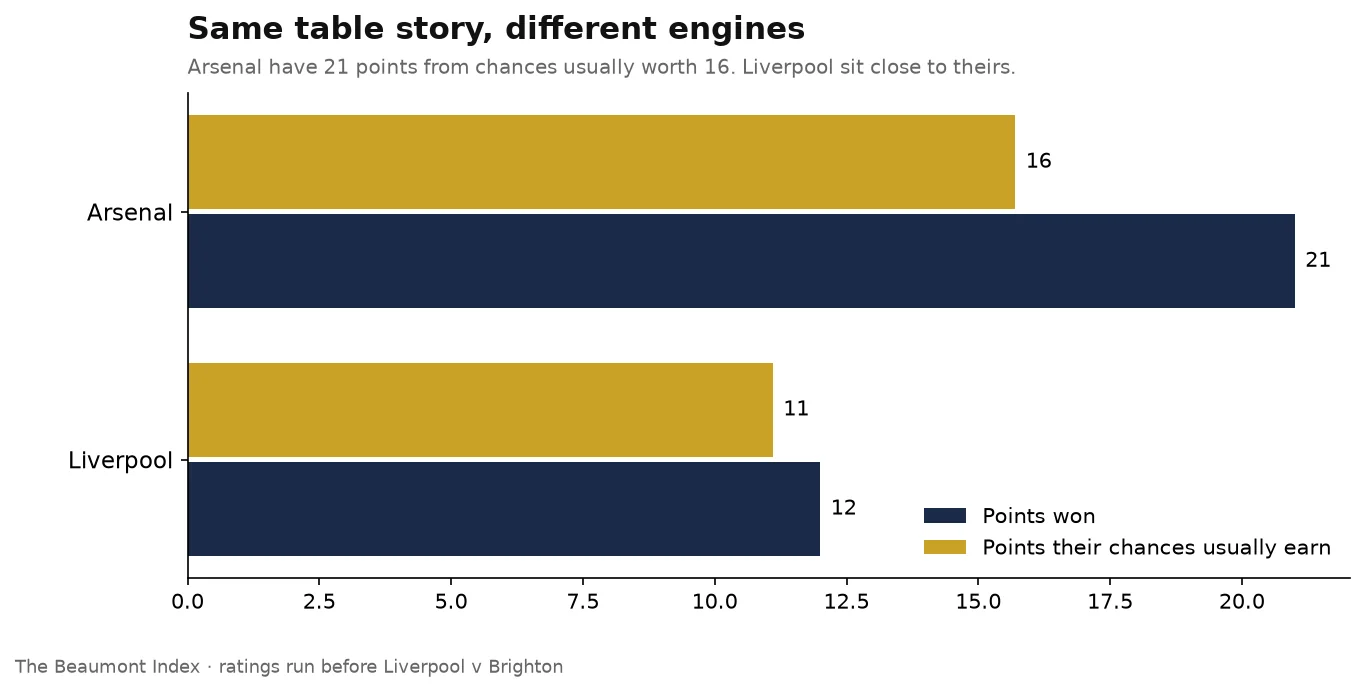
For every team, we estimate how many points its chances for and against would usually earn. Arsenal have 21 points from chances that would usually earn about 16. That is around five points ahead. Only Manchester City, also on 21 points from chances worth about 15, are further ahead in the league.
Our trend measure compares a team's level this season with its level last season.
On its own, five points over eight games would not tell us much. What makes it interesting is that it is not new. Last season Arsenal won the title with 85 points from chances worth about 80, again about five ahead. The season before, they were roughly level with their chances.
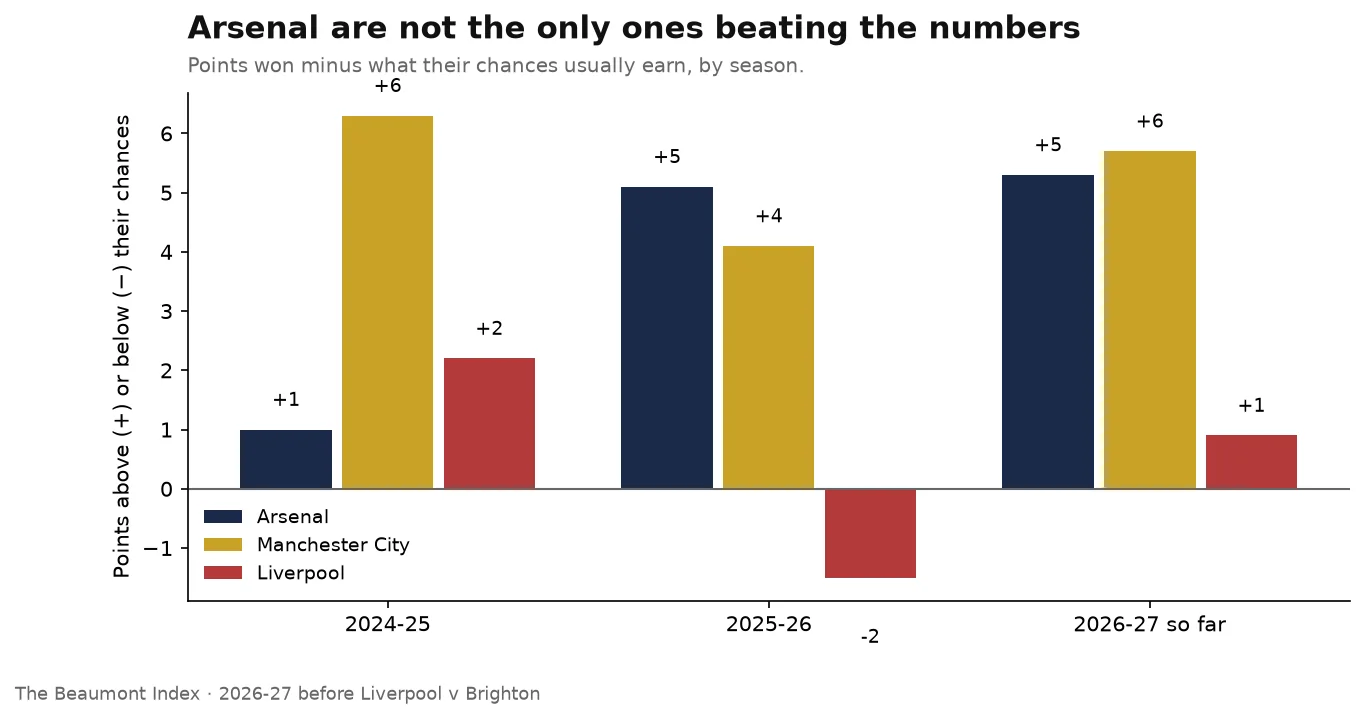
Two seasons in a row is where this starts to get hard to call luck. And the comparison with City matters. City have beaten their chances in each of the last three seasons, by about six, four and now six points. When the two best-resourced sides in the league both keep doing it, there is a reasonable case that something real is going on: better finishers, better goalkeepers, or teams that manage leads well and give away few late chances.
Our ratings take a cautious line. They give Arsenal full credit for their performances and no credit for points beyond them. On performances alone, Arsenal are still the best side in the world. If their finishing really is a skill, the rating will catch up over time. If it is not, the points will come back towards the performances.
Liverpool are the honest case. Before the win over Brighton, which our latest run does not yet include, they had 12 points from chances worth about 11. Last season they finished about a point and a half below their chances, and the season before about two above. What you see from Liverpool is roughly what they are. That is useful information on its own: when Liverpool win, our numbers say the football justified it.
A system team and a star team
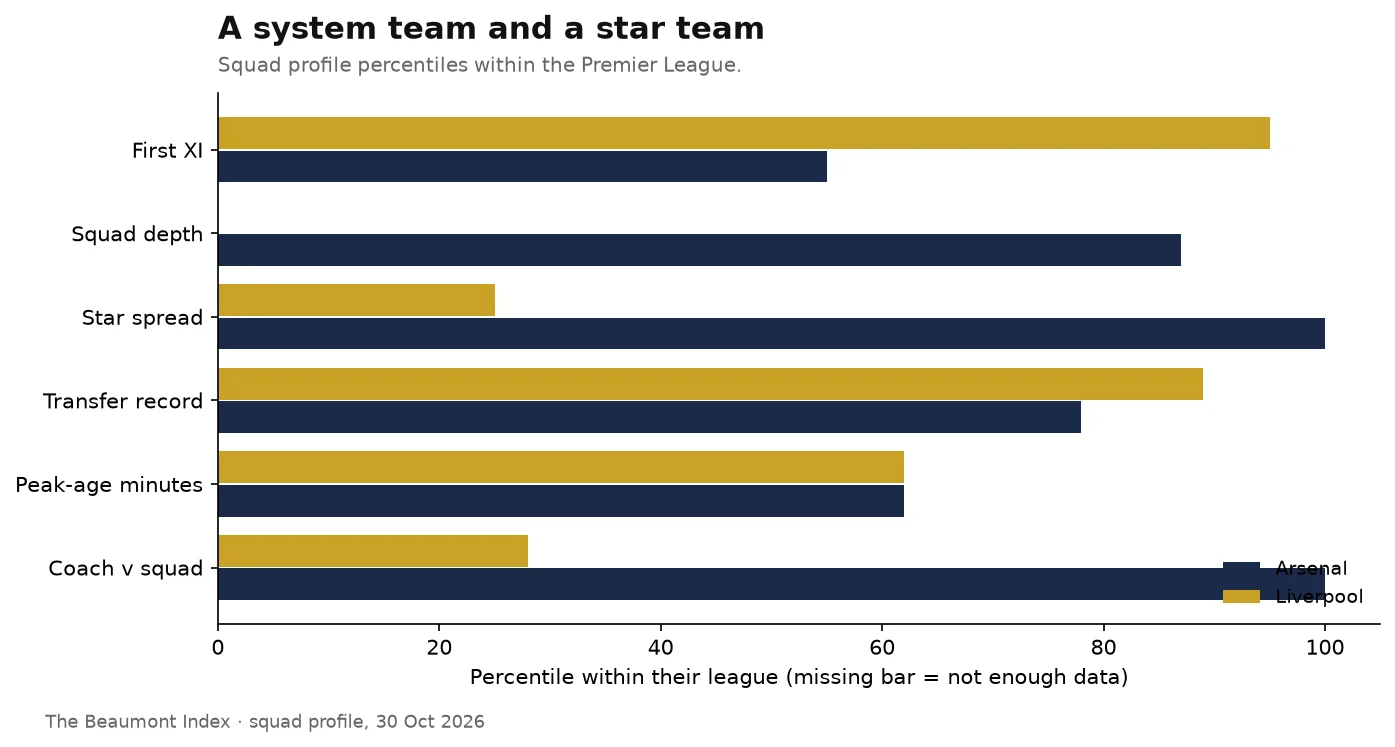
Our squad profile shows two very different ways of being a top side.
Arsenal's quality is spread almost perfectly evenly. On star spread, which measures how much a team relies on one or two players, they are in the 100th percentile of the league: no club depends less on individuals. Their depth is in the 87th percentile. Their usual first eleven, perhaps surprisingly, is only in the 55th. On our measure of how a team performs under its current coach compared with what the squad suggests, Arsenal are at the top of the league. Read together, those numbers describe a coaching system that gets more from a deep, balanced squad than its individual parts would predict.
Liverpool are the reverse. Their usual first eleven is in the 95th percentile, one of the strongest in the league. But their star spread is in the 25th percentile, so their quality is concentrated in a few players, and on the coach measure they sit in the 28th percentile. On paper, Liverpool's best eleven is better than Arsenal's. On the pitch, Arsenal have been the better team.
That contrast is the heart of Sunday's game. Liverpool's ceiling depends on their best players being fit and in form. Arsenal's floor is protected by depth and structure, which is one reason they keep winning on days when they are not at their best.
How each side gets there
Both teams live in the opponent's half. Arsenal are well above the league norm for completions near the box and for touches in it. Liverpool are even further above it on both measures.
Arsenal's other outlier is what they do without the ball. Once possession is taken into account, they make very few interceptions. That fits a team that controls games by keeping the ball and holding its shape, rather than by hunting the ball high up the pitch. It works when Arsenal have the ball. Against a Liverpool side that gets into the box as often as anyone, it means Arsenal will need their shape to hold when they do not.
A note on the fixture list
It is sometimes said that Liverpool have had the hardest start. Our numbers do not support that. Their opponents so far have been almost exactly league average in strength, 12th-toughest of the 20 schedules. Arsenal's rank sixth. Chelsea and Leeds have had the toughest runs. Neither Liverpool's nor Arsenal's numbers are inflated or deflated much by who they have played, which makes the comparison between them cleaner.
What Fleetwood does and does not tell us
A League Cup exit to a fourth-tier side is a shock, and it is right that Arsenal's captain called the performance not good enough. But it is one game, against an opponent our ratings place 1,043rd in the world. It feeds into our ratings at half weight, as all domestic cup games do. It moves Arsenal's rating a little. It does not move our view of them much.
What it does do is fit a pattern. A side whose points have run ahead of its performances can look untouchable until a night when the finishing and goalkeeping that carried it are merely normal. Fleetwood looked like one of those nights.
Where Arsenal's points could come back
If Arsenal's points do drift back towards their performances, it will not look like a collapse. It will look like a run of draws in games they would have won last season: a late equaliser conceded, a one-goal lead that does not hold, a chance that goes wide instead of in. That is what returning to the underlying numbers usually looks like for a strong side. Their chances are still the best in the league per game, ahead of City's on our measure, so even a full correction would leave them as title contenders.
For Liverpool, the opposite applies. Because their results already match their football, there is no cushion to lose and no hidden credit to collect. Their route to the top is to raise the level itself, which is why Sunday is a better test of Iraola's side than of Arsenal's: a strong performance at home against the best team in the world would move Liverpool's rating, whatever the score.
What Sunday can tell us
An Arsenal win at Anfield would put them six points clear of Liverpool and move the conversation on from Fleetwood. It would not, on its own, settle whether their points lead is sustainable. A Liverpool win would cut the gap to three and fit our view that the table flatters Arsenal a little. A draw would change very little for either side.
The things to watch are the ones that do not appear in the score. Whether Arsenal create chances at Anfield of the quality they did last season. Whether Liverpool's first eleven, the strongest in this fixture on paper, turns that quality into control of the game. And whether Arsenal's low-interception, shape-first defending holds against a side that gets into the box as often as Liverpool.
We will not put a percentage on it. What we will say is that Sunday is a meeting between the best team in the world on performance and the team whose results most honestly match its football. The interesting question is not who wins, but which of those two descriptions changes afterwards.
See the full Premier League ratings.
FAQ
Are Arsenal the best team in the world?
On the Beaumont Index, yes: first in the world, with an 80% range of first to fourth. But their level is below last season's.
Are Arsenal lucky?
Their results are about five points ahead of what their chances usually earn, this season and last. Our ratings credit their performances, not their points.
Where are Liverpool on the Index?
Seventh in the world and third in the Premier League on performance, with results close to their underlying numbers.